Categoría: Defensive & Retirement ETFs

  • How to Protect Your Portfolio From Inflation Using ETFs

    How to Protect Your Portfolio From Inflation Using ETFs

    Inflation is one of the most significant threats to long-term wealth. While moderate inflation is a normal part of a growing economy, sustained increases in consumer prices can gradually erode purchasing power, reduce real investment returns, and make it more difficult to achieve long-term financial goals.

    For investors, the challenge is not simply generating returns, but generating returns that outpace inflation over time. This is where Exchange-Traded Funds (ETFs) can play a crucial role. By providing exposure to asset classes that have historically performed well during inflationary periods, ETFs offer a practical and cost-effective way to help preserve purchasing power and strengthen portfolio resilience.

    As investors continue to monitor inflation trends in 2026, understanding how to use ETFs as an inflation hedge has become an increasingly important component of portfolio construction.

    Why Inflation Matters to Investors

    Inflation reduces the value of money over time. A portfolio that grows by 5% annually may appear successful on paper, but if inflation is running at 4%, the real return is only 1%.

    Over long periods, even modest inflation can have a substantial impact on wealth accumulation. For retirees, inflation can be particularly damaging because it increases the cost of everyday expenses while reducing the purchasing power of fixed income streams.

    Protecting against inflation requires owning assets that have the potential to grow faster than rising prices.

    Equities: The First Line of Defense

    Historically, stocks have been one of the most effective long-term inflation hedges. Companies can often pass higher costs on to consumers through price increases, allowing revenues and earnings to grow alongside inflation.

    Broad-market equity ETFs provide exposure to businesses across multiple sectors and industries.

    One of the most widely used options is the Vanguard Total Stock Market ETF (VTI), which offers diversified exposure to the entire U.S. equity market.

    Why Stocks Help Combat Inflation

    • Corporate earnings often rise over time
    • Businesses can adjust pricing strategies
    • Economic growth supports revenue expansion
    • Equities have historically outpaced inflation over long periods

    While stocks may experience short-term volatility, they remain one of the strongest long-term tools for preserving purchasing power.

    Treasury Inflation-Protected Securities (TIPS) ETFs

    For investors seeking a more direct inflation hedge, Treasury Inflation-Protected Securities (TIPS) can be an effective solution.

    TIPS are U.S. government bonds specifically designed to adjust with inflation. Their principal value increases when inflation rises, helping investors maintain purchasing power.

    Popular TIPS ETFs include:

    • iShares TIPS Bond ETF (TIP)
    • Schwab U.S. TIPS ETF (SCHP)

    Benefits of TIPS ETFs

    • Direct inflation protection
    • Government-backed securities
    • Diversified bond exposure
    • Potential income generation

    TIPS ETFs are often used as a defensive allocation within inflation-conscious portfolios.

    Commodity ETFs

    Commodities have historically performed well during periods of rising inflation because they represent the raw materials used throughout the economy.

    As prices rise, commodity values often increase as well.

    Investors commonly gain exposure through broad commodity ETFs rather than purchasing individual commodities.

    Examples include funds tracking:

    • Energy
    • Industrial metals
    • Agriculture
    • Precious metals

    Commodity ETFs can help diversify a portfolio and provide inflation-sensitive exposure that differs from traditional stocks and bonds.

    Benefits of Commodity Exposure

    • Historically positive correlation with inflation
    • Diversification benefits
    • Exposure to real assets
    • Potential hedge against supply-driven inflation

    However, commodities can be highly volatile and are generally best used as a complementary allocation rather than a portfolio core.

    Gold ETFs as an Inflation Hedge

    Gold has long been viewed as a store of value during periods of inflation and currency weakness.

    Investors frequently use ETFs to gain exposure without owning physical bullion.

    One of the most widely held gold funds is the SPDR Gold Shares (GLD).

    Why Investors Use Gold

    • Historically viewed as an inflation hedge
    • Potential protection during economic uncertainty
    • Diversification benefits
    • Low correlation with some traditional assets

    Although gold does not generate income, many investors allocate a small portion of their portfolios to precious metals for risk management purposes.

    Real Estate ETFs

    Real estate can also provide inflation protection because property values and rental income often increase over time.

    Real Estate Investment Trusts (REITs) offer a convenient way to gain exposure through ETFs.

    One popular option is the Vanguard Real Estate ETF (VNQ).

    Benefits of Real Estate Exposure

    • Potential rental income growth
    • Property value appreciation
    • Inflation-linked revenue streams
    • Portfolio diversification

    REITs can be particularly attractive during periods when inflation is driven by rising housing and property costs.

    Dividend Growth ETFs

    Companies with a history of consistently increasing dividends often possess strong pricing power and durable business models.

    Dividend growth ETFs focus on these businesses.

    Examples include:

    • Vanguard Dividend Appreciation ETF (VIG)
    • Schwab U.S. Dividend Equity ETF (SCHD)

    Why Dividend Growth Matters

    • Rising dividend income can offset inflation
    • Financially strong companies often adapt better to inflationary environments
    • Long-term total return potential
    • Income growth over time

    For income-oriented investors, dividend growth may be more valuable than simply pursuing the highest current yield.

    International ETFs and Inflation Diversification

    Inflation affects countries differently.

    By investing globally, investors can reduce dependence on a single economy and potentially benefit from stronger growth in regions experiencing lower inflationary pressures.

    Broad international ETFs include:

    • Vanguard Total International Stock ETF (VXUS)
    • iShares Core MSCI Total International Stock ETF (IXUS)

    Global diversification can help improve portfolio resilience during periods of uneven inflation across markets.

    Sample Inflation-Resistant ETF Portfolio

    An investor seeking inflation protection might consider a diversified allocation such as:

    • 50% VTI
    • 15% VXUS
    • 15% TIP
    • 10% VNQ
    • 5% GLD
    • 5% SCHD

    This structure combines growth assets, inflation-linked bonds, real assets, and dividend income sources.

    The exact allocation should be adjusted based on risk tolerance, investment objectives, and time horizon.

    Common Mistakes Investors Make

    When attempting to hedge inflation, investors often make several errors:

    Holding Too Much Cash

    Cash may feel safe, but inflation steadily erodes its purchasing power.

    Chasing Short-Term Inflation Trends

    Inflation cycles can change quickly, making tactical decisions difficult.

    Ignoring Diversification

    No single asset class provides perfect inflation protection under all circumstances.

    Overallocating to Gold or Commodities

    While useful as hedges, these assets can experience prolonged periods of underperformance.

    A balanced approach is generally more effective than relying on a single inflation hedge.

    Final Thoughts

    Inflation is an unavoidable reality for investors, but it does not have to undermine long-term financial goals. A thoughtfully diversified ETF portfolio can help preserve purchasing power while continuing to generate growth and income over time.

    Broad-market equity funds such as the Vanguard Total Stock Market ETF (VTI) remain the foundation of most inflation-resistant portfolios. Investors can further strengthen their defenses through inflation-linked bonds such as the iShares TIPS Bond ETF (TIP), real estate exposure through the Vanguard Real Estate ETF (VNQ), dividend-growth strategies such as the Schwab U.S. Dividend Equity ETF (SCHD), and selective allocations to gold and commodities.

    Ultimately, the most effective inflation strategy is not attempting to predict inflation perfectly, but building a diversified portfolio capable of adapting to a wide range of economic environments. Over the long run, diversification, discipline, and consistent investing remain the strongest tools for protecting wealth against rising prices.

  • Best ETFs for Retirement Planning in 2026

    Best ETFs for Retirement Planning in 2026

    Retirement planning has always been about balancing growth, income, and risk management. In 2026, that challenge remains as important as ever. Investors must navigate changing interest rates, evolving market conditions, inflation concerns, and increasing life expectancies while building portfolios capable of supporting decades of retirement spending.

    Exchange-traded funds (ETFs) have become one of the most effective tools for retirement investing. They offer diversification, low costs, transparency, and flexibility, making them ideal for long-term wealth accumulation and income generation. Whether you’re decades away from retirement or already transitioning into retirement income, the right ETF selection can play a crucial role in achieving your financial goals.

    Here are some of the best ETFs for retirement planning in 2026 and how they can fit into a well-structured retirement portfolio.

    What Makes a Good Retirement ETF?

    Retirement investors typically prioritize several key characteristics:

    • Broad diversification
    • Low expense ratios
    • Long-term growth potential
    • Reliable income generation
    • Lower portfolio volatility
    • Strong liquidity

    Rather than chasing short-term performance, successful retirement investing focuses on creating a portfolio that can withstand market cycles while continuing to grow and generate income over time.

    1. Vanguard Total Stock Market ETF (VTI)

    The Vanguard Total Stock Market ETF (VTI) remains one of the most popular retirement ETFs for a simple reason: it provides exposure to virtually the entire U.S. stock market.

    The fund includes:

    • Large-cap companies
    • Mid-cap companies
    • Small-cap companies
    • Growth and value stocks

    This broad diversification makes VTI an excellent core holding for long-term retirement portfolios.

    Why It Works for Retirement

    • Comprehensive U.S. equity exposure
    • Low expense ratio
    • Strong long-term growth potential
    • Suitable for investors at almost any age

    For investors focused on long-term wealth accumulation, VTI often serves as the foundation of a retirement portfolio.

    2. Vanguard Total International Stock ETF (VXUS)

    The Vanguard Total International Stock ETF (VXUS) provides exposure to thousands of companies outside the United States.

    The fund includes both:

    • Developed markets
    • Emerging markets

    International diversification can help reduce dependence on U.S. market performance while providing access to global economic growth.

    Why It Works for Retirement

    • Global diversification
    • Exposure to international growth opportunities
    • Reduced geographic concentration risk
    • Complements U.S. equity holdings

    Many retirement portfolios allocate between 15% and 30% of equities to international stocks.

    3. Vanguard Total Bond Market ETF (BND)

    The Vanguard Total Bond Market ETF (BND) remains one of the leading bond ETFs for retirement investors.

    The fund invests in:

    • U.S. Treasuries
    • Corporate bonds
    • Mortgage-backed securities
    • Government agency debt

    As retirement approaches, bonds often become increasingly important for reducing portfolio volatility and generating income.

    Why It Works for Retirement

    • Broad bond market exposure
    • Income generation
    • Diversification benefits
    • Lower volatility than equities

    BND is frequently used as the fixed-income cornerstone of retirement portfolios.

    4. Vanguard Dividend Appreciation ETF (VIG)

    The Vanguard Dividend Appreciation ETF (VIG) focuses on companies with a history of consistently increasing dividends.

    Unlike many high-yield funds, VIG emphasizes dividend growth rather than simply chasing the highest current yields.

    Why It Works for Retirement

    • Quality-focused portfolio
    • Growing income stream
    • Historically lower volatility
    • Exposure to financially strong companies

    Dividend growth can help investors maintain purchasing power throughout retirement.

    5. Schwab U.S. Dividend Equity ETF (SCHD)

    The Schwab U.S. Dividend Equity ETF (SCHD) has become one of the most widely discussed dividend ETFs among retirement investors.

    The fund focuses on companies with:

    • Strong balance sheets
    • Consistent dividends
    • Sustainable cash flows

    Why It Works for Retirement

    • Attractive income potential
    • Quality dividend companies
    • Competitive expense ratio
    • Long-term income growth opportunities

    Many retirees use SCHD as a core income-generating position within their portfolios.

    6. iShares Core U.S. Aggregate Bond ETF (AGG)

    The iShares Core U.S. Aggregate Bond ETF (AGG) offers broad exposure to the investment-grade U.S. bond market.

    Similar to BND, AGG includes:

    • Treasuries
    • Corporate bonds
    • Mortgage-backed securities

    Why It Works for Retirement

    • Diversified fixed-income exposure
    • Income generation
    • Lower portfolio volatility
    • Strong liquidity

    AGG is frequently used by retirement investors seeking stability and predictable income.

    7. Vanguard Total World Stock ETF (VT)

    The Vanguard Total World Stock ETF (VT) offers one of the simplest retirement investing solutions available.

    The fund combines:

    • U.S. stocks
    • Developed international stocks
    • Emerging market stocks

    All within a single ETF.

    Why It Works for Retirement

    • Global diversification
    • One-fund simplicity
    • Automatic regional allocation
    • Minimal maintenance

    For investors seeking a hands-off approach, VT can serve as a complete equity portfolio.

    Sample ETF Retirement Portfolios

    Growth-Oriented Retirement Portfolio

    Suitable for younger investors:

    • 70% VTI
    • 20% VXUS
    • 10% BND

    This allocation emphasizes growth while maintaining some bond exposure.

    Balanced Retirement Portfolio

    Suitable for mid-career investors:

    • 50% VTI
    • 20% VXUS
    • 30% BND

    This structure balances growth potential with stability.

    Income-Focused Retirement Portfolio

    Suitable for retirees:

    • 30% VTI
    • 20% SCHD
    • 10% VXUS
    • 40% BND

    This allocation seeks to combine income generation with long-term growth.

    Common Retirement Investing Mistakes

    Investors should avoid several common pitfalls:

    Overconcentration in Stocks

    While stocks drive long-term growth, excessive equity exposure can increase retirement risk.

    Chasing Yield

    The highest-yielding investments often carry elevated risks.

    Ignoring International Diversification

    Global exposure can strengthen portfolio resilience.

    Paying High Fees

    Even small fee differences can significantly impact retirement outcomes over decades.

    Frequent Trading

    Successful retirement investing generally rewards patience and consistency.

    The Importance of Asset Allocation

    The best ETF for retirement is not necessarily the one with the highest return potential. Success often depends more on how different ETFs work together within a diversified portfolio.

    A thoughtful mix of:

    • U.S. stocks
    • International stocks
    • Bonds
    • Dividend-focused investments

    can help investors balance growth, income, and risk throughout retirement.

    Final Thoughts

    The best ETFs for retirement planning in 2026 combine broad diversification, low costs, and long-term reliability. For many investors, a portfolio built around the Vanguard Total Stock Market ETF (VTI), Vanguard Total International Stock ETF (VXUS), and Vanguard Total Bond Market ETF (BND) provides a strong foundation for long-term financial success.

    Investors seeking additional income may complement these core holdings with dividend-focused funds such as the Vanguard Dividend Appreciation ETF (VIG) or the Schwab U.S. Dividend Equity ETF (SCHD).

    Ultimately, retirement planning is not about finding the perfect ETF. It is about building a diversified portfolio, maintaining a disciplined investment strategy, and allowing time and compounding to work in your favor. Those principles remain just as valuable in 2026 as they have throughout investing history.

  • BND vs AGG vs TLT: Which Bond ETF Is Best Today?

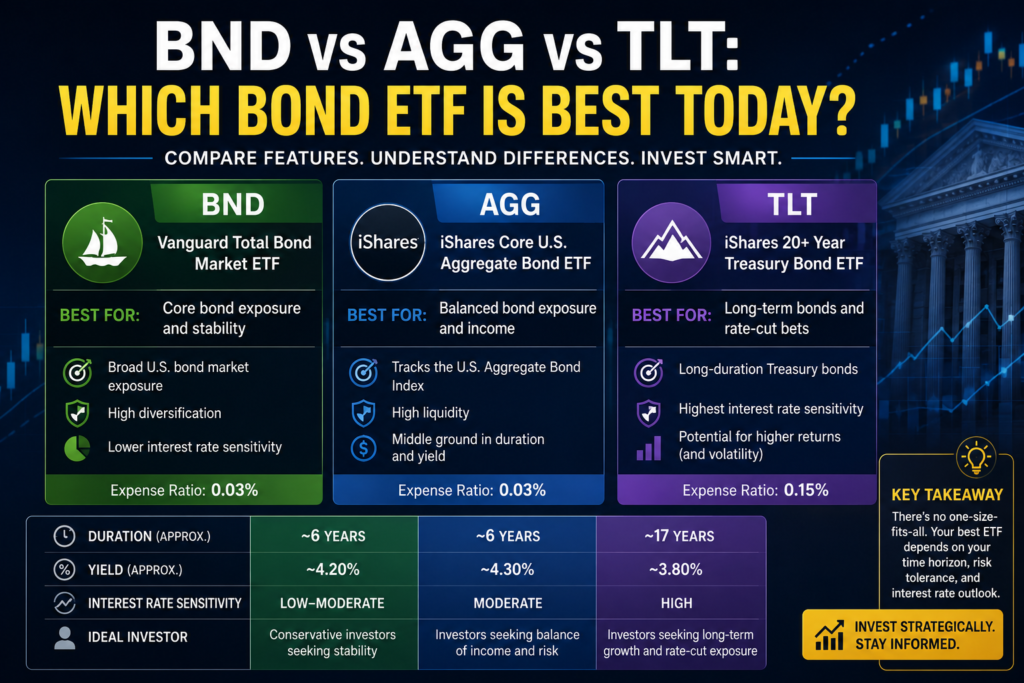
    BND vs AGG vs TLT: Which Bond ETF Is Best Today?

    Bond ETFs have regained the attention of investors in recent years as higher interest rates have restored meaningful income opportunities to fixed-income markets. However, not all bond ETFs are created equal. Three of the most widely followed bond funds—BND, AGG, and TLT—serve different purposes and can behave very differently depending on economic conditions, interest-rate trends, and investor objectives.

    While all three provide exposure to the bond market, their risk profiles, duration characteristics, and return potential vary significantly. Understanding these differences is essential for investors looking to generate income, reduce portfolio volatility, or position for future interest-rate changes.

    So, which bond ETF is the best choice today? The answer depends largely on what role you want bonds to play in your portfolio.

    Understanding the Three ETFs

    Before comparing performance and risk, it’s important to understand what each fund actually owns.

    Vanguard Total Bond Market ETF (BND)

    The Vanguard Total Bond Market ETF (BND) is designed to represent the broad U.S. investment-grade bond market.

    Its portfolio includes:

    • U.S. Treasury bonds
    • Government agency securities
    • Mortgage-backed securities
    • Investment-grade corporate bonds

    BND is often viewed as a core bond holding because it provides broad diversification across multiple segments of the fixed-income market.

    iShares Core U.S. Aggregate Bond ETF (AGG)

    The iShares Core U.S. Aggregate Bond ETF (AGG) tracks the Bloomberg U.S. Aggregate Bond Index, one of the most widely followed bond benchmarks in the world.

    Like BND, AGG holds:

    • Treasury securities
    • Agency bonds
    • Mortgage-backed securities
    • Investment-grade corporate debt

    In practice, AGG and BND are remarkably similar and often produce nearly identical long-term performance.

    iShares 20+ Year Treasury Bond ETF (TLT)

    The iShares 20+ Year Treasury Bond ETF (TLT) is fundamentally different from both BND and AGG.

    Rather than holding a broad mix of bonds, TLT focuses exclusively on long-term U.S. Treasury securities with maturities exceeding 20 years.

    This concentration creates:

    • Higher duration risk
    • Greater sensitivity to interest-rate changes
    • Larger price fluctuations
    • Higher potential upside if rates fall

    TLT is often used as a tactical interest-rate play rather than a core bond allocation.

    BND vs AGG: The Similarity Is Striking

    For most investors, the comparison between BND and AGG comes down to minor differences.

    Both funds:

    • Focus on investment-grade bonds
    • Track broad U.S. bond indexes
    • Provide diversified exposure
    • Serve as core fixed-income holdings
    • Carry similar duration profiles

    Historically, performance differences between the two funds have been extremely small.

    BND Advantages

    • Slightly broader bond market exposure
    • Vanguard’s reputation for low-cost indexing
    • Competitive expense ratio

    AGG Advantages

    • Strong liquidity
    • Widely used institutional benchmark
    • Extensive trading volume

    For long-term investors, choosing between BND and AGG is unlikely to significantly affect portfolio outcomes.

    Why TLT Is Different

    The comparison changes dramatically when TLT enters the discussion.

    Unlike BND and AGG, TLT owns only long-term Treasury bonds.

    This means TLT’s performance depends heavily on interest-rate movements.

    When Interest Rates Fall

    Long-term bonds generally increase in value.

    Because of its high duration, TLT can experience substantial price appreciation when yields decline.

    In falling-rate environments, TLT often outperforms broad bond funds by a wide margin.

    When Interest Rates Rise

    The opposite is also true.

    Long-term Treasury bonds can experience significant losses when rates rise.

    This makes TLT considerably more volatile than either BND or AGG.

    Investors considering TLT must be comfortable with much larger price swings than traditional bond investors typically expect.

    Comparing Interest-Rate Sensitivity

    Interest-rate sensitivity is one of the most important distinctions among these ETFs.

    BND

    • Moderate duration
    • Balanced exposure
    • Lower volatility

    AGG

    • Similar duration to BND
    • Moderate interest-rate sensitivity
    • Core portfolio role

    TLT

    • Very high duration
    • Significant interest-rate sensitivity
    • Elevated volatility

    For investors concerned about persistent rate uncertainty, BND and AGG generally provide a more balanced risk profile.

    Income Potential

    One reason investors are revisiting bond ETFs is the return of attractive yields.

    BND

    Offers diversified income from a mix of government and corporate bonds.

    AGG

    Provides similar income characteristics to BND due to its comparable holdings.

    TLT

    Typically offers yields tied to long-term Treasury rates.

    While the income can be attractive, investors must remember that price volatility can significantly impact total returns.

    Yield alone should not determine ETF selection.

    Which ETF Performs Best If Rates Fall?

    If investors believe interest rates will decline substantially over the coming years, TLT may offer the greatest upside potential.

    Long-duration Treasury funds tend to benefit the most from falling yields because bond prices rise as rates decline.

    In such a scenario:

    1. TLT would likely benefit the most.
    2. BND and AGG would also benefit but to a lesser extent.
    3. TLT’s gains could significantly exceed those of broad-market bond funds.

    However, this potential comes with increased risk.

    Which ETF Is Best If Rates Stay Elevated?

    If rates remain relatively high or decline only gradually, BND and AGG may offer more attractive risk-adjusted outcomes.

    Their diversified portfolios:

    • Generate income from multiple bond sectors
    • Reduce concentration risk
    • Experience less volatility than long-term Treasury funds

    For investors seeking stability and income, broad-market bond ETFs often remain the preferred choice.

    Which ETF Is Best for Retirees?

    Retirees often prioritize:

    • Income generation
    • Capital preservation
    • Lower volatility

    For these objectives, BND and AGG are generally better suited than TLT.

    Their diversified exposure helps reduce the dramatic price fluctuations that can occur with long-term Treasury funds.

    Many retirement portfolios use broad bond market ETFs as core holdings because they balance income and risk more effectively.

    Which ETF Is Best for Younger Investors?

    Younger investors may be willing to accept greater volatility if they have a strong conviction about future interest-rate declines.

    In this case, TLT can serve as a tactical position within a broader portfolio.

    However, even younger investors should generally avoid relying exclusively on long-duration Treasury exposure for their fixed-income allocation.

    Expense Ratios and Costs

    All three ETFs are highly competitive from a cost perspective.

    The expense differences between BND, AGG, and TLT are relatively small and unlikely to be the deciding factor for most investors.

    Instead, investors should focus on:

    • Portfolio objectives
    • Duration exposure
    • Risk tolerance
    • Interest-rate outlook

    These factors will have a far greater impact on long-term results than minor fee differences.

    Final Verdict

    The choice between BND, AGG, and TLT depends less on which fund is objectively «best» and more on what role bonds are expected to play in a portfolio.

    For most long-term investors, the Vanguard Total Bond Market ETF (BND) and the iShares Core U.S. Aggregate Bond ETF (AGG) remain the strongest all-around options. Both provide diversified exposure to the investment-grade bond market, generate reliable income, and help reduce overall portfolio volatility.

    The iShares 20+ Year Treasury Bond ETF (TLT) is a more specialized tool. It may appeal to investors expecting lower interest rates or seeking long-duration Treasury exposure, but it carries significantly greater risk than traditional bond funds.

    For investors seeking a core bond allocation in today’s market, BND and AGG are likely the better choices. For those making a tactical bet on future rate cuts, TLT may offer greater upside potential—but with considerably higher volatility along the way.

  • Best Bond ETFs for a High-Interest-Rate Environment

    Best Bond ETFs for a High-Interest-Rate Environment

    For much of the past decade, bond investors faced a challenging reality: historically low interest rates meant lower yields and limited income potential. However, the investment landscape has changed dramatically. With interest rates remaining elevated in 2026 compared to the ultra-low-rate era, bonds have once again become an attractive asset class for income-focused and diversified portfolios.

    Yet not all bond ETFs perform equally well in a high-interest-rate environment. Some are better positioned to benefit from higher yields, while others remain vulnerable to interest-rate risk. Understanding which bond ETFs are best suited for today’s market conditions can help investors generate income while managing portfolio volatility.

    Why Interest Rates Matter for Bond Investors

    Bond prices and interest rates typically move in opposite directions. When rates rise, existing bonds with lower yields become less attractive, causing their prices to fall. Conversely, when rates decline, existing bonds generally increase in value.

    This relationship makes bond selection particularly important during periods of elevated or uncertain interest rates.

    Key factors investors should evaluate include:

    • Duration sensitivity
    • Credit quality
    • Yield levels
    • Diversification
    • Interest-rate exposure

    In a high-rate environment, shorter-duration bonds often experience less volatility, while newly issued bonds may offer significantly more attractive yields than those available just a few years ago.

    1. Vanguard Short-Term Bond ETF (BSV)

    The Vanguard Short-Term Bond ETF (BSV) is one of the most popular choices for investors seeking lower interest-rate risk.

    BSV primarily invests in high-quality U.S. government and corporate bonds with relatively short maturities.

    Key Advantages

    • Lower sensitivity to rate fluctuations
    • High-quality bond exposure
    • Relatively stable performance
    • Competitive yield for a short-duration fund

    In a market where rates may remain elevated or unpredictable, BSV offers a defensive approach without sacrificing income potential.

    Best For

    Conservative investors seeking stability and reduced volatility.

    2. iShares 0-5 Year Investment Grade Corporate Bond ETF (SLQD)

    The iShares 0-5 Year Investment Grade Corporate Bond ETF (SLQD) focuses on short-term investment-grade corporate debt.

    Because its holdings mature relatively quickly, the fund has less duration risk than traditional intermediate- or long-term bond funds.

    Key Advantages

    • Higher yields than many government bond funds
    • Short duration profile
    • Strong credit quality
    • Lower rate sensitivity

    For investors prioritizing income while limiting exposure to future rate increases, SLQD remains a compelling option.

    Best For

    Income-focused investors seeking moderate risk.

    3. Vanguard Total Bond Market ETF (BND)

    The Vanguard Total Bond Market ETF (BND) remains one of the most widely held bond ETFs in the world.

    The fund provides broad exposure to the U.S. investment-grade bond market, including:

    • U.S. Treasuries
    • Mortgage-backed securities
    • Corporate bonds
    • Government agency debt

    Key Advantages

    • Broad diversification
    • Core portfolio holding
    • Investment-grade quality
    • Low expense ratio

    Although BND carries more duration risk than short-term funds, higher prevailing yields have improved its long-term return prospects.

    Best For

    Investors seeking a diversified core bond allocation.

    4. iShares Short Treasury Bond ETF (SHV)

    The iShares Short Treasury Bond ETF (SHV) invests in very short-term U.S. Treasury securities.

    Because Treasury bills mature quickly, SHV has minimal sensitivity to interest-rate changes.

    Key Advantages

    • Extremely low credit risk
    • High liquidity
    • Minimal duration exposure
    • Attractive yields relative to cash alternatives

    For investors waiting for market opportunities or seeking a defensive allocation, SHV serves as an effective cash-management vehicle.

    Best For

    Capital preservation and liquidity.

    5. SPDR Bloomberg 1-3 Month T-Bill ETF (BIL)

    The SPDR Bloomberg 1-3 Month T-Bill ETF (BIL) has become increasingly popular during the current rate environment.

    The fund holds ultra-short-term Treasury bills and regularly benefits from prevailing short-term interest rates.

    Key Advantages

    • Very low volatility
    • Direct exposure to short-term Treasury yields
    • Strong liquidity
    • Limited interest-rate risk

    Many investors have used BIL as an alternative to traditional savings vehicles while maintaining easy access to capital.

    Best For

    Investors seeking short-term income with minimal market risk.

    6. Vanguard Intermediate-Term Corporate Bond ETF (VCIT)

    The Vanguard Intermediate-Term Corporate Bond ETF (VCIT) offers exposure to investment-grade corporate bonds with intermediate maturities.

    Higher interest rates have improved yields across corporate bond markets, making funds like VCIT more attractive than they were during the low-rate era.

    Key Advantages

    • Higher income potential
    • Investment-grade credit quality
    • Diversified corporate exposure
    • Competitive expense ratio

    While VCIT carries greater duration risk than short-term bond funds, it may offer stronger total return potential if rates stabilize or eventually decline.

    Best For

    Investors willing to accept moderate risk for higher income.

    7. iShares iBoxx $ Investment Grade Corporate Bond ETF (LQD)

    The iShares iBoxx $ Investment Grade Corporate Bond ETF (LQD) is one of the largest corporate bond ETFs available.

    It focuses on high-quality corporate debt issued by major companies.

    Key Advantages

    • Attractive yields
    • Investment-grade credit exposure
    • Deep liquidity
    • Broad diversification

    LQD may benefit significantly if interest rates eventually move lower, although it remains more sensitive to rate changes than shorter-duration alternatives.

    Best For

    Long-term investors seeking income and potential capital appreciation.

    Should Investors Consider Treasury ETFs or Corporate Bond ETFs?

    The answer depends largely on risk tolerance.

    Treasury ETFs

    Advantages:

    • Backed by the U.S. government
    • Lower credit risk
    • Greater stability during market stress

    Examples:

    • SHV
    • BIL

    Corporate Bond ETFs

    Advantages:

    • Higher yields
    • Greater income potential
    • Potential for stronger returns

    Examples:

    • VCIT
    • LQD
    • SLQD

    Investors often combine both categories to balance income generation and risk management.

    Duration Matters More Than Ever

    One of the most important concepts in bond investing is duration.

    Generally speaking:

    • Short-duration funds experience less price volatility.
    • Long-duration funds are more sensitive to interest-rate changes.
    • Intermediate-duration funds offer a balance between yield and risk.

    In uncertain rate environments, many investors prefer shorter-duration ETFs because they provide flexibility while still benefiting from elevated yields.

    Sample Bond ETF Allocations

    Conservative Income Portfolio

    • 50% BSV
    • 30% SHV
    • 20% BIL

    Balanced Bond Portfolio

    • 50% BND
    • 25% VCIT
    • 25% SHV

    Income-Focused Portfolio

    • 40% VCIT
    • 40% LQD
    • 20% BIL

    These examples demonstrate how investors can tailor bond allocations to their specific objectives.

    Final Thoughts

    After years of historically low yields, bonds have once again become an attractive asset class for income-oriented investors. The higher-interest-rate environment of 2026 has created opportunities for investors to earn meaningful income without taking excessive risk.

    For conservative investors, short-duration funds such as the Vanguard Short-Term Bond ETF (BSV), iShares Short Treasury Bond ETF (SHV), and SPDR Bloomberg 1-3 Month T-Bill ETF (BIL) offer stability and attractive yields. Meanwhile, investors seeking greater income potential may find value in corporate bond funds such as the Vanguard Intermediate-Term Corporate Bond ETF (VCIT) and the iShares iBoxx $ Investment Grade Corporate Bond ETF (LQD).

    Ultimately, the best bond ETF is not simply the one with the highest yield, but the one that aligns with your risk tolerance, income needs, and long-term investment strategy. In today’s market, bonds once again deserve serious consideration as a core component of a diversified portfolio.