
Last updated: June 2026 | Reading time: 9 min
Disclaimer: This article is for informational and educational purposes only. Nothing here constitutes financial advice. Past performance is not a guarantee of future results. Always consult a licensed financial advisor before making investment decisions.
Why Inflation Still Matters in 2026
Inflation cooled significantly from its 2022 peak, but it has not disappeared. In 2026, investors are dealing with a more complex picture: headline inflation is manageable, but certain categories — housing, services, energy, and food — continue to run hotter than the Federal Reserve’s 2% target. For long-term investors, even moderate inflation at 3–4% per year quietly destroys purchasing power over time.
A portfolio that earns 6% annually but faces 4% inflation is really only growing at 2% in real terms. Over 20 or 30 years, that difference is enormous. The question is not whether you need inflation protection — you do — but which ETFs provide it most effectively.
How Inflation Damages a Portfolio
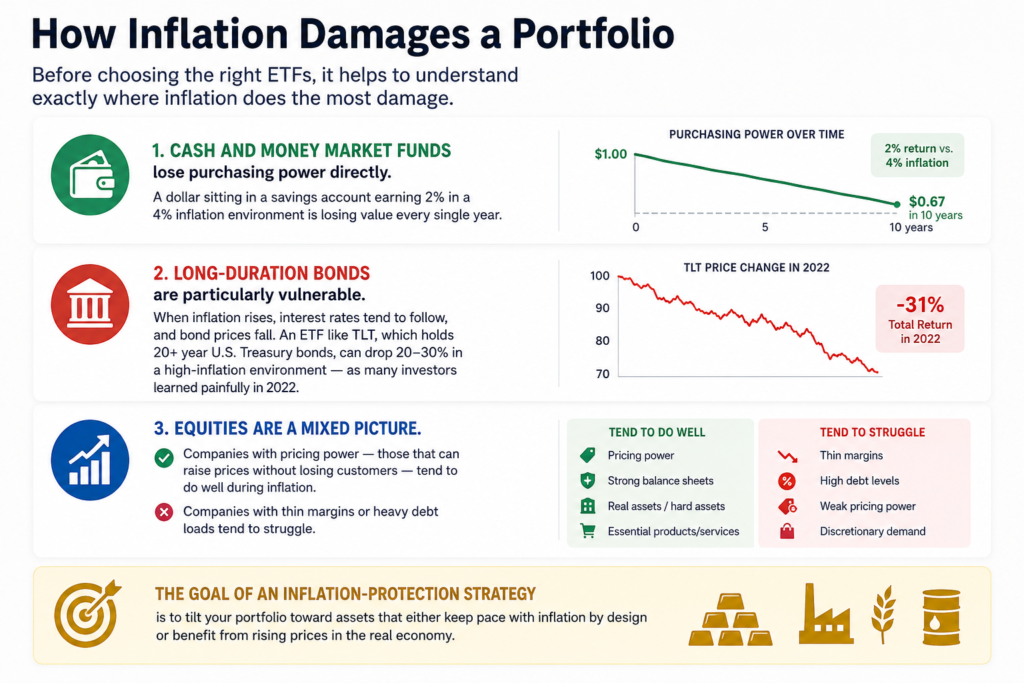
Before choosing the right ETFs, it helps to understand exactly where inflation does the most damage.
Cash and money market funds lose purchasing power directly. A dollar sitting in a savings account earning 2% in a 4% inflation environment is losing value every single year.
Long-duration bonds are particularly vulnerable. When inflation rises, interest rates tend to follow, and bond prices fall. An ETF like TLT, which holds 20+ year U.S. Treasury bonds, can drop 20–30% in a high-inflation environment — as many investors learned painfully in 2022. (To understand the operational differences between these core fixed-income assets, read our full breakdown of BND vs. AGG vs. TLT: which bond ETF is best today?).
Equities are a mixed picture. Companies with pricing power — those that can raise prices without losing customers — tend to do well during inflation. Companies with thin margins or heavy debt loads tend to struggle.
The goal of an inflation-protection strategy is to tilt your portfolio toward assets that either keep pace with inflation by design or benefit from rising prices in the real economy.
The Best ETF Categories for Inflation Protection
TIPS ETFs — Treasury Inflation-Protected Securities
TIPS are U.S. government bonds whose principal value adjusts automatically with the Consumer Price Index. When inflation rises, the principal increases, and so do your interest payments. When inflation falls, the opposite happens.
TIPS ETFs give you diversified exposure to these bonds without buying individual securities.
iShares TIPS Bond ETF (TIP) TER: 0.19% AUM: Over $15 billion This is the most widely held TIPS ETF in the market. It holds a broad range of TIPS across different maturities, providing balanced inflation exposure without excessive interest rate risk.
Vanguard Short-Term Inflation-Protected Securities ETF (VTIP) TER: 0.04% AUM: Over $12 billion VTIP focuses on short-term TIPS (0–5 years), which means it has much less sensitivity to interest rate movements than longer-duration TIPS funds. In an environment where both inflation and rates are elevated, VTIP holds up better than TIP. The 0.04% fee is exceptionally low.
What to know: TIPS perform best when inflation surprises to the upside — when actual inflation comes in higher than the market expected. If inflation is already priced in, TIPS offer less advantage. They are a hedge, not a guaranteed return.
Commodity ETFs
Commodities — oil, natural gas, gold, agricultural products, industrial metals — tend to rise in price during inflationary periods because they are inputs to the broader economy. When everything costs more, raw materials are often leading the charge.
Invesco DB Commodity Index Tracking Fund (DBC) TER: 0.85% AUM: Over $2 billion DBC tracks a diversified basket of commodities including energy, metals, and agriculture. It uses futures contracts, which introduces roll costs over time, but for medium-term inflation hedging it serves its purpose.
iShares S&P GSCI Commodity-Indexed Trust (GSG) TER: 0.75% AUM: Over $1 billion GSG is heavily weighted toward energy (oil and natural gas represent a large share), which makes it more volatile but also more responsive to energy-driven inflation.
What to know: Commodity ETFs can be volatile and their long-term returns as standalone investments have historically been modest. They work best as a smaller allocation (5–10% of a portfolio) specifically to offset inflation risk, not as a core holding.
Gold ETFs
Gold is the oldest inflation hedge in human history. It does not produce earnings or dividends, but it has maintained purchasing power over centuries. In periods of currency debasement or elevated inflation, gold tends to hold or increase its real value.
SPDR Gold Shares (GLD) TER: 0.40% AUM: Over $60 billion GLD is the largest and most liquid gold ETF in the world. Each share represents a fractional ownership of physical gold held in vaults. It is the standard choice for investors seeking straightforward gold exposure.
iShares Gold Trust (IAU) TER: 0.25% AUM: Over $30 billion IAU offers the same physical gold exposure as GLD at a meaningfully lower fee. For long-term holders, that 0.15% difference compounds significantly over time. Most long-term investors are better served by IAU than GLD.
What to know: Gold can go years without appreciating and can be highly volatile in the short term. It is a long-term store of value and crisis hedge, not a short-term inflation trade. Position sizing matters — most financial advisors suggest 5–10% maximum for gold in a diversified portfolio.
Real Estate ETFs (REITs)
Real estate has historically been one of the best inflation hedges available. Property values and rents tend to rise with inflation, and REITs (Real Estate Investment Trusts) are required to distribute at least 90% of taxable income as dividends, providing income that can keep pace with rising prices.
Vanguard Real Estate ETF (VNQ) TER: 0.13% AUM: Over $35 billion VNQ is the largest and cheapest U.S. REIT ETF. It holds over 150 real estate companies across commercial, residential, industrial, and specialty segments. The diversification means you are not concentrated in any single property type.
iShares U.S. Real Estate ETF (IYR) TER: 0.40% AUM: Over $4 billion IYR offers similar broad REIT exposure but at a higher fee than VNQ. For most investors, VNQ is the better choice unless specific index methodology differences matter.
What to know: REITs are sensitive to interest rates. When rates rise sharply — as happened in 2022 — REIT prices can fall even as underlying property values hold. This makes REITs a better inflation hedge over a 5–10 year horizon than over 12 months.
Energy Sector ETFs
Energy companies — oil producers, natural gas companies, pipeline operators — benefit directly from higher energy prices, which are often a primary driver of inflation. Holding energy sector ETFs gives your portfolio assets that tend to appreciate precisely when energy-driven inflation is hurting other parts of your holdings.
Energy Select Sector SPDR Fund (XLE) TER: 0.09% AUM: Over $35 billion XLE holds the largest U.S. energy companies, including ExxonMobil, Chevron, and ConocoPhillips. At 0.09%, it is one of the cheapest sector ETFs available and provides clean exposure to energy price movements.
Vanguard Energy ETF (VDE) TER: 0.10% AUM: Over $7 billion VDE holds a broader set of energy companies than XLE and is weighted slightly more toward smaller energy producers. Both are solid choices for energy inflation hedging.
What to know: Energy ETFs are cyclical and can be volatile. They are not a permanent hedge — they are most valuable when energy prices are rising. In a deflationary or low-growth environment, energy stocks can underperform significantly.
Dividend Growth ETFs as an Inflation Hedge
Companies with strong dividend growth records — those that have raised dividends consistently for 10, 20, or 30 years — tend to have the pricing power and financial strength to outpace inflation over time. Their dividends grow faster than inflation, which means your income stream does not erode in real terms.
Schwab U.S. Dividend Equity ETF (SCHD) TER: 0.06% AUM: Over $60 billion SCHD screens for dividend growth, payout sustainability, and financial quality. Over the past decade it has delivered dividend growth that has comfortably outpaced inflation. It is not a pure inflation hedge, but as a core equity holding it provides meaningful inflation resilience.
Vanguard Dividend Appreciation ETF (VIG) TER: 0.06% AUM: Over $80 billion VIG tracks companies that have grown their dividends for at least 10 consecutive years. The portfolio leans toward high-quality blue chips with strong balance sheets — exactly the type of companies that can pass rising costs on to consumers.
Building an Inflation-Protected Portfolio With ETFs
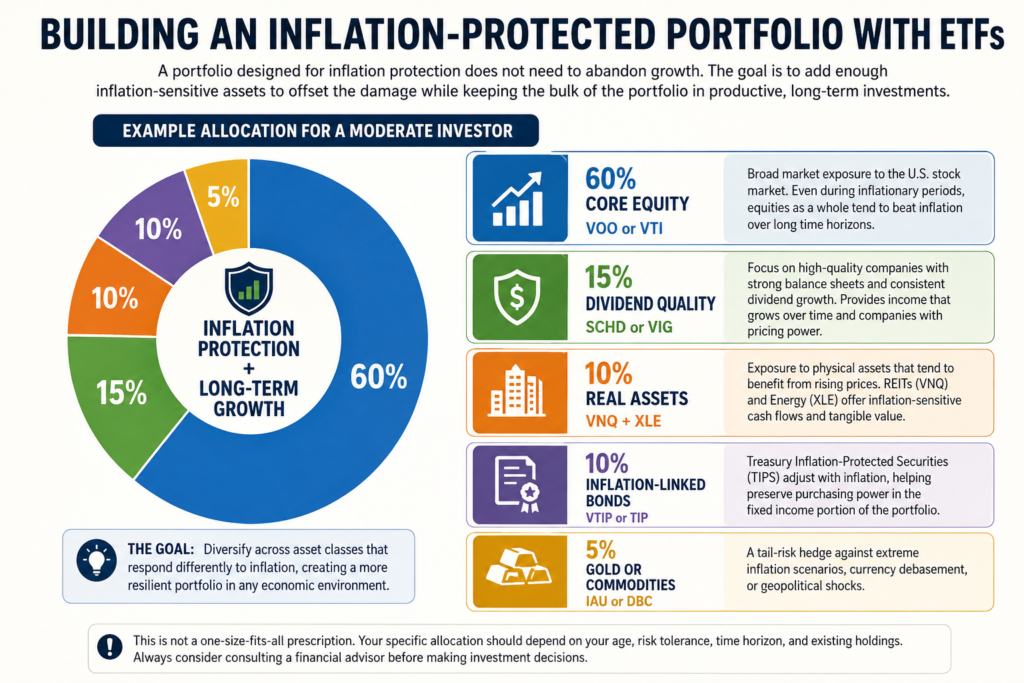
A portfolio designed for inflation protection does not need to abandon growth. The goal is to add enough inflation-sensitive assets to offset the damage while keeping the bulk of the portfolio in productive, long-term investments.
Here is a practical example of how an inflation-aware ETF allocation might look for a moderate investor:
Core equity (60%): VOO or VTI for broad market exposure. Even during inflationary periods, equities as a whole tend to beat inflation over long time horizons.
Dividend quality (15%): SCHD or VIG for income that grows over time and companies with pricing power.
Real assets (10%): A combination of VNQ (REITs) and XLE (energy) provides exposure to physical assets that benefit from rising prices.
Inflation-linked bonds (10%): VTIP or TIP to hedge specifically against inflation in the fixed income portion of the portfolio.
Gold or commodities (5%): IAU or DBC as a tail-risk hedge against extreme inflation scenarios.
This is not a one-size-fits-all prescription. Your specific allocation should depend on your age, risk tolerance, time horizon, and existing holdings. But the logic is sound: diversifying across asset classes that respond differently to inflation creates a more resilient portfolio than sitting entirely in nominal bonds or cash.
What Does Not Work as an Inflation Hedge
It is worth being specific about what to avoid when inflation is a concern.
Long-duration Treasury bond ETFs like TLT are particularly dangerous in inflationary environments. They were designed for deflation and low-rate scenarios, not for rising prices. Investors who held TLT through 2022 saw losses of over 30%.
Cash and money market funds protect nominal value but lose real purchasing power by definition when inflation exceeds the interest rate they pay.
High-growth tech stocks with no current earnings struggle during inflation because their value is based on future cash flows that get discounted more heavily when interest rates rise.
The Timing Problem With Inflation Hedges
One practical challenge with inflation protection is that the best time to add hedges is before inflation accelerates, not after. By the time inflation is running at 6% and it is front-page news, the market has already priced it into TIPS, gold, and energy stocks. The protection you buy then is expensive.
The implication is that some level of inflation protection makes sense to hold permanently — not because inflation is always a threat, but because you can never reliably predict when it will be. VTIP, IAU, VNQ, and SCHD are all reasonable permanent holdings for an inflation-aware investor, not emergency purchases to make when prices are already rising.
Bottom Line
Inflation is one of the few risks that operates silently and continuously, eroding purchasing power without any single dramatic event. The good news is that ETFs make inflation protection more accessible and affordable than ever before.
TIPS ETFs like VTIP, real estate funds like VNQ, gold via IAU, energy exposure through XLE, and dividend quality through SCHD each provide a different dimension of inflation resilience. Used together in appropriate proportions, they can meaningfully reduce the real damage inflation does to a long-term portfolio without sacrificing the growth potential you need to build wealth over time.
The worst response to inflation is doing nothing and hoping your cash or nominal bonds will be enough. The best response is building a diversified, inflation-aware portfolio before you need it.
Frequently Asked Questions
Are TIPS ETFs better than I Bonds for inflation protection? I Bonds offer excellent inflation protection and are backed by the U.S. government, but they have purchase limits ($10,000 per year per person) and a one-year lockup period. TIPS ETFs have no purchase limits and are fully liquid, making them more practical for most investors as part of a larger portfolio.
Does gold always go up during inflation? No. Gold can underperform during inflationary periods, particularly when real interest rates are rising. It is a long-term store of value and crisis hedge, not a guaranteed short-term inflation trade. Its role in a portfolio is as insurance, not as a primary growth driver.
How much of my portfolio should be in inflation hedges? There is no universal answer, but a common framework is to allocate 15–25% of a moderate portfolio to inflation-sensitive assets (REITs, TIPS, energy, commodities, gold). The exact amount depends on your specific circumstances and outlook.
Is VOO enough to protect against inflation? Broad equity exposure through VOO provides long-term inflation protection because companies grow earnings over time. But it does not provide short-term inflation hedging — in years when inflation is high and growth is slowing, the S&P 500 can fall in both nominal and real terms simultaneously. Combining VOO with some of the assets listed above creates better balance.