
Last updated: June 2026Last updated: July 2026 | Reading time: 10 min | Reviewed by the FinanMind Research Team
Disclaimer: This article is for informational and educational purposes only and does not constitute financial, investment, tax, or legal advice. FinanMind is not a registered investment advisor and is not affiliated with any of the fund issuers, brokers, or companies mentioned below. Nothing in this article should be interpreted as a recommendation to buy or sell any specific security. ETFs, including the ones discussed here, carry risk, including the potential loss of principal. Past performance is not a guarantee of future results. Always do your own research and consult a licensed financial advisor before making investment decisions.
Every month, asset managers launch new ETFs hoping to capture investor attention — and investor money. Some fill a genuine gap in the market. Most don’t. In June 2026, the pace of new launches stayed high, driven by continued interest in AI infrastructure, the energy transition, and niche thematic strategies.
Below, we break down some of the more notable ETFs launched or newly listed in recent weeks, apply a consistent evaluation framework, and explain — in general, educational terms — what factors an investor might weigh before considering any of them. This is analysis, not a buy list. Full methodology is explained in the next section, and you can read our complete evaluation criteria on our Methodology page.
How We Evaluate New ETFs
Before looking at individual funds, here’s the framework we apply to every new launch. These are the same publicly available data points any investor can check directly on the issuer’s website, ETF.com, or Morningstar:
- TER (Total Expense Ratio): The annual fee charged as a percentage of your investment. Lower generally means more of your return stays with you, all else being equal.
- AUM (Assets Under Management): A new ETF starts at or near zero. Industry data shows that funds still under roughly $50 million in assets after six months face a meaningfully higher risk of closure.
- Index or strategy transparency: Is the fund tracking a clearly defined, rules-based index, or is it built around a more discretionary, marketing-driven stock basket?
- Overlap with existing funds: Does this ETF offer exposure that isn’t already available more cheaply through an established fund?
- Issuer track record: Larger issuers such as Vanguard, iShares, Schwab, and State Street have decades of operational history running ETFs at scale. Newer or smaller issuers can still launch solid products, but they generally warrant extra scrutiny before committing meaningful capital.
None of these factors guarantee a fund’s future performance. They simply describe the same due-diligence questions a cautious investor would ask before adding any new holding.
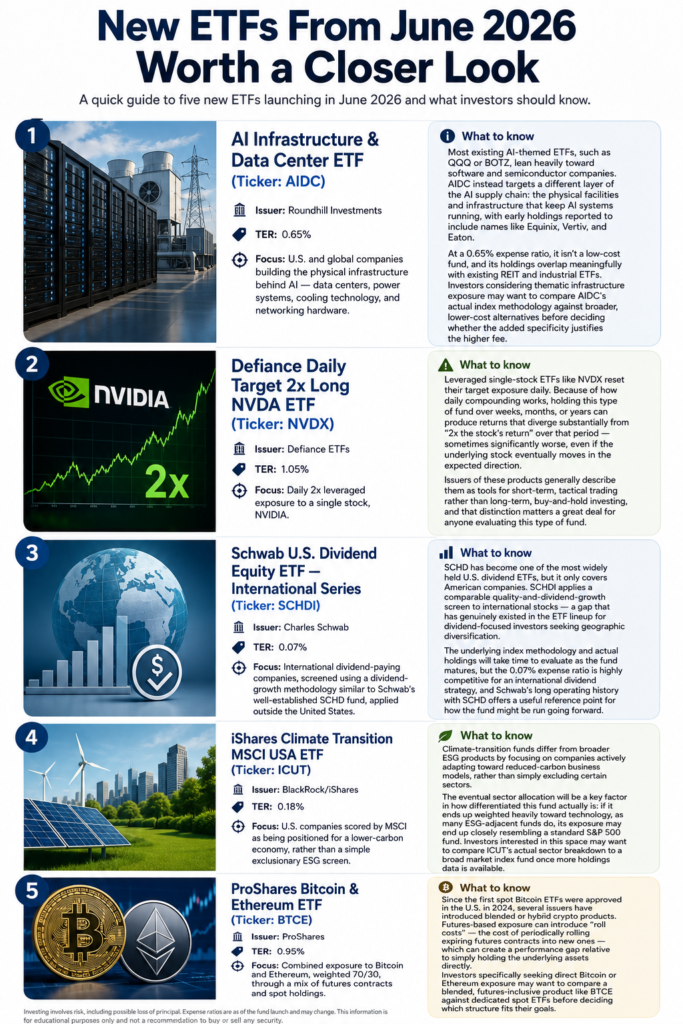
New ETFs From June 2026 Worth a Closer Look
1. AI Infrastructure & Data Center ETF (Ticker: AIDC)
Issuer: Roundhill Investments · TER: 0.65% · Focus: U.S. and global companies building the physical infrastructure behind AI — data centers, power systems, cooling technology, and networking hardware.
Most existing AI-themed ETFs, such as QQQ or BOTZ, lean heavily toward software and semiconductor companies. AIDC instead targets a different layer of the AI supply chain: the physical facilities and infrastructure that keep AI systems running, with early holdings reported to include names like Equinix, Vertiv, and Eaton.
At a 0.65% expense ratio, it isn’t a low-cost fund, and its holdings overlap meaningfully with existing REIT and industrial ETFs. Investors considering thematic infrastructure exposure may want to compare AIDC’s actual index methodology against broader, lower-cost alternatives before deciding whether the added specificity justifies the higher fee.
2. Defiance Daily Target 2x Long NVDA ETF (Ticker: NVDX)
Issuer: Defiance ETFs · TER: 1.05% · Focus: Daily 2x leveraged exposure to a single stock, NVIDIA.
Leveraged single-stock ETFs like NVDX reset their target exposure daily. Because of how daily compounding works, holding this type of fund over weeks, months, or years can produce returns that diverge substantially from «2x the stock’s return» over that period — sometimes significantly worse, even if the underlying stock eventually moves in the expected direction. Issuers of these products generally describe them as tools for short-term, tactical trading rather than long-term, buy-and-hold investing, and that distinction matters a great deal for anyone evaluating this type of fund.
3. Schwab U.S. Dividend Equity ETF — International Series (Ticker: SCHDI)
Issuer: Charles Schwab · TER: 0.07% · Focus: International dividend-paying companies, screened using a dividend-growth methodology similar to Schwab’s well-established SCHD fund, applied outside the United States.
SCHD has become one of the most widely held U.S. dividend ETFs, but it only covers American companies. SCHDI applies a comparable quality-and-dividend-growth screen to international stocks — a gap that has genuinely existed in the ETF lineup for dividend-focused investors seeking geographic diversification.
The underlying index methodology and actual holdings will take time to evaluate as the fund matures, but the 0.07% expense ratio is highly competitive for an international dividend strategy, and Schwab’s long operating history with SCHD offers a useful reference point for how the fund might be run going forward.
4. iShares Climate Transition MSCI USA ETF (Ticker: ICUT)
Issuer: BlackRock/iShares · TER: 0.18% · Focus: U.S. companies scored by MSCI as being positioned for a lower-carbon economy, rather than a simple exclusionary ESG screen.
Climate-transition funds differ from broader ESG products by focusing on companies actively adapting toward reduced-carbon business models, rather than simply excluding certain sectors. The eventual sector allocation will be a key factor in how differentiated this fund actually is: if it ends up weighted heavily toward technology, as many ESG-adjacent funds do, its exposure may end up closely resembling a standard S&P 500 fund. Investors interested in this space may want to compare ICUT’s actual sector breakdown to a broad market index fund once more holdings data is available.
5. ProShares Bitcoin & Ethereum ETF (Ticker: BTCE)
Issuer: ProShares · TER: 0.95% · Focus: Combined exposure to Bitcoin and Ethereum, weighted 70/30, through a mix of futures contracts and spot holdings.
Since the first spot Bitcoin ETFs were approved in the U.S. in 2024, several issuers have introduced blended or hybrid crypto products. Futures-based exposure can introduce «roll costs» — the cost of periodically rolling expiring futures contracts into new ones — which can create a performance gap relative to simply holding the underlying assets directly. Investors specifically seeking direct Bitcoin or Ethereum exposure may want to compare a blended, futures-inclusive product like BTCE against dedicated spot ETFs before deciding which structure fits their goals.
Launches That Didn’t Make This List
A number of other funds launched in June 2026 aren’t covered in detail here because they don’t meet our basic evaluation threshold — generally due to extremely low initial AUM (under $10 million), a lack of transparent, rules-based methodology, or being close variations of existing strategies at a higher cost. That doesn’t necessarily mean they’re bad products, only that there isn’t yet enough public data to evaluate them meaningfully.
What Most New ETFs Have in Common
The U.S. ETF industry launches somewhere in the range of 400–500 new funds every year. A large share of these are built around a specific trend or media narrative rather than a durable, long-term investment case, and industry data consistently shows that a majority of niche, thematic ETFs launched in any given year are eventually liquidated within about five years due to insufficient investor demand.
Some of the most widely held ETFs today — funds like VOO, VTI, SCHD, QQQ, and BND — weren’t necessarily novel when they launched. What they had in common was a low cost structure, a transparent methodology, and exposure to a durable, well-understood segment of the market. That combination remains a reasonable benchmark against which to evaluate any new fund.
A General Framework for Evaluating New ETF Launches
For investors who want a repeatable process rather than reacting to each new headline, these are the questions worth asking about any newly launched ETF:
- Give it time. Waiting at least six months to a year lets AUM build, holdings stabilize, and any tracking error against the fund’s stated benchmark become visible.
- Compare the fee to existing alternatives. If a new, niche fund charges 0.60%–1.00% for exposure that closely resembles something already available for 0.03%–0.10%, it’s worth understanding exactly what the extra cost is paying for.
- Identify the specific gap it fills. If it’s difficult to articulate, in one sentence, what a new ETF adds that your current holdings don’t already provide, that’s a reasonable signal to keep researching before adding it to a portfolio.
- Weigh issuer track record. Established issuers have more operational history managing ETFs through different market cycles. That doesn’t guarantee future performance, but it is a relevant data point in assessing a fund’s staying power.
The Bottom Line
Of the funds covered in this roundup, SCHDI stands out as the most structurally straightforward new launch from June 2026 for investors focused on long-term dividend income and international diversification — it comes from an established issuer, carries a competitive fee, and addresses a real gap in the existing ETF lineup. Others, like AIDC, ICUT, NVDX, and BTCE, involve varying degrees of added complexity, cost, or risk that are worth understanding fully before considering them.
For most long-term investors, the more consistently reliable approach has little to do with chasing new launches — it’s continuing to build a diversified portfolio through regular contributions to established, low-cost, broadly diversified funds. New isn’t automatically better. Low-cost, transparent, and diversified tends to hold up better over time, though as always, all investing involves risk and no strategy guarantees a positive outcome.
Frequently Asked Questions
How many ETFs are launched every month? On average, roughly 30–50 new ETFs are listed on U.S. exchanges each month, though the pace varies. Industry data suggests a significant share of these do not remain listed over the long term.
Is it generally advisable to buy an ETF in its first month of trading? New ETFs typically have low initial AUM, can carry wider bid-ask spreads, and have no real performance track record yet. Many investors choose to wait six to twelve months to evaluate a fund’s actual behavior before considering an investment, though this is a general observation, not personalized advice.
What happens if an ETF is liquidated? Fund managers are generally required to give shareholders advance notice, typically 30–60 days, before closing a fund. Investors usually receive the net asset value of their shares in cash. This isn’t automatically a financial loss, but it can trigger a taxable event and requires reallocating that capital elsewhere.
Where can I find a complete, up-to-date list of new ETF launches? ETF.com and ETFdb.com maintain regularly updated databases of new ETF filings and launches, and Morningstar publishes analysis on many significant new funds.