Categoría: International ETFs

  • The Best Global ETFs for Long-Term Investors

    The Best Global ETFs for Long-Term Investors

    Building long-term wealth often comes down to a simple principle: diversification. Rather than trying to predict which country, sector, or company will outperform over the next decade, many investors choose to own a broad slice of the global market through exchange-traded funds (ETFs). Global ETFs provide exposure to companies across multiple regions, helping investors reduce concentration risk while participating in worldwide economic growth.

    In an increasingly interconnected world, limiting a portfolio to a single country can leave investors vulnerable to regional economic slowdowns, policy changes, or market-specific risks. Global ETFs address this challenge by offering access to thousands of companies across developed and emerging markets through a single investment.

    For long-term investors focused on growth, diversification, and simplicity, the following global ETFs stand out as some of the strongest options available in 2026.

    Why Invest in Global ETFs?

    Global ETFs are designed to provide exposure to international equity markets, often including both U.S. and non-U.S. stocks within a single fund.

    Key benefits include:

    • Broad geographic diversification
    • Reduced dependence on a single economy
    • Exposure to global growth opportunities
    • Lower portfolio concentration risk
    • Simplified portfolio management

    By investing globally, investors can benefit from innovation and economic growth wherever it occurs, whether in the United States, Europe, Asia, or emerging markets.

    1. Vanguard Total World Stock ETF (VT)

    The Vanguard Total World Stock ETF (VT) is widely regarded as one of the most complete global equity ETFs available.

    VT tracks a global index that includes thousands of stocks from both developed and emerging markets. The fund automatically allocates assets based on global market capitalization, meaning investors receive exposure to companies from around the world without needing to manage separate regional funds.

    Key Advantages

    • Global diversification in a single ETF
    • Exposure to both developed and emerging markets
    • Automatic regional weighting
    • Low maintenance
    • Cost-efficient structure

    For investors seeking a truly hands-off investment approach, VT may be the closest thing to a complete stock portfolio in one fund.

    2. iShares MSCI ACWI ETF (ACWI)

    The iShares MSCI ACWI ETF (ACWI) is another leading global ETF that tracks the MSCI All Country World Index.

    Like VT, ACWI provides exposure to both developed and emerging markets, offering investors a diversified portfolio across dozens of countries.

    Key Advantages

    • Broad global exposure
    • Strong liquidity
    • Long performance history
    • Widely followed benchmark

    ACWI is particularly popular among institutional investors and financial advisors due to its established track record and global reach.

    3. Vanguard FTSE All-World ex-US ETF (VEU)

    For investors who already hold substantial U.S. stock exposure, the Vanguard FTSE All-World ex-US ETF (VEU) offers a compelling complement.

    VEU focuses exclusively on international equities, providing access to both developed and emerging markets outside the United States.

    Key Advantages

    • Broad international diversification
    • Exposure to thousands of companies
    • Complements U.S.-focused portfolios
    • Low expense ratio

    Many investors pair VEU with a U.S. stock ETF to create a customized global allocation.

    4. Vanguard Total International Stock ETF (VXUS)

    The Vanguard Total International Stock ETF (VXUS) is one of the most widely used international ETFs in the market.

    Unlike VEU, VXUS includes an even broader selection of international stocks, including small-cap companies across developed and emerging markets.

    Key Advantages

    • Extensive international coverage
    • Developed and emerging market exposure
    • Inclusion of small-cap stocks
    • Low-cost diversification

    For investors building their own global portfolio, VXUS remains a cornerstone holding.

    5. iShares Core MSCI Total International Stock ETF (IXUS)

    The iShares Core MSCI Total International Stock ETF (IXUS) serves as one of the primary competitors to VXUS.

    IXUS offers diversified exposure to international equities across a wide range of countries and sectors.

    Key Advantages

    • Comprehensive international coverage
    • Broad diversification
    • Competitive expense ratio
    • Strong liquidity

    Performance differences between IXUS and VXUS are generally small, making both strong choices for long-term investors.

    6. SPDR MSCI ACWI IMI ETF (ACIM)

    The SPDR MSCI ACWI IMI ETF (ACIM) seeks to provide exposure to the entire global equity market, including large-, mid-, and small-cap companies.

    Because it tracks an investable market index, ACIM offers one of the broadest forms of equity diversification available.

    Key Advantages

    • Global market coverage
    • Small-cap exposure
    • Developed and emerging markets
    • Diversified across thousands of holdings

    Investors seeking maximum diversification often find ACIM particularly attractive.

    Global ETF Performance Considerations

    While global ETFs offer significant diversification benefits, investors should understand that performance may differ from a U.S.-only portfolio.

    Over the past decade, U.S. equities have generally outperformed many international markets. However, market leadership changes over time. There have been extended periods when international stocks outperformed the United States.

    A globally diversified portfolio helps reduce the risk of being overly dependent on a single market’s future performance.

    One Global ETF vs Multiple Regional ETFs

    Investors often face a choice between owning one global ETF or combining multiple regional funds.

    One-ETF Approach

    Examples:

    • VT
    • ACWI

    Advantages:

    • Maximum simplicity
    • Automatic rebalancing
    • Minimal maintenance

    Multi-ETF Approach

    Examples:

    • U.S. ETF + VXUS
    • U.S. ETF + VEU + Emerging Markets ETF

    Advantages:

    • Greater customization
    • More control over allocations
    • Ability to adjust regional exposure

    Neither approach is inherently superior. The best choice depends on an investor’s preference for simplicity versus flexibility.

    What Long-Term Investors Should Prioritize

    When selecting a global ETF, investors should focus on several factors:

    Diversification

    The broader the exposure, the less dependent the portfolio becomes on individual countries or sectors.

    Costs

    Lower expense ratios allow investors to retain more of their long-term returns.

    Liquidity

    Highly liquid ETFs generally offer tighter bid-ask spreads and easier trading.

    Consistency

    A well-diversified ETF with a transparent methodology can help investors stay committed to their strategy during market fluctuations.

    Final Thoughts

    Global ETFs offer one of the most effective ways to build a diversified, long-term investment portfolio. By providing exposure to thousands of companies across developed and emerging markets, they help investors participate in global economic growth while reducing concentration risk.

    For investors seeking maximum simplicity, the Vanguard Total World Stock ETF (VT) remains one of the strongest one-fund solutions available. Meanwhile, the iShares MSCI ACWI ETF (ACWI) offers a similarly diversified global approach with a long-established track record.

    Ultimately, successful long-term investing is less about predicting which country will outperform next and more about maintaining broad diversification, keeping costs low, and staying invested through changing market conditions. Global ETFs provide an efficient framework for achieving exactly that.

  • Vanguard vs iShares International ETFs: Full Comparison

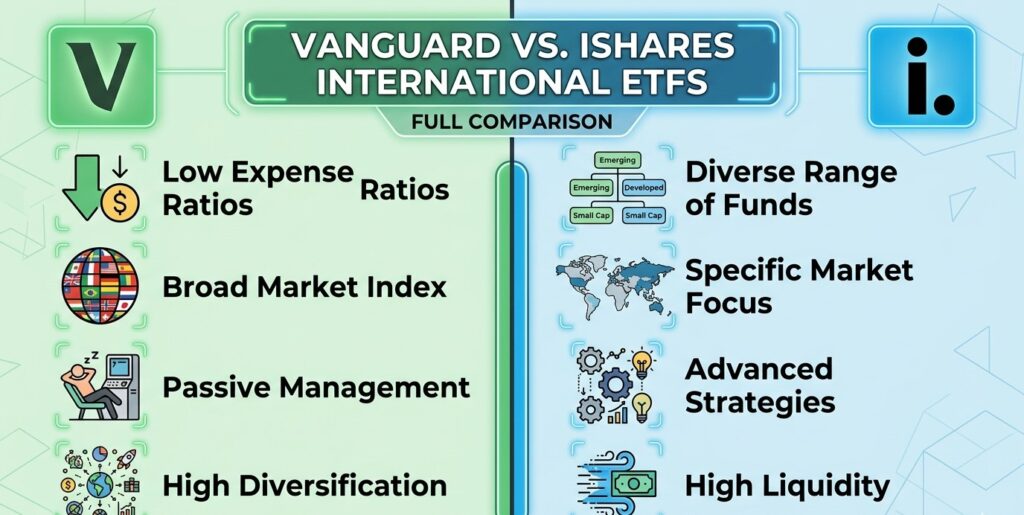
    Vanguard vs iShares International ETFs: Full Comparison

    When it comes to international investing, two names dominate the ETF landscape: Vanguard and iShares. Both firms offer a wide range of low-cost funds that provide exposure to developed and emerging markets around the world. For investors seeking to diversify beyond the United States, choosing between Vanguard and iShares international ETFs is often one of the most important portfolio decisions.

    At first glance, the differences may appear minimal. Both providers offer broad global diversification, competitive expense ratios, and access to thousands of companies across international markets. However, there are meaningful distinctions in fund structure, index methodology, country exposure, costs, and overall portfolio construction.

    This comparison examines the strengths and weaknesses of Vanguard and iShares international ETFs to help investors determine which provider may be the better fit for their long-term investment strategy.

    Why International ETFs Matter

    Many investors remain heavily concentrated in U.S. equities, particularly after years of strong performance from large American technology companies. However, international stocks still represent a substantial portion of the global equity market and provide exposure to economic growth occurring outside the United States.

    International ETFs can help investors:

    • Diversify geographic risk
    • Gain exposure to different economic cycles
    • Access industries underrepresented in U.S. indexes
    • Reduce reliance on a single market
    • Participate in long-term global growth trends

    Whether investing in developed economies such as Japan and Germany or emerging markets such as India and Brazil, international ETFs can play a valuable role in a diversified portfolio.

    Vanguard’s International ETF Lineup

    Vanguard has built its reputation around low-cost indexing and broad diversification.

    Its most popular international ETFs include:

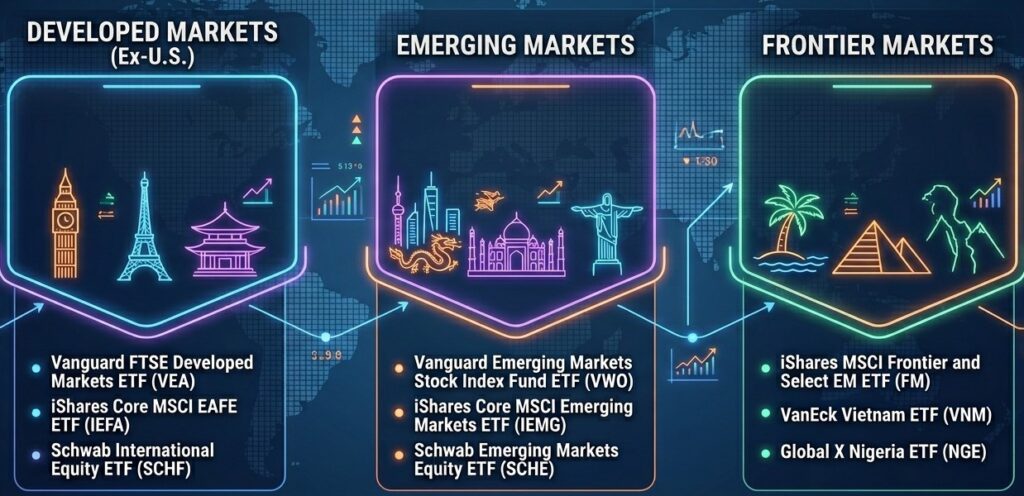
    • Vanguard Total International Stock ETF (VXUS)
    • Vanguard FTSE Developed Markets ETF (VEA)
    • Vanguard FTSE Emerging Markets ETF (VWO)

    The hallmark of Vanguard’s approach is simplicity. Most funds track broad-market indexes and provide extensive diversification across regions, sectors, and company sizes.

    Many investors appreciate Vanguard’s straightforward philosophy of owning the entire market at the lowest possible cost.

    iShares’ International ETF Lineup

    Managed by BlackRock, iShares is the world’s largest ETF provider and offers one of the most extensive ETF selections available.

    Its leading international funds include:

    • iShares Core MSCI Total International Stock ETF (IXUS)
    • iShares MSCI EAFE ETF (EFA)
    • iShares Core MSCI Emerging Markets ETF (IEMG)

    iShares tends to offer more specialized products and greater flexibility for investors seeking precise exposure to specific regions, sectors, or investment factors.

    While Vanguard focuses on simplicity, iShares often appeals to investors who want additional customization options.

    VXUS vs IXUS: The Core International ETF Battle

    For most investors, the comparison begins with VXUS and IXUS.

    Vanguard Total International Stock ETF (VXUS)

    VXUS provides exposure to virtually the entire investable international stock market outside the United States.

    Key characteristics:

    • Developed and emerging markets
    • Large-, mid-, and small-cap companies
    • Thousands of holdings
    • Extremely broad diversification

    VXUS is often considered one of the most comprehensive international ETFs available.

    iShares Core MSCI Total International Stock ETF (IXUS)

    IXUS serves a very similar purpose.

    The fund offers:

    • Developed and emerging market exposure
    • Broad geographic diversification
    • Thousands of holdings
    • Low-cost structure

    In practice, performance differences between VXUS and IXUS are usually minimal because both funds track highly diversified international indexes.

    Which Is Better?

    For most long-term investors, the difference is negligible.

    VXUS tends to have a slight advantage among investors who prefer Vanguard’s indexing philosophy, while IXUS may appeal to those already using other iShares products within their portfolio.

    Developed Markets: VEA vs EFA

    Investors seeking developed-market exposure often compare VEA and EFA.

    Vanguard FTSE Developed Markets ETF (VEA)

    VEA focuses on developed economies outside the United States, including:

    • Japan
    • United Kingdom
    • Canada
    • France
    • Switzerland
    • Australia

    The fund is known for:

    • Low expenses
    • Broad diversification
    • Large number of holdings

    iShares MSCI EAFE ETF (EFA)

    EFA tracks developed markets across Europe, Australasia, and the Far East.

    The fund has:

    • A long operating history
    • Strong liquidity
    • Extensive institutional use

    However, EFA generally carries a higher expense ratio than VEA.

    Which Is Better?

    For cost-conscious long-term investors, VEA is often viewed as the more efficient choice. EFA remains popular due to its liquidity and long track record, particularly among institutional investors.

    Emerging Markets: VWO vs IEMG

    Emerging markets are another area where Vanguard and iShares compete directly.

    Vanguard FTSE Emerging Markets ETF (VWO)

    VWO provides broad exposure to emerging economies, including:

    • China
    • India
    • Taiwan
    • Brazil
    • Saudi Arabia
    • South Africa

    The fund is known for its low expense ratio and diversified approach.

    iShares Core MSCI Emerging Markets ETF (IEMG)

    IEMG also offers broad emerging-market exposure while including a large number of small- and mid-cap companies.

    Many investors view IEMG as slightly more comprehensive due to its broader company coverage.

    Which Is Better?

    Both are excellent choices.

    VWO often appeals to investors prioritizing lower costs, while IEMG may attract those seeking broader representation of emerging-market companies.

    Cost Comparison

    One area where Vanguard has historically excelled is cost efficiency.

    Most Vanguard international ETFs feature extremely competitive expense ratios, reinforcing the company’s reputation as a leader in low-cost investing.

    However, iShares has significantly reduced fees in recent years, narrowing the gap considerably.

    Today, expense ratios are unlikely to be the deciding factor for most investors, though Vanguard still maintains a slight edge in many categories.

    Portfolio Construction Philosophy

    The biggest difference between Vanguard and iShares may not be cost but philosophy.

    Vanguard

    Vanguard emphasizes:

    • Simplicity
    • Broad-market exposure
    • Long-term investing
    • Low turnover
    • Low costs

    Its products are often designed as core portfolio building blocks.

    iShares

    iShares emphasizes:

    • Flexibility
    • Product variety
    • Specialized exposures
    • Institutional applications
    • Tactical portfolio management

    Its lineup offers significantly more niche options for sophisticated investors.

    Which Provider Is Better for Long-Term Investors?

    For investors seeking a simple, diversified buy-and-hold strategy, Vanguard’s international ETFs are often difficult to beat. Funds such as VXUS, VEA, and VWO provide broad exposure at extremely low costs and integrate easily into long-term portfolios.

    For investors who value flexibility, customization, and access to more specialized international strategies, iShares offers one of the deepest ETF lineups in the industry.

    In reality, many portfolios successfully combine products from both providers.

    Final Verdict

    The Vanguard versus iShares debate does not have a universal winner because both companies offer exceptional international ETF products.

    For investors seeking simplicity and cost efficiency, the Vanguard Total International Stock ETF (VXUS) remains one of the strongest all-around choices available. Meanwhile, the iShares Core MSCI Total International Stock ETF (IXUS) provides comparable global exposure and fits naturally within the broader iShares ecosystem.

    Ultimately, the most important decision is not whether to choose Vanguard or iShares, but whether to maintain meaningful international diversification at all. A well-constructed global portfolio can benefit from exposure to both developed and emerging markets, regardless of which ETF provider you select.

  • Should Investors Add Emerging Markets ETFs in 2026?

    Should Investors Add Emerging Markets ETFs in 2026?

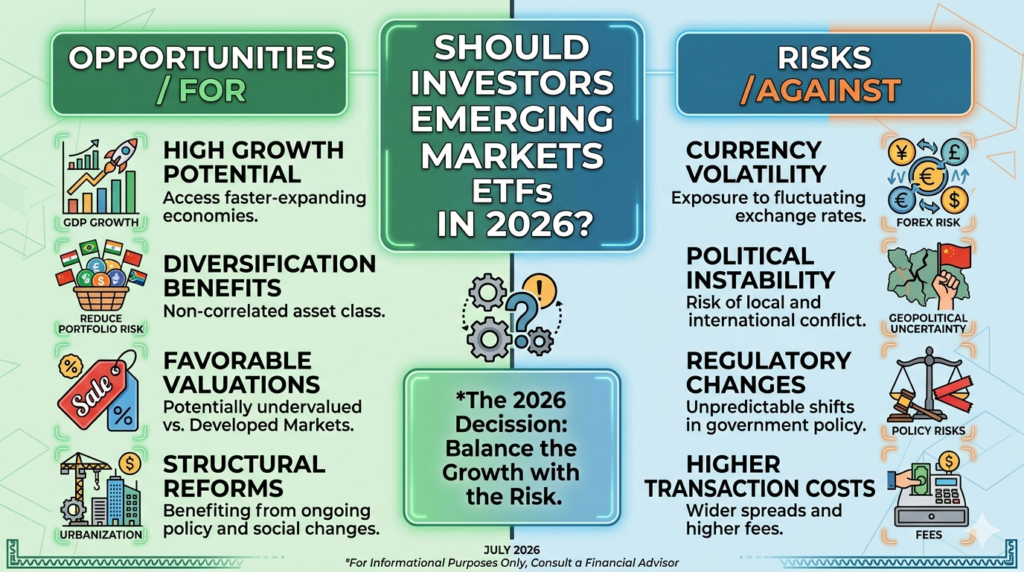
    Emerging markets have long been one of the most debated areas of global investing. Supporters point to their higher economic growth rates, expanding middle classes, and increasing influence on the global economy. Critics highlight their greater volatility, political uncertainty, and historically inconsistent returns. As investors evaluate portfolio allocations in 2026, the question remains: do emerging market ETFs deserve a place in a diversified portfolio?

    The answer depends on an investor’s objectives, risk tolerance, and time horizon. While emerging markets should rarely dominate a portfolio, they can play an important role in enhancing diversification and providing exposure to some of the world’s fastest-growing economies.

    Understanding Emerging Markets

    Emerging markets are countries whose economies are still developing but are becoming increasingly integrated into the global financial system. These nations often experience faster GDP growth than developed economies, driven by industrialization, urbanization, technological adoption, and rising consumer spending.

    Major emerging markets include countries such as China, India, Brazil, Mexico, Indonesia, Saudi Arabia, and South Africa. Together, these economies represent a significant portion of global population growth and future consumption trends.

    Investors typically gain exposure through diversified ETFs rather than individual country funds, reducing the risks associated with any single market.

    Why Emerging Markets Remain Attractive in 2026

    Several structural factors continue to support the long-term investment case for emerging markets.

    Stronger Economic Growth Potential

    Many emerging economies are expected to grow faster than developed markets over the coming decade. Younger populations, rising productivity, infrastructure investment, and increasing domestic consumption create favorable conditions for long-term expansion.

    Countries such as India and Indonesia continue to benefit from demographic trends that contrast sharply with the aging populations of many developed nations.

    Expanding Middle Classes

    One of the most compelling investment themes in emerging markets is the growth of the middle class. As incomes rise, consumer spending typically increases across sectors such as financial services, healthcare, technology, travel, and consumer goods.

    This creates opportunities for companies serving domestic demand rather than relying solely on exports.

    Attractive Valuations

    Compared with many U.S. equities, emerging market stocks often trade at lower valuation multiples. While lower valuations do not guarantee higher future returns, they can provide a more attractive starting point for long-term investors.

    Periods of valuation discounts have historically created opportunities for patient investors willing to tolerate short-term volatility.

    The Risks Investors Must Consider

    While the growth story is compelling, emerging markets are not without significant risks.

    Political and Regulatory Uncertainty

    Government policies can have a substantial impact on corporate profitability and investor sentiment. Regulatory changes, capital controls, and geopolitical tensions may affect markets unexpectedly.

    Unlike developed markets, institutional frameworks can sometimes be less predictable, increasing uncertainty for investors.

    Currency Risk

    International investors are exposed not only to stock market performance but also to fluctuations in local currencies.

    Even when local stock markets perform well, currency depreciation against the U.S. dollar can reduce returns for international investors.

    Higher Volatility

    Emerging market equities tend to experience larger price swings than developed-market stocks. Economic shocks, commodity cycles, political events, and capital flows can all contribute to elevated volatility.

    Investors should be prepared for periods of significant underperformance relative to U.S. equities.

    The Case for Emerging Market ETFs

    For most investors, ETFs provide the most efficient way to access emerging markets.

    Rather than attempting to select individual companies or countries, ETFs offer broad diversification across multiple regions and sectors. This reduces company-specific and country-specific risks while maintaining exposure to long-term growth opportunities.

    Popular options include the Vanguard FTSE Emerging Markets ETF (VWO) and the iShares Core MSCI Emerging Markets ETF (IEMG).

    Both funds provide exposure to hundreds or even thousands of companies across Asia, Latin America, the Middle East, Eastern Europe, and Africa.

    How Much Exposure Is Appropriate?

    One of the most common mistakes investors make is treating emerging markets as an all-or-nothing decision.

    For most diversified portfolios, emerging markets should represent a complementary allocation rather than a core holding. Financial advisors and institutional investors often allocate between 5% and 15% of total equity exposure to emerging markets, depending on risk tolerance.

    Examples include:

    Conservative investor

    • 5% emerging markets
    • 95% developed-market equities and bonds

    Balanced investor

    • 10% emerging markets
    • 90% developed-market equities and bonds

    Growth-oriented investor

    • 15% to 20% emerging markets
    • 80% to 85% developed-market equities

    These allocations provide meaningful diversification without allowing emerging-market volatility to dominate portfolio performance.

    Emerging Markets vs. Developed Markets

    Investors should avoid viewing emerging markets as a replacement for developed-market exposure.

    Developed markets continue to offer:

    • Greater political stability
    • More mature regulatory systems
    • Stronger corporate governance
    • Lower volatility

    Emerging markets, on the other hand, offer:

    • Higher growth potential
    • More attractive demographic trends
    • Greater long-term consumption growth
    • Exposure to developing economic leaders

    The most effective approach is often combining both rather than choosing one over the other.

    A Strategic Approach for 2026

    Rather than attempting to predict whether emerging markets will outperform in a given year, investors should focus on their long-term role within a diversified portfolio.

    A practical framework might include:

    • Core U.S. equity exposure through broad-market ETFs
    • Developed international exposure through diversified international funds
    • A modest allocation to emerging markets for additional growth potential

    This approach recognizes both the opportunities and risks associated with developing economies while maintaining broad global diversification.

    Final Thoughts

    Emerging market ETFs remain a compelling portfolio component in 2026, particularly for investors with long investment horizons and the ability to tolerate higher volatility. While these markets may not outperform every year, they provide exposure to some of the world’s most dynamic economies and can enhance diversification beyond the United States and other developed markets.

    For most investors, broad-based ETFs such as the Vanguard FTSE Emerging Markets ETF (VWO) or the iShares Core MSCI Emerging Markets ETF (IEMG) offer an efficient and cost-effective way to participate in this growth story.

    Ultimately, the strongest case for emerging markets is not based on short-term performance forecasts but on their ability to complement a globally diversified portfolio. For investors seeking balanced long-term growth, a measured allocation to emerging market ETFs continues to be a prudent consideration in 2026.

  • Best International ETFs to Diversify Beyond the U.S.

    Best International ETFs to Diversify Beyond the U.S.

    Many investors naturally focus on U.S. stocks because they are familiar, accessible, and have delivered exceptional returns over the past decade. However, limiting your portfolio to a single country can expose you to unnecessary concentration risk. International ETFs offer a simple way to diversify across different economies, currencies, industries, and growth opportunities around the world.

    While the U.S. remains the largest stock market globally, international markets still account for a significant share of global economic activity. By adding international ETFs to your portfolio, you gain exposure to thousands of companies outside the United States and reduce your dependence on the performance of a single market.

    Here are some of the best international ETFs for investors looking to build a more globally diversified portfolio.

    Why International Diversification Matters

    Investing internationally provides several potential benefits:

    • Exposure to global economic growth
    • Reduced reliance on the U.S. economy
    • Access to industries less represented in U.S. indexes
    • Currency diversification
    • Potential opportunities when international markets outperform U.S. stocks

    Although U.S. stocks have dominated recent years, history shows that leadership rotates between regions. International diversification helps investors avoid concentrating all their risk in one market.

    1. Vanguard Total International Stock ETF (VXUS)

    The Vanguard Total International Stock ETF (VXUS) is often considered the gold standard for international diversification.

    VXUS provides exposure to thousands of companies across both developed and emerging markets outside the United States.

    Key features:

    • Broad global diversification
    • Exposure to Europe, Asia, Canada, Australia, and emerging markets
    • Thousands of holdings
    • Low expense ratio

    Because of its broad reach, VXUS is frequently used as the international component of a long-term ETF portfolio.

    Best For

    Investors seeking a single ETF that covers nearly the entire non-U.S. stock market.

    2. iShares Core MSCI Total International Stock ETF (IXUS)

    The iShares Core MSCI Total International Stock ETF (IXUS) is one of the closest competitors to VXUS.

    Like VXUS, IXUS provides exposure to developed and emerging markets worldwide while excluding U.S. stocks.

    Advantages include:

    • Broad international exposure
    • Large number of holdings
    • Low-cost structure
    • Strong diversification across regions

    Performance differences between IXUS and VXUS are generally small because both funds track similar global markets.

    Best For

    Investors looking for a broad international ETF outside the Vanguard ecosystem.

    3. Vanguard FTSE Developed Markets ETF (VEA)

    The Vanguard FTSE Developed Markets ETF (VEA) focuses exclusively on developed markets outside the United States.

    Major country exposures include:

    • Japan
    • United Kingdom
    • Canada
    • France
    • Switzerland
    • Germany
    • Australia

    Unlike VXUS, VEA excludes emerging markets.

    Many investors prefer this approach because developed markets tend to be less volatile than emerging economies.

    Best For

    Investors who want international exposure while avoiding emerging-market risk.

    4. iShares MSCI EAFE ETF (EFA)

    The iShares MSCI EAFE ETF (EFA) is one of the oldest and most established international ETFs.

    EAFE stands for:

    • Europe
    • Australasia
    • Far East

    The fund focuses on developed markets and excludes both the United States and emerging markets.

    Although newer ETFs often offer lower fees, EFA remains popular due to its long track record and liquidity.

    Best For

    Investors seeking established exposure to developed international markets.

    5. Vanguard FTSE Emerging Markets ETF (VWO)

    The Vanguard FTSE Emerging Markets ETF (VWO) provides targeted exposure to emerging economies.

    Countries typically represented include:

    • China
    • India
    • Taiwan
    • Brazil
    • Saudi Arabia
    • South Africa

    Emerging markets often offer higher growth potential but can also experience greater volatility and political risk.

    For investors with a long time horizon, adding a dedicated emerging-market allocation can increase diversification and growth opportunities.

    Best For

    Investors seeking higher-growth international exposure.

    6. iShares Core MSCI Emerging Markets ETF (IEMG)

    The iShares Core MSCI Emerging Markets ETF (IEMG) is another leading emerging-markets ETF.

    Compared with VWO, IEMG offers slightly different country and company weightings but serves a similar purpose.

    Benefits include:

    • Broad emerging-market exposure
    • Access to fast-growing economies
    • Large number of holdings
    • Competitive expense ratio

    Many investors choose between VWO and IEMG based primarily on provider preference.

    Best For

    Investors looking for diversified emerging-market exposure.

    7. Vanguard Total World Stock ETF (VT)

    Some investors prefer not to separate U.S. and international investments at all.

    The Vanguard Total World Stock ETF (VT) combines both U.S. and international stocks into a single fund.

    VT includes:

    • U.S. large-cap stocks
    • U.S. small-cap stocks
    • Developed international markets
    • Emerging markets

    This makes VT one of the simplest globally diversified investment solutions available.

    Best For

    Investors who want worldwide diversification through a single ETF.

    Developed Markets vs Emerging Markets

    One important decision investors face is how much exposure to allocate between developed and emerging markets.

    Developed Markets

    Advantages:

    • More stable economies
    • Lower volatility
    • Strong regulatory systems
    • Established corporations

    Examples include Japan, the United Kingdom, Germany, and Canada.

    Emerging Markets

    Advantages:

    • Higher growth potential
    • Younger populations
    • Expanding middle classes
    • Faster economic development

    Examples include India, Brazil, Indonesia, and Mexico.

    Many investors combine both for balanced international exposure.

    Sample International ETF Allocations

    Simple Global Portfolio

    • 80% U.S. stocks
    • 20% VXUS

    A common allocation for investors seeking moderate international diversification.

    Developed + Emerging Split

    • 70% U.S. stocks
    • 20% VEA
    • 10% VWO

    This allows investors to control emerging-market exposure separately.

    Global Stock Portfolio

    • 100% VT

    The ultimate one-fund global solution.

    Common Mistakes to Avoid

    When investing internationally, investors should avoid:

    • Ignoring international markets entirely
    • Overweighting a single country
    • Chasing recent performance trends
    • Assuming the U.S. will always outperform
    • Taking excessive emerging-market risk

    A diversified approach is usually more effective than making large bets on individual regions.

    Final Thoughts

    International ETFs play an important role in building a diversified investment portfolio. While U.S. stocks remain a powerful engine of growth, adding global exposure can reduce concentration risk and provide access to opportunities beyond American markets.

    For most investors, the Vanguard Total International Stock ETF (VXUS) stands out as the best all-around international ETF due to its broad diversification, low cost, and exposure to both developed and emerging markets. Investors seeking additional customization can combine developed-market funds such as Vanguard FTSE Developed Markets ETF (VEA) with emerging-market funds like Vanguard FTSE Emerging Markets ETF (VWO).

    Ultimately, international investing is not about replacing U.S. stocks—it’s about complementing them. A globally diversified portfolio can help investors navigate changing market conditions while positioning themselves for long-term growth across the world economy.