
Last updated: June 2026 | Reading time: 10 min
Disclaimer: This article is for informational and educational purposes only. Nothing here constitutes financial advice. Past performance is not a guarantee of future results. Always consult a licensed financial advisor before making investment decisions.
Two Giants, One Decision
When it comes to international ETF investing, two names dominate the conversation: Vanguard and iShares. Together they manage the vast majority of assets held in international equity ETFs by U.S. retail investors. Both offer low costs, broad diversification, and decades of operational track record. Both are available on virtually every major brokerage platform.
So why does the choice matter? Because despite their similarities, Vanguard and iShares international ETFs differ in meaningful ways — the indexes they track, the number of stocks they hold, the fees they charge, the indexes they follow, and how they handle dividends and tax efficiency. For a long-term investor holding these funds for 20 or 30 years, those differences compound into real outcomes. (If you want to step back and look at how these funds fit into a broader global portfolio framework, make sure to check out our ultimate roadmap on the best global ETFs for long-term investors).
This article compares the most important Vanguard and iShares international ETFs side by side, explains what drives the differences, and helps you decide which is the better fit for your specific situation.
The Core Funds: What Each Provider Offers
Vanguard’s international ETF lineup is anchored by three funds that cover the main categories of international investing.
VXUS (Vanguard Total International Stock ETF) is the broadest option — all international markets, developed and emerging, in a single fund. VEA (Vanguard FTSE Developed Markets ETF) covers developed markets only. VWO (Vanguard FTSE Emerging Markets ETF) covers emerging markets only. Together, VEA and VWO replicate what VXUS holds as a single fund.
iShares offers a parallel set of funds. IXUS (iShares Core MSCI Total International Stock ETF) is the broad all-international option. IEFA (iShares Core MSCI EAFE ETF) covers developed markets. IEMG (iShares Core MSCI Emerging Markets ETF) covers emerging markets. Again, IEFA and IEMG together approximate what IXUS holds.
The structure is nearly identical. The differences lie in the details.
Index Methodology: FTSE vs MSCI
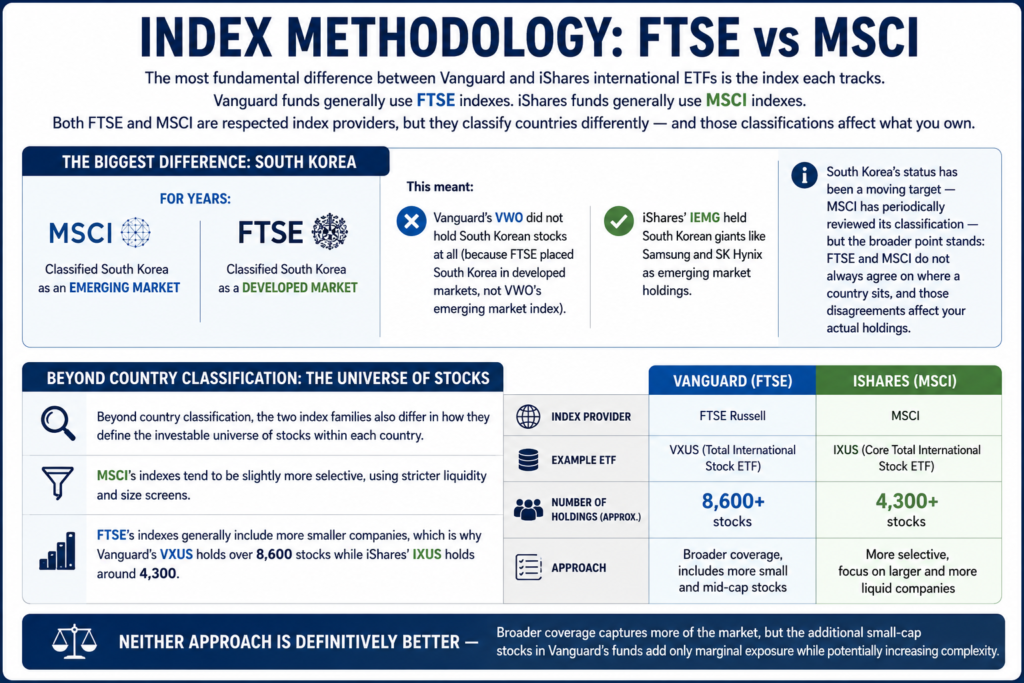
The most fundamental difference between Vanguard and iShares international ETFs is the index each tracks. Vanguard funds generally use FTSE indexes. iShares funds generally use MSCI indexes. Both FTSE and MSCI are respected index providers, but they classify countries differently — and those classifications affect what you own.
The most significant and historically consequential difference has been the treatment of South Korea. For years, MSCI classified South Korea as an emerging market while FTSE classified it as a developed market. This meant that investors in Vanguard’s VWO did not hold South Korean stocks at all (because FTSE placed South Korea in developed markets, not VWO’s emerging market index), while investors in iShares’ IEMG held South Korean giants like Samsung and SK Hynix as emerging market holdings.
South Korea’s status has been a moving target — MSCI has periodically reviewed its classification — but the broader point stands: FTSE and MSCI do not always agree on where a country sits, and those disagreements affect your actual holdings. Before choosing between the two providers, it is worth checking the current country classifications that affect each fund.
Beyond country classification, the two index families also differ in how they define the investable universe of stocks within each country. MSCI’s indexes tend to be slightly more selective, using stricter liquidity and size screens. FTSE’s indexes generally include more smaller companies, which is why Vanguard’s VXUS holds over 8,600 stocks while iShares’ IXUS holds around 4,300. Neither approach is definitively better — broader coverage captures more of the market, but the additional small-cap stocks in Vanguard’s funds add only marginal exposure while potentially increasing complexity.
Side-by-Side Comparison: Broad International ETFs
VXUS vs IXUS — Total International (Developed + Emerging)
VXUS tracks the FTSE Global All Cap ex US Index. IXUS tracks the MSCI ACWI ex USA Investable Market Index.
TER: VXUS 0.07% — IXUS 0.07% AUM: VXUS over $70 billion — IXUS over $35 billion Holdings: VXUS over 8,600 stocks — IXUS over 4,300 stocks Dividend yield: Both approximately 3.0–3.5% Dividend frequency: Both quarterly
Both funds charge the same fee and provide the same core function — broad international equity exposure covering developed and emerging markets. VXUS holds roughly twice as many stocks due to its index’s broader small-cap coverage. Performance between the two has been nearly identical over most time periods, with occasional short-term divergence driven by the South Korea and country classification differences.
For most investors, choosing between VXUS and IXUS comes down to platform preference, existing account structure, or a preference for either Vanguard or BlackRock as the fund manager. There is no meaningful long-term performance advantage to either.
Side-by-Side Comparison: Developed Markets ETFs
VEA vs IEFA — Developed International Markets
VEA tracks the FTSE Developed All Cap ex US Index. IEFA tracks the MSCI EAFE Investable Market Index.
TER: VEA 0.05% — IEFA 0.07% AUM: VEA over $120 billion — IEFA over $100 billion Holdings: VEA over 3,900 stocks — IEFA over 3,000 stocks Key difference: VEA includes Canada; IEFA excludes Canada
This is the most important structural difference in the developed markets comparison. VEA includes Canadian stocks because FTSE includes Canada in its developed markets index. IEFA excludes Canada because MSCI’s EAFE index (Europe, Australasia, and Far East) was specifically designed to exclude North America.
If you are a U.S. investor pairing an international ETF with a U.S. equity fund, and you want Canadian exposure, VEA gives it to you automatically. If you prefer to keep your North American allocation entirely within your U.S. ETF (which typically holds no Canadian stocks either), then neither fund gives you Canada — which means Canadian stocks would be absent from your portfolio unless you add them separately.
The fee difference is also notable. VEA at 0.05% is cheaper than IEFA at 0.07%, a small but real advantage that compounds over decades of holding.
In terms of geographic concentration, both funds are heavily weighted toward Japan, the United Kingdom, France, Germany, Switzerland, and Australia — the largest developed market economies outside North America. The country weightings are very similar, with the Canada inclusion in VEA being the primary structural divergence.
Side-by-Side Comparison: Emerging Markets ETFs
VWO vs IEMG — Emerging Markets
VWO tracks the FTSE Emerging Markets All Cap China A Inclusion Index. IEMG tracks the MSCI Emerging Markets Investable Market Index.
TER: VWO 0.08% — IEMG 0.09% AUM: VWO over $80 billion — IEMG over $70 billion Holdings: VWO over 4,700 stocks — IEMG over 2,700 stocks Key difference: VWO excludes South Korea (FTSE classifies it as developed); IEMG includes South Korea
This is where the index methodology difference has the most practical impact. Samsung Electronics is one of the largest companies in the world and a core holding in most emerging market indexes. In IEMG, Samsung and other South Korean companies are significant holdings. In VWO, they are absent entirely — held instead in VEA on the developed markets side.
The implication is important: an investor holding VWO for emerging market exposure and VXUS for broad international exposure actually has South Korea covered in VXUS’s developed market component. But an investor holding VWO as a standalone emerging markets addition to a U.S.-only portfolio may be surprised to discover they have no South Korean exposure at all.
Both funds are heavily weighted toward China, India, Taiwan, and Brazil. The China exposure through both funds includes both Hong Kong-listed stocks and mainland China A-shares, giving access to the full breadth of China’s publicly listed companies. India has grown to become a larger weight in both funds as its economy and stock market have expanded.
The fee difference between VWO (0.08%) and IEMG (0.09%) is negligible. The South Korea difference is the primary reason to choose one over the other, and that choice depends on whether you want South Korea in your emerging market fund or your developed market fund.
Dividend Handling: Qualified Dividends and Foreign Tax Credits
Both Vanguard and iShares international ETFs generate dividend income from the foreign stocks they hold. International dividends generally receive less favorable tax treatment than U.S. qualified dividends, though the specifics depend on tax treaties between the U.S. and each country.
One meaningful but often overlooked difference involves how each fund structure handles foreign withholding taxes. Vanguard’s unique mutual fund/ETF share class structure has historically allowed its ETFs to manage certain tax aspects more efficiently than standalone ETF structures. BlackRock’s iShares funds use a standard ETF structure without the mutual fund share class overlay.
In practice, both Vanguard and iShares international ETFs qualify investors for the foreign tax credit on their U.S. tax returns — meaning you can reclaim a portion of the foreign withholding taxes paid on international dividends. The mechanics differ slightly based on fund structure, but both providers handle this efficiently for retail investors holding in taxable accounts.
For holdings in tax-advantaged accounts like IRAs, foreign withholding taxes are permanently lost and cannot be reclaimed — a consideration that makes international ETFs slightly less tax-efficient in retirement accounts than in taxable accounts, regardless of whether you choose Vanguard or iShares.
Cost Comparison: The Full Picture
Expense ratios are the most visible cost, but not the only one. The total cost of holding an ETF also includes bid-ask spreads (the difference between the price you pay to buy and the price you receive when you sell) and tracking error (how closely the ETF follows its benchmark index).
On bid-ask spreads, both VXUS and IXUS, VEA and IEFA, and VWO and IEMG are highly liquid with very tight spreads. For retail investors making regular purchases rather than large institutional trades, the spread difference between any of these pairs is immaterial.
On tracking error, both Vanguard and iShares have strong track records of closely following their benchmark indexes. Vanguard’s scale and operational efficiency give it an edge in minimizing tracking error in some funds, but the difference is very small across international ETFs specifically.
The expense ratio comparison gives Vanguard a narrow edge in two of the three categories: VXUS and IXUS are tied at 0.07%, but VEA beats IEFA at 0.05% vs 0.07%, and VWO beats IEMG at 0.08% vs 0.09%. For cost-conscious long-term investors, Vanguard’s total cost advantage across an international portfolio built with VXUS or VEA plus VWO is real, though small.
Which Platform Are You Using?
The best ETF in theory is not always the best ETF in practice if your brokerage charges a commission to buy it. While most major brokerages offer commission-free trading on both Vanguard and iShares ETFs today, there are exceptions — particularly in 401(k) plans and some smaller brokerage platforms that have preferred fund relationships.
Vanguard brokerage clients naturally have seamless access to Vanguard ETFs and may find VXUS, VEA, and VWO better integrated into their account tools and automatic investment features. Fidelity clients have historically had strong iShares integration, with IXUS, IEFA, and IEMG frequently available commission-free and well-supported in Fidelity’s planning tools.
For investors using Schwab, TD Ameritrade (now part of Schwab), or Robinhood, both Vanguard and iShares ETFs are typically available on equal terms. The platform consideration matters most for Vanguard and Fidelity account holders where there may be preferential treatment of the respective house-brand products.
When to Choose Vanguard International ETFs
Choose Vanguard if you value the broadest possible market coverage — VXUS’s 8,600+ holdings versus IXUS’s 4,300 gives you more comprehensive exposure to smaller international companies. Choose Vanguard if slightly lower fees matter to you — VEA at 0.05% beats IEFA at 0.07% over decades. Choose Vanguard if you want Canadian stocks included naturally in your developed market allocation through VEA. Choose Vanguard if you are a Vanguard brokerage customer and want your portfolio consolidated in one ecosystem.
When to Choose iShares International ETFs
Choose iShares if you want South Korean stocks in your emerging market fund — IEMG includes Samsung and other Korean companies that VWO excludes. Choose iShares if you are a Fidelity customer where iShares integration is strongest. Choose iShares if you prefer the MSCI index methodology, which is the global institutional standard used by pension funds, endowments, and most professional asset managers worldwide. Choose iShares if you already hold other iShares funds and want consistency in your fund family.
The Verdict
For most long-term retail investors, the choice between Vanguard and iShares international ETFs will have a negligible impact on long-term wealth outcomes. Both families offer excellent products at very low cost with strong operational track records. The decision is genuinely close.
If forced to pick one family for a complete international allocation, Vanguard has a slight edge on cost and breadth — VXUS or the VXUS plus VWO combination holds more stocks at slightly lower fees. The VEA vs IEFA comparison in particular favors Vanguard, with a lower expense ratio and the inclusion of Canada providing slightly more complete developed market coverage.
That said, iShares’ inclusion of South Korea in IEMG is a genuine structural advantage for investors who want the full emerging market universe in their emerging markets fund. And the MSCI methodology’s status as the global institutional standard gives iShares a credibility advantage for investors who want their portfolio aligned with how the world’s largest professional investors allocate capital.
The right answer for most investors: pick one family, build your international allocation with their funds, and do not switch back and forth. The costs of changing — potential capital gains taxes in taxable accounts, transaction friction — outweigh any theoretical advantage of mixing fund families for international equity exposure.
Frequently Asked Questions
Is VXUS or IXUS better for a long-term investor? Both are excellent and the long-term performance difference has been minimal. VXUS holds more stocks and charges the same 0.07% fee. IXUS uses the MSCI methodology preferred by institutional investors. For most retail investors the choice is irrelevant — pick the one better integrated with your brokerage platform.
Why does VWO not hold South Korean stocks? FTSE, the index provider that VWO follows, classifies South Korea as a developed market rather than an emerging market. This means South Korean stocks are included in Vanguard’s developed market funds (VXUS and VEA) rather than in VWO. Investors who specifically want South Korea in their emerging market allocation should use IEMG instead.
Can I mix Vanguard and iShares ETFs in the same portfolio? Yes, absolutely. Many investors hold VXUS from Vanguard alongside IEMG from iShares, or VEA with IEMG, without any issue. ETFs from different providers hold entirely separate pools of stocks and there is no structural reason to stick to one fund family. The main consideration is whether mixing creates unintended overlap or gaps in coverage.
Do Vanguard or iShares international ETFs hedge currency risk? The standard versions of these funds — VXUS, VXUS, VXUS, IEFA, IEMG — do not hedge currency risk. Your returns will be affected by movements in the euro, yen, pound, yuan, and dozens of other currencies relative to the dollar. Currency-hedged versions exist for some funds but cost more and are generally not recommended for long-term buy-and-hold investors, as currency effects tend to average out over long time horizons.
Which is better for a taxable brokerage account: Vanguard or iShares? Vanguard has historically had a slight tax efficiency advantage due to its unique fund structure that allows ETFs and mutual funds to share a single share class, enabling more efficient management of capital gains. However, both Vanguard and iShares international ETFs are reasonably tax-efficient in taxable accounts, and both qualify you for the foreign tax credit on dividends. The difference is real but small for most retail investors.