
Last updated: June 2026 | Reading time: 9 min
Disclaimer: This article is for informational and educational purposes only. Nothing here constitutes financial advice. Past performance is not a guarantee of future results. Always consult a licensed financial advisor before making investment decisions.
Why Global Diversification Matters More Than Ever
For the past decade, U.S. investors who ignored international markets did well. The S&P 500 outperformed nearly every major international index from 2012 to 2023, and the argument for staying home seemed increasingly compelling. But long-term investing is not about the last decade — it is about the next two or three.
In 2026, the case for global diversification has strengthened considerably. U.S. equity valuations remain historically elevated by almost every traditional metric. International markets — Europe, Japan, emerging Asia, Latin America — trade at significant discounts to U.S. stocks on a price-to-earnings basis. Currency diversification reduces dependence on the dollar. And the rise of genuinely world-class companies outside the United States means that limiting your portfolio to U.S. stocks means missing a growing share of global economic value creation.
Global ETFs solve this problem elegantly. Instead of researching individual companies in dozens of countries, a single global ETF gives you diversified exposure to thousands of stocks across the world at minimal cost. For long-term investors building wealth over 20 or 30 years, global ETFs are one of the most powerful tools available.
What to Look for in a Global ETF
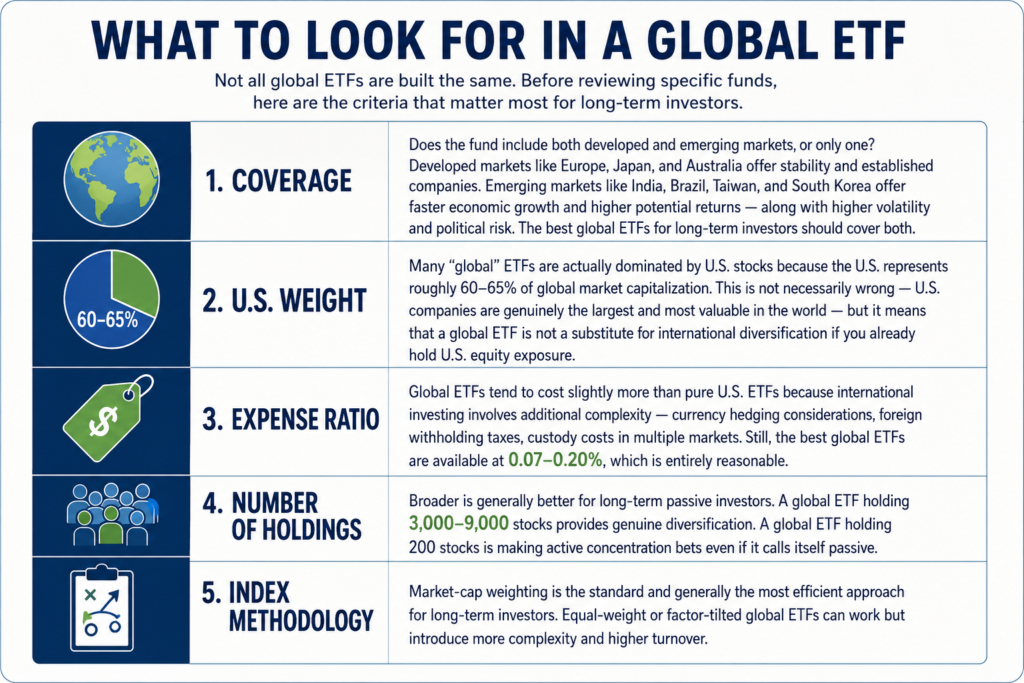
Not all global ETFs are built the same. Before reviewing specific funds, here are the criteria that matter most for long-term investors.
Coverage: Does the fund include both developed and emerging markets, or only one? Developed markets like Europe, Japan, and Australia offer stability and established companies. Emerging markets like India, Brazil, Taiwan, and South Korea offer faster economic growth and higher potential returns — along with higher volatility and political risk. The best global ETFs for long-term investors should cover both.
U.S. weight: Many «global» ETFs are actually dominated by U.S. stocks because the U.S. represents roughly 60–65% of global market capitalization. This is not necessarily wrong — U.S. companies are genuinely the largest and most valuable in the world — but it means that a global ETF is not a substitute for international diversification if you already hold U.S. equity exposure.
Expense ratio: Global ETFs tend to cost slightly more than pure U.S. ETFs because international investing involves additional complexity — currency hedging considerations, foreign withholding taxes, custody costs in multiple markets. Still, the best global ETFs are available at 0.07–0.20%, which is entirely reasonable.
Number of holdings: Broader is generally better for long-term passive investors. A global ETF holding 3,000–9,000 stocks provides genuine diversification. A global ETF holding 200 stocks is making active concentration bets even if it calls itself passive.
Index methodology: Market-cap weighting is the standard and generally the most efficient approach for long-term investors. Equal-weight or factor-tilted global ETFs can work but introduce more complexity and higher turnover.
The Best Global ETFs for Long-Term Investors
Vanguard Total World Stock ETF (VT)
TER: 0.07% AUM: Over $40 billion Holdings: Over 9,800 stocks across 50+ countries U.S. weight: Approximately 62% Geographic coverage: U.S., developed international, and emerging markets
VT is the simplest and most complete answer to global equity investing. One fund, one ticker, one fee of 0.07% per year, and you own a slice of virtually every publicly traded company on earth worth owning. It covers U.S. large and small caps, European blue chips, Japanese industrials, Korean technology companies, Indian consumer businesses, Brazilian commodity producers, and everything in between.
The automatic rebalancing of VT is one of its most underappreciated features. As market values shift globally — as emerging markets grow faster than developed markets, or as one country’s stock market outperforms another — VT reweights itself without any action required from the investor. You never have to decide when to shift from U.S. to international or how to time the rotation. The fund does it for you, continuously, at no additional cost.
For investors who want the ultimate simplicity — one ETF that handles the entire equity portion of a long-term portfolio — VT is the answer. Pair it with BND for bonds, and you have a complete, globally diversified, ultra-low-cost portfolio in two funds.
Best for: Investors who want complete global equity exposure in a single fund, those who prefer simplicity over optimization, and beginners building their first long-term portfolio.
Vanguard Total International Stock ETF (VXUS)
TER: 0.07% AUM: Over $70 billion Holdings: Over 8,600 stocks across 47 countries U.S. weight: 0% (intentionally excludes the United States) Geographic coverage: Developed and emerging markets outside the U.S.
VXUS is the international complement to U.S.-focused ETFs like VOO or VTI. It holds everything VT holds except U.S. stocks — developed markets in Europe, Japan, Australia, Canada, and Singapore, plus emerging markets across Asia, Latin America, Africa, and Eastern Europe.
The reason many investors prefer VXUS over VT is control. If you already own VOO or VTI for U.S. exposure, adding VT would give you double U.S. weighting. VXUS lets you set your own U.S. vs. international split. A common approach is 70% VOO and 30% VXUS, or 60/40 depending on your conviction about international markets. This gives you more active control over geographic allocation without having to pick individual country ETFs.
VXUS is also one of the most efficient ways to access international diversification. At 0.07%, it holds over 8,600 stocks and provides exposure to economies at every stage of development. No single country or sector dominates — you get genuine global breadth.
Best for: Investors who already hold U.S. equity ETFs and want to add international exposure separately, those who want to control their U.S. vs. international allocation, and anyone building a two or three-fund portfolio.
iShares Core MSCI Total International Stock ETF (IXUS)
TER: 0.07% AUM: Over $35 billion Holdings: Over 4,300 stocks across 44 countries U.S. weight: 0% (excludes the United States) Geographic coverage: Developed and emerging markets outside the U.S.
IXUS is BlackRock’s answer to VXUS. It provides very similar international exposure — developed and emerging markets outside the U.S. — at the same 0.07% fee. The primary differences are index methodology and the number of holdings. IXUS tracks the MSCI ACWI ex USA Investable Market Index while VXUS tracks the FTSE Global All Cap ex US Index, which leads to slightly different country weightings and a different number of holdings.
In practice, the performance of IXUS and VXUS has been very similar over time. The choice between them comes down to preference for iShares vs. Vanguard products and which is better integrated into your specific brokerage account. Investors at Fidelity or who already use iShares products may prefer IXUS. Vanguard account holders will naturally gravitate toward VXUS. Both are excellent long-term holdings.
Best for: Investors in the iShares ecosystem, Fidelity account holders, and those who want international exposure functionally equivalent to VXUS with a slight preference for the MSCI index methodology.
iShares Core MSCI World ETF (URTH)
TER: 0.24% AUM: Over $5 billion Holdings: Over 1,500 stocks across 23 developed countries U.S. weight: Approximately 70% Geographic coverage: Developed markets only — no emerging markets
URTH tracks the MSCI World Index, which covers large and mid-cap stocks across 23 developed market countries. It deliberately excludes emerging markets, which makes it a less volatile option than funds like VT or VXUS that include countries like China, India, and Brazil.
The appeal of URTH is its focus on the most stable, established markets in the world — the United States, Western Europe, Japan, Australia, Canada, and other high-income economies. Investors who want global diversification but are uncomfortable with the political and currency risks of emerging markets find URTH a cleaner option.
The trade-off is higher cost (0.24% vs. 0.07% for VT or VXUS) and lower exposure to the faster-growing economies that could drive outperformance over the next decade. Emerging markets currently represent roughly 12–15% of global market cap, and excluding them means missing that portion of global growth. For investors with a very long time horizon, that exclusion has historically cost some return over complete global market exposure.
Best for: Conservative long-term investors who want global diversification without emerging market volatility, those uncomfortable with China or political risk in developing economies, and investors in European-listed versions who are familiar with the MSCI World methodology.
Schwab International Equity ETF (SCHF)
TER: 0.06% AUM: Over $30 billion Holdings: Over 1,500 stocks across 25 developed countries U.S. weight: 0% (excludes the United States) Geographic coverage: Developed markets only — no emerging markets
SCHF is the cheapest way to access developed international markets, period. At 0.06%, it undercuts most competitors and covers the major developed economies outside the U.S. — Europe, Japan, Australia, Canada, Hong Kong, and Singapore among others. Large and mid-cap companies from 25 countries make up its portfolio.
The exclusion of emerging markets keeps SCHF’s volatility lower than broader international ETFs, while the extremely low fee means you keep nearly all of the income and return the fund generates. For investors who want international developed market exposure as a complement to their U.S. equity holdings — without venturing into emerging markets — SCHF is arguably the most cost-efficient option available.
A common long-term portfolio using SCHF pairs it with VOO for U.S. exposure and a smaller emerging markets ETF like IEMG for developing economy coverage, giving full global diversification at blended costs well under 0.10%.
Best for: Cost-conscious investors who want developed international exposure, those who prefer to manage developed and emerging market exposure separately, and anyone looking for the cheapest option in international developed market ETFs.
iShares Core MSCI Emerging Markets ETF (IEMG)
TER: 0.09% AUM: Over $70 billion Holdings: Over 2,700 stocks across 24 emerging market countries U.S. weight: 0% Geographic coverage: Emerging markets only — China, India, Taiwan, South Korea, Brazil, and more
IEMG is the defining ETF for emerging market exposure. It holds over 2,700 companies across 24 developing economies, with China, India, Taiwan, and South Korea representing the largest country weights. Together, these four countries account for a significant majority of the fund, reflecting their dominance of global emerging market capitalization.
In 2026, emerging markets present a genuine valuation opportunity. Price-to-earnings ratios in markets like China, South Korea, and Brazil are at significant discounts to U.S. equities. India continues to grow rapidly and is increasingly becoming a core holding in emerging market indexes. For long-term investors with a 10–20 year horizon, the combination of discounted valuations and faster underlying economic growth makes emerging market exposure compelling.
The risks are real and should not be dismissed. Currency volatility, geopolitical risk (particularly around Taiwan and China-U.S. relations), and varying standards of corporate governance are genuine concerns. IEMG manages these by spreading exposure across 2,700 companies and 24 countries rather than concentrating in any single name or nation.
For most long-term global portfolios, a 10–20% allocation to IEMG alongside a developed market fund provides appropriate emerging market exposure without excessive concentration. (If you are on the fence about whether to allocate capital to developing economies right now, explore our deep-dive analysis on should investors add emerging markets ETFs in 2026?).
Best for: Long-term investors who want exposure to faster-growing developing economies, those building a complete global portfolio from individual components, and investors comfortable with higher short-term volatility in exchange for higher long-term growth potential.
Building a Complete Global Portfolio With ETFs
The funds above can be combined in several ways depending on how much control and complexity you want.
The one-fund solution VT covers everything — U.S., developed international, and emerging markets — in a single holding. Add BND for bonds and you have a complete portfolio. This is the right approach for investors who want simplicity above all else and are comfortable letting the market determine their geographic allocation automatically.
The two-fund international split VOO or VTI for U.S. exposure plus VXUS or IXUS for international. This gives you control over your U.S. vs. international weighting. A 70/30 or 60/40 split is common and defensible. Both funds together cost under 0.07% on average — cheaper than almost any mutual fund equivalent.
The three-fund global build VOO for U.S. large caps, SCHF for developed international, and IEMG for emerging markets. This approach gives maximum control — you can set your own weighting for each geographic category and adjust over time as your view of relative valuations evolves. The blended cost of this three-fund combination is under 0.08% per year.
The conservative global approach For investors who want global exposure with lower volatility, combining VOO with URTH or SCHF (both excluding emerging markets) creates a portfolio weighted heavily toward the world’s most stable economies. You sacrifice some long-term growth potential from emerging markets but reduce the day-to-day volatility of your international allocation.
The Currency Question
One aspect of global ETF investing that deserves attention is currency risk. When you hold VXUS, SCHF, or IEMG, your returns are affected not just by the stock prices of the companies you own but also by the exchange rates between those currencies and the U.S. dollar. A strong dollar reduces the dollar-denominated returns of international holdings; a weak dollar amplifies them.
Currency-hedged versions of international ETFs exist — they use derivatives to neutralize currency movements — but they cost more and introduce their own complexities. For long-term investors with 10+ year horizons, the evidence suggests that currency effects tend to wash out over time, making unhedged ETFs like VXUS and SCHF the better choice for most retail investors. Currency hedging makes more sense for shorter-term tactical positions.
A Note on Home Country Bias
Research consistently shows that investors around the world dramatically overweight their home country’s stocks relative to that country’s share of global market capitalization. U.S. investors hold portfolios that are 80–90% U.S. stocks when the U.S. represents roughly 60% of global market cap. This home country bias feels comfortable but introduces unnecessary concentration risk.
The underperformance of international markets relative to the U.S. over the past decade has reinforced this bias — but history is full of examples of dominant markets losing their edge for extended periods. Japan was the world’s most valuable stock market in 1989. The U.S. underperformed international markets significantly in the 2000s. Diversification across geographies is protection against the scenario where your home market disappoints.
A reasonable long-term target for U.S. investors is to hold 20–40% in international stocks, either through VXUS, IXUS, SCHF plus IEMG, or the all-in-one simplicity of VT. None of these requires predicting which country will outperform — they simply ensure you participate in global economic growth wherever it occurs.
Bottom Line
The best global ETFs for long-term investors in 2026 are the ones that provide broad, low-cost exposure to the widest possible range of markets. VT is the single best option for investors who want maximum simplicity. VXUS and IXUS are the best complements to an existing U.S. equity portfolio. SCHF is the cheapest developed international option. IEMG is the standard for emerging market access.
No one knows whether U.S. or international markets will outperform over the next decade. What we do know is that diversifying globally costs almost nothing with today’s ETFs and protects long-term investors against the very real risk of prolonged underperformance in any single market. The investors who will regret global diversification are few. The investors who will regret the lack of it could be many.
Frequently Asked Questions
How much of my portfolio should be in international ETFs? A common framework for U.S. investors is to hold 20–40% in international stocks. The lower end suits investors who are more comfortable with U.S. market concentration and believe in continued U.S. outperformance. The higher end reflects a more globally neutral view, weighting international stocks closer to their share of global market cap. VT automatically sets this allocation at approximately 38% international, which is a reasonable baseline.
Is VT better than holding VOO and VXUS separately? VT is simpler and functionally equivalent to holding VOO and VXUS in roughly a 62/38 ratio. The advantage of holding them separately is control — you can set your own U.S. vs. international weighting and adjust it over time. The advantage of VT is simplicity — one fund, automatic rebalancing, one fee. For most investors the difference in outcomes over time is minimal. Choose based on whether you value control or simplicity more.
Do global ETFs include China? Broad global and emerging market ETFs like VT, VXUS, and IEMG do include Chinese stocks, typically as the largest or second-largest country weight in the emerging market portion. China represents a meaningful share of global market cap and economic output. Investors who want to exclude China can use ex-China emerging market ETFs, though these come with higher fees and reduced diversification.
Why have international ETFs underperformed U.S. ETFs for so long? The primary reasons have been faster U.S. earnings growth (driven by technology), a strengthening dollar, and the dominance of U.S. mega-cap tech companies that had no international equivalents. Whether these advantages persist is uncertain. International markets currently trade at significant valuation discounts to the U.S., which historically has been a predictor of better relative future returns over long periods.
Are global ETFs tax-efficient? Most broad global ETFs are reasonably tax-efficient because they use market-cap weighting and have low turnover. One additional benefit of holding international ETFs in a taxable account is the foreign tax credit — U.S. investors can typically claim a credit for foreign withholding taxes paid on international dividends, which partially offsets the tax drag from holding international stocks.