For long-term investors, fees may seem insignificant at first glance. After all, what difference does a few hundredths of a percent make? The reality is that even tiny differences in expenses can add up to thousands of dollars over decades of investing.
That’s why many investors searching for S&P 500 ETFs focus on one key metric: expense ratio. Since most S&P 500 ETFs track the same index and hold nearly identical stocks, lower fees often translate directly into higher long-term returns.
In this guide, we’ll rank some of the cheapest S&P 500 ETFs available in 2026 and explain how expense ratios can impact your investment results over time.
Why ETF Fees Matter
Every ETF charges an annual fee known as the expense ratio. This fee is automatically deducted from the fund’s assets and helps cover operating expenses.
While expense ratios are usually small, they can have a significant impact over the long run because of compounding.
For example:
- A $10,000 investment growing at 8% annually for 30 years becomes approximately $100,600.
- Higher fees reduce that growth every year.
- Over decades, even a 0.05% difference can result in hundreds or thousands of dollars in lost returns.
Because S&P 500 ETFs generally hold the same companies, minimizing costs becomes one of the easiest ways to improve long-term performance.
What Is a Good ETF Expense Ratio?
In today’s ETF market, investors can find S&P 500 funds with expense ratios below 0.05%.
As a general guideline:
- Below 0.05% = Excellent
- 0.05% to 0.10% = Very Good
- 0.10% to 0.20% = Acceptable
- Above 0.20% = Expensive for a passive S&P 500 ETF
Fortunately, competition among ETF providers has driven fees lower than ever.
1. Vanguard S&P 500 ETF (VOO)
Expense Ratio: Extremely Low
VOO has become one of the most popular ETFs in the world thanks to Vanguard’s commitment to low-cost investing.
The fund tracks the S&P 500 Index and provides exposure to approximately 500 of the largest U.S. companies.
Advantages
- Ultra-low fees
- Massive assets under management
- Excellent liquidity
- Strong reputation among long-term investors
Best For
Buy-and-hold investors focused on maximizing long-term returns.
2. iShares Core S&P 500 ETF (IVV)
Expense Ratio: Extremely Low
IVV is BlackRock’s flagship S&P 500 ETF and competes directly with VOO.
The fund tracks the same index and delivers nearly identical performance.
Advantages
- Very low expenses
- High liquidity
- Strong tracking accuracy
- Backed by the world’s largest asset manager
Best For
Investors seeking a low-cost alternative to Vanguard.
3. Schwab S&P 500 Index ETF (SCHX)
Although technically broader than the S&P 500, SCHX is often considered a close substitute because it tracks large-cap U.S. companies.
Advantages
- Low costs
- Broad market exposure
- Investor-friendly structure
Best For
Investors already using Schwab’s brokerage platform.
4. SPDR Portfolio S&P 500 ETF (SPLG)
SPLG has gained popularity among cost-conscious investors in recent years.
Originally designed as a lower-cost alternative to SPY, SPLG now offers one of the most competitive fee structures available.
Advantages
- Very low expense ratio
- Strong liquidity
- Similar holdings to other S&P 500 ETFs
Best For
Investors looking for a low-cost option from State Street.
5. SPDR S&P 500 ETF Trust (SPY)
SPY is the oldest and most famous ETF in the United States.
It remains the most actively traded ETF in the world.
However, despite its popularity, SPY is no longer among the cheapest options.
Advantages
- Exceptional liquidity
- Massive options market
- Preferred by active traders
Disadvantages
- Higher expense ratio than competitors
- Less attractive for long-term investors focused on minimizing costs
Best For
Traders rather than long-term investors.
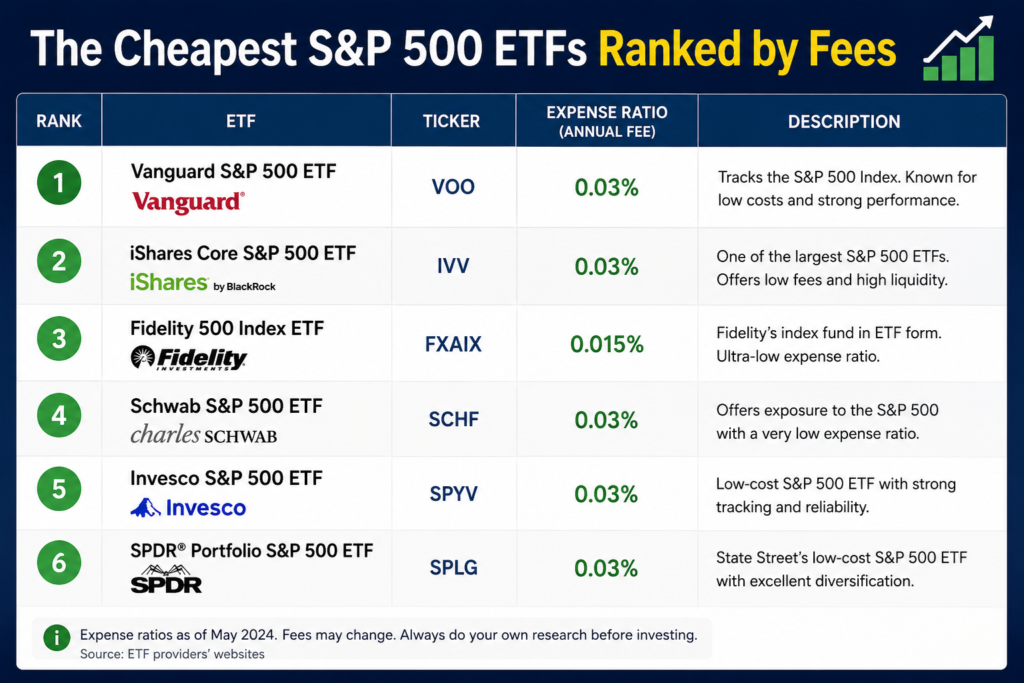
Fee Ranking: Cheapest to Most Expensive
| Rank | ETF | Fee Competitiveness |
|---|---|---|
| 1 | VOO | Excellent |
| 2 | IVV | Excellent |
| 3 | SPLG | Excellent |
| 4 | SCHX | Very Good |
| 5 | SPY | Good |
While the differences appear small, lower-cost ETFs tend to outperform over long periods simply because they keep more of the market’s returns.
Performance Differences Are Usually Minimal
One important point many investors overlook is that fee differences do not create dramatically different annual returns.
Because all these ETFs track similar benchmarks, performance remains extremely close.
For example:
- VOO and IVV often produce nearly identical returns.
- SPLG performs similarly to both.
- SPY generally trails slightly because of its higher fees.
The gap may be tiny in a single year but becomes more noticeable over decades.
Which ETF Is Best for Long-Term Investors?
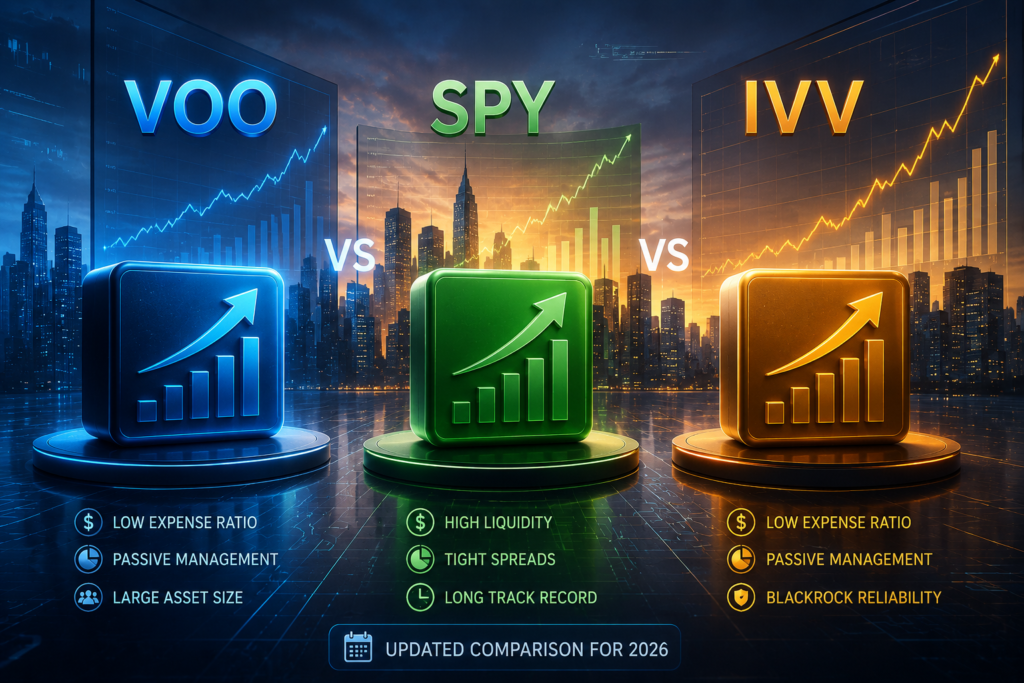
For investors focused on retirement or wealth accumulation, VOO and IVV are often considered the strongest choices.
Both offer:
- Extremely low costs
- Strong liquidity
- Excellent tracking accuracy
- Broad diversification
Most long-term investors would be unlikely to notice any meaningful performance difference between the two.
Which ETF Is Best for Traders?
SPY remains the clear leader for active traders.
Its advantages include:
- Highest trading volume
- Tight bid-ask spreads
- Deep options market
- Institutional-grade liquidity
For investors making frequent trades, these benefits may outweigh the slightly higher fees.
Should You Switch ETFs to Save on Fees?
If you’re currently invested in a higher-cost S&P 500 ETF, switching may make sense in some situations.
However, investors should consider:
- Tax consequences
- Transaction costs
- Portfolio simplicity
For many investors, the best strategy is simply choosing a low-cost ETF from the beginning and holding it for the long term.
Final Verdict
The race to offer the cheapest S&P 500 ETF has benefited investors tremendously. Today, funds such as VOO, IVV, and SPLG provide broad exposure to America’s largest companies at incredibly low costs.
For most long-term investors, VOO remains the gold standard, combining ultra-low fees, strong liquidity, and Vanguard’s proven low-cost philosophy. IVV is an equally compelling alternative, while SPLG offers another excellent low-cost option.
Although fees should never be the only factor when selecting an ETF, they are one of the few variables investors can control. Choosing a low-cost S&P 500 ETF today can help maximize wealth accumulation for decades to come.
Disclaimer: This article is for informational purposes only and should not be considered financial advice. Always conduct your own research before making investment decisions.