
Last updated: June 2026
If you’ve searched «VOO vs SPY vs IVV,» you’re in good company — it’s one of the most-searched ETF comparisons on the internet. These three funds collectively hold trillions of dollars in assets and are the default answer to «how do I invest in the S&P 500?» But despite tracking the exact same index, they are not the same product, and the differences genuinely matter depending on how you plan to use them.
This guide breaks down what’s actually changed in 2026 — including a real milestone for VOO — and gives you a clear answer on which fund fits which type of investor.
Disclaimer: This article is for informational and educational purposes only and does not constitute financial advice. Past performance does not guarantee future results. Always do your own research and consider speaking with a licensed financial advisor before investing.
What’s new in 2026: VOO crosses $1 trillion
The biggest headline in this comparison this year: VOO recently crossed $1 trillion in assets under management, becoming the world’s first ETF to reach that milestone, according to etf.com. That’s a meaningful shift in the competitive landscape — for years SPY held the title of world’s largest ETF, but the gap has narrowed sharply and VOO has now pulled ahead. IVV isn’t far behind, with assets in the high hundreds of billions, also closing in on SPY.
This matters less for performance — all three funds still deliver virtually identical returns, since they track the same index — and more as a signal of where long-term investor capital is flowing. The shift toward VOO and IVV over SPY reflects a broader trend: buy-and-hold investors increasingly prioritizing rock-bottom costs over SPY’s trading-focused advantages.
(However, while capital is flooding into these low-cost vehicles at a record pace, it’s worth asking what kind of market environment you are actually buying into. Read our tactical data breakdown on Is the S&P 500 Overvalued? Best ETFs to Consider Now to see why current Shiller CAPE levels are flashing warning signs).
All three track the same index — so what’s actually different?
VOO, SPY, and IVV all track the S&P 500 Index — the same 500 large U.S. companies, weighted by market cap, rebalanced together whenever the index changes. They hold essentially identical stocks in essentially identical proportions. The differences come from everything else: cost, legal structure, liquidity profile, and tax treatment.
Quick comparison: VOO vs. SPY vs. IVV in 2026
| VOO (Vanguard) | SPY (State Street) | IVV (BlackRock/iShares) | |
|---|---|---|---|
| Expense ratio | 0.03% | 0.0945% | 0.03% |
| Approx. AUM | ~$1.0–1.5 trillion | ~$620–641B | ~$560–686B |
| Fund structure | Open-end fund | Unit Investment Trust (UIT) | Open-end fund |
| Dividend handling | Reinvested promptly | Held in cash until quarterly distribution | Reinvested promptly |
| Launch year | 2010 | 1993 (oldest S&P 500 ETF) | 2000 |
| Best suited for | Long-term buy-and-hold | Active trading, options strategies | Long-term buy-and-hold |
Figures as of early-to-mid 2026, sourced from fund providers, etf.com, and Benzinga. AUM figures shift daily given how much capital moves through these funds — always check current data before investing.
The expense ratio gap: small percentage, real dollars
SPY charges 0.0945% — more than three times the 0.03% charged by both VOO and IVV. On a $5,000 investment, that’s roughly $4.73 a year for SPY versus $1.50 for VOO or IVV — a difference that looks almost irrelevant at retail scale. But the gap compounds dramatically at institutional scale: a $5 billion allocation would cost about $4.73 million annually in SPY versus $1.5 million in VOO or IVV — a $3.23 million difference. That gap, multiplied across decades for any investor’s personal holding period, is exactly why the lower-cost funds have increasingly out-attracted SPY among long-term investors.
The structural difference that actually matters: UIT vs. open-end fund
This is the most underappreciated distinction in the VOO vs. SPY vs. IVV debate, and it’s a structural one rather than a cost one.
SPY is organized as a Unit Investment Trust (UIT) — an older fund structure with a key limitation: it cannot reinvest dividends internally. Instead, dividends collected from the underlying stocks sit in cash until SPY’s quarterly distribution date, creating a small «cash drag» on returns compared to funds that reinvest dividends immediately.
VOO and IVV are both open-end funds, the more modern and flexible structure, which allows dividends to be reinvested promptly rather than sitting idle in cash. Over a multi-decade holding period, this structural difference adds up alongside the expense ratio gap — and explains why the «set it and forget it» crowd has gravitated toward VOO and IVV rather than SPY, even though all three deliver nearly indistinguishable headline returns.
When SPY is actually the better choice
Despite the higher cost and the dividend drag, SPY remains the dominant choice for one specific group: active traders and options users. SPY’s trading volume and options market liquidity are unmatched among S&P 500 ETFs — tens of millions of shares trade daily, with bid-ask spreads so tight they often round down to effectively zero. Covered calls, protective puts, and other hedging strategies are generally cheaper and easier to execute with SPY than with VOO or IVV, simply because of how much deeper and more liquid SPY’s options market is.
If you’re a long-term, buy-and-hold investor who never trades options, this advantage is largely irrelevant to you, and you’re paying a real, ongoing cost (the higher expense ratio plus the dividend drag) for liquidity you may never use.
VOO vs. IVV: splitting hairs between near-identical twins
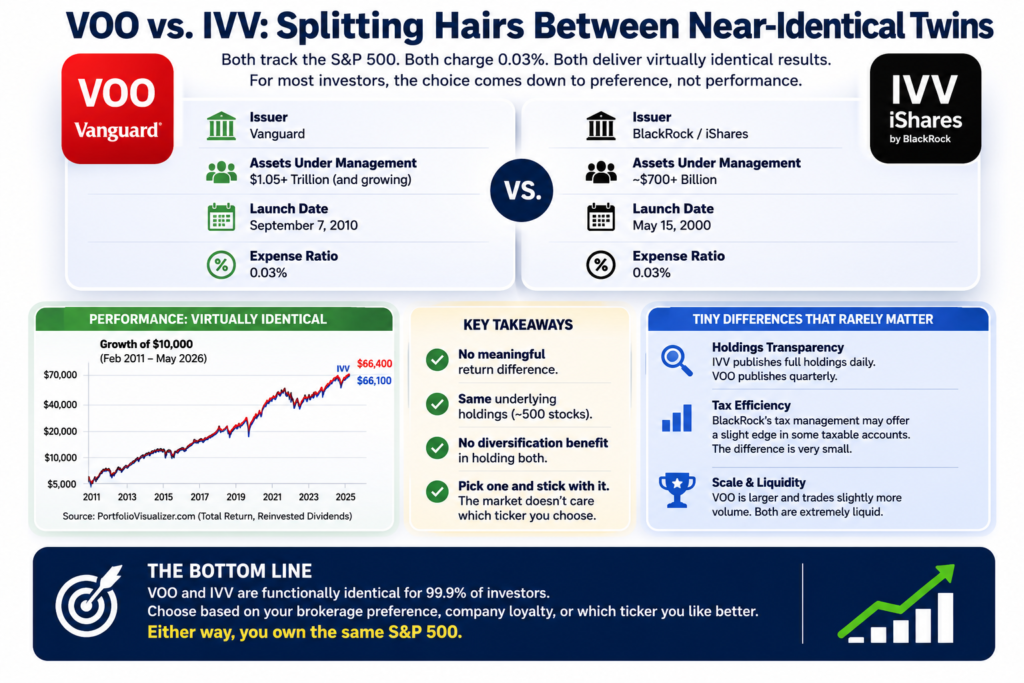
Between VOO and IVV specifically, the choice comes down almost entirely to preference rather than any meaningful financial difference. Both charge the identical 0.03% expense ratio, both are open-end funds with the same tax treatment, and both have delivered virtually identical total returns since VOO launched in 2010. The only real distinctions are:
- Issuer: Vanguard (VOO) vs. BlackRock/iShares (IVV)
- Scale: VOO is larger, having recently crossed $1 trillion in AUM, versus IVV’s high hundreds of billions
- Launch date: IVV is roughly a decade older than VOO
- Minor tracking and tax nuances: IVV has a slight edge in daily holdings transparency, and BlackRock’s tax management approach may offer a marginal benefit in some taxable account scenarios — though this difference is small enough that most investors won’t notice it in practice
There’s no diversification benefit to holding both VOO and IVV simultaneously — they hold the same roughly 500 stocks in the same weights, so combining them simply means owning the S&P 500 through two share classes instead of one.
So, which one should you actually buy in 2026?
- Long-term, buy-and-hold investor with no plans to trade options? → VOO or IVV. The lower 0.03% expense ratio and open-end fund structure (no dividend drag) make these the more cost-efficient choice over any extended holding period, and the difference between the two comes down to personal preference.
- Active trader, or you use options strategies like covered calls or protective puts? → SPY. Its unmatched liquidity and deep options market make the higher cost a reasonable trade-off for traders who actually use that liquidity.
- Starting out with limited capital and want the same exposure at an even lower entry price? Some investors in this position look at SPLG, a lower-priced alternative tracking the same index — worth researching separately if share price accessibility matters to you.
- Already own one of these three? There’s generally no reason to switch between VOO, SPY, or IVV once you’ve started — the cost of triggering a taxable event by selling one to buy another usually outweighs the modest fee savings, especially when comparing VOO and IVV, which are already nearly identical.
Frequently asked questions
Is VOO really better than SPY, or just cheaper? For long-term investors, VOO’s lower cost and open-end structure (no dividend cash drag) make it the more efficient choice over time. For active traders who rely on SPY’s deep options liquidity, SPY’s higher cost is arguably justified by capabilities VOO doesn’t offer.
Why does SPY still exist if VOO and IVV are cheaper? SPY was the first S&P 500 ETF ever launched, in 1993, and its decades-long head start built an enormous, deeply liquid options ecosystem that newer, cheaper funds haven’t replicated. That liquidity — not cost efficiency — is SPY’s primary remaining advantage.
Should I switch from SPY to VOO or IVV to save on fees? That depends on your personal tax situation and how long you’ve held SPY. Selling an existing position to switch funds can trigger capital gains taxes that may outweigh the modest expense ratio savings, particularly in a taxable account. This is a decision worth discussing with a tax professional or financial advisor before acting on it.
Can I just buy all three — VOO, SPY, and IVV — for extra diversification? No meaningful diversification benefit exists from holding multiple S&P 500 ETFs simultaneously — they all hold the same underlying 500 companies in the same proportions. Owning more than one of these funds just means owning the S&P 500 through multiple share classes rather than spreading your risk further.