
Last updated: June 2026 | Reading time: 9 min
Disclaimer: This article is for informational and educational purposes only. Nothing here constitutes financial advice. Past performance is not a guarantee of future results. Always consult a licensed financial advisor before making investment decisions.
A Question Worth Taking Seriously
Every serious income investor eventually arrives at this question. You have decided that dividends are going to be part of your portfolio strategy — now you have to decide whether to buy a fund that bundles hundreds of dividend-paying stocks together, or to build your own collection of individual companies, picking each one yourself.
The answer is not as obvious as either camp tends to claim. Dividend ETF advocates point to simplicity, diversification, and low costs. Individual stock investors point to higher yields, more control, and the ability to avoid companies they do not want to own. Both sides have real arguments. What matters is which trade-offs make sense for your specific situation.
This article lays out the honest case on both sides so you can make that decision with a clear picture of what you are actually choosing between.
What You Are Actually Comparing
A dividend ETF holds anywhere from 30 to 400+ dividend-paying stocks in a single fund. When you buy one share of SCHD or VYM, you instantly own a proportional slice of every company in that index. The fund rebalances automatically, reinvests or distributes dividends on a set schedule, and requires no active decision-making on your part beyond the initial purchase.
Building a portfolio of individual dividend stocks means selecting each company yourself — Johnson & Johnson, Realty Income, Coca-Cola, Chevron, and so on — monitoring each one, tracking ex-dividend dates, and deciding when and whether to sell if a company cuts its dividend or deteriorates fundamentally. You are the portfolio manager.
Both approaches can generate strong, consistent dividend income. The differences show up in how much work they require, how much risk you take on, and what kind of investor you need to be to execute each one well.
The Case for Dividend ETFs
The strongest argument for ETFs is instant diversification at near-zero cost. (If you want to skip the theory and jump straight to the exact tickers leading the market right now, check out our updated review of the best high-yield dividend ETFs this year). A single share of VYM gives you exposure to over 400 companies across financials, consumer staples, healthcare, energy, utilities, and more. No single company failure — even a dramatic one — can meaningfully damage your income stream. When General Electric cut its dividend in 2018 or when energy companies slashed payouts in 2020, ETF investors barely noticed. Individual stock investors holding those positions did.
The cost advantage is also real and durable. SCHD charges 0.06% per year. VYM charges 0.06%. DGRO charges 0.08%. On a $100,000 portfolio, that is $60–80 per year in total fund expenses. Building and maintaining a portfolio of 20–30 individual stocks costs nothing in fund fees, but it costs time — research time, monitoring time, and the cognitive load of staying current on dozens of companies across multiple industries.
ETFs also remove the emotional decision-making problem. When a stock you personally selected cuts its dividend, it feels like a personal failure, and many investors respond by holding too long, averaging down inappropriately, or selling in panic. An ETF handles these events automatically according to its index rules, without requiring any decision from you.
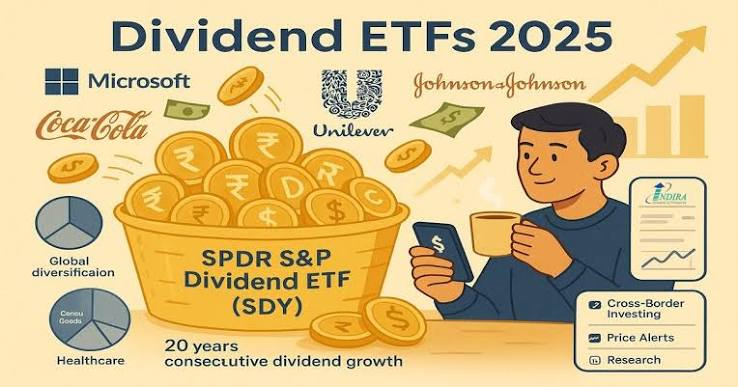
For investors who do not have the time, interest, or expertise to analyze individual companies deeply, a well-chosen dividend ETF is almost certainly a better outcome than a self-managed stock portfolio assembled from surface-level research.
The Case for Individual Dividend Stocks
The most compelling argument for individual stocks is yield. The best dividend ETFs — SCHD, VYM, DGRO — yield between 2.4% and 3.6%. A carefully selected portfolio of individual dividend stocks can realistically deliver 4–6% on a diversified basis, sometimes more, without resorting to the options strategies that JEPI and JEPQ use to reach their higher yields.
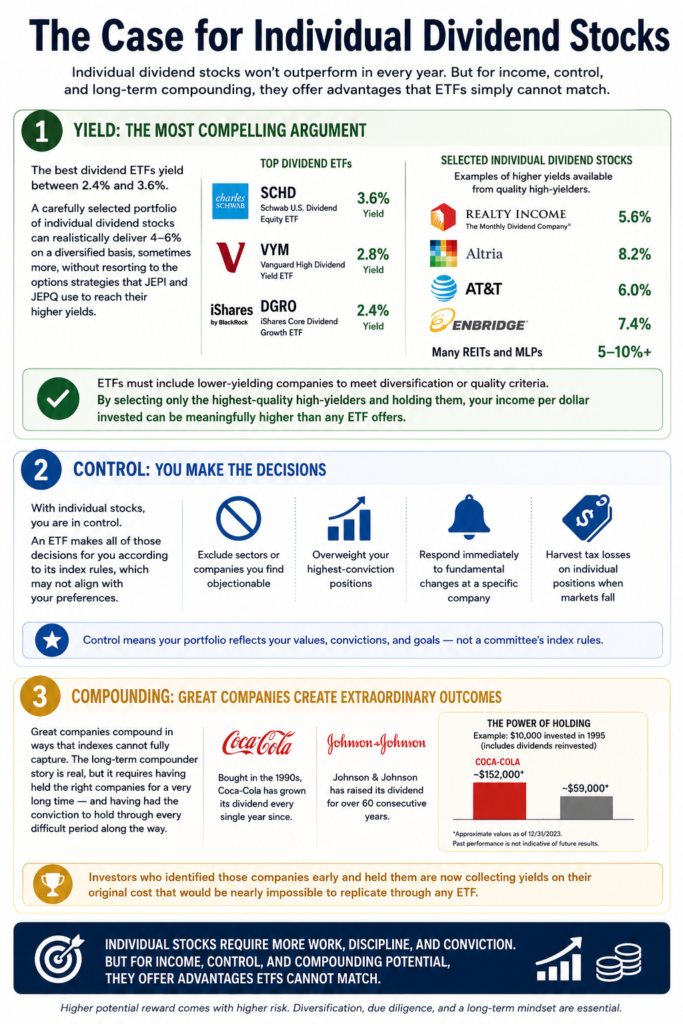
Companies like Realty Income, Altria, AT&T (at various points in its history), Enbridge, and many REITs and MLPs offer yields that ETFs cannot replicate at the index level because the index must also include lower-yielding companies to meet its diversification or quality criteria. If you select only the highest-quality high-yielders and hold them, your income per dollar invested can be meaningfully higher than any ETF offers.
Control is the second major advantage. With individual stocks, you can exclude sectors or companies you find objectionable, overweight your highest-conviction positions, respond immediately to fundamental changes at a specific company, and harvest tax losses on individual positions when markets fall. An ETF makes all of those decisions for you according to its index rules, which may not align with your preferences.
The third argument is that great companies compound in ways that indexes cannot fully capture. Coca-Cola bought in the 1990s has grown its dividend every single year since. Johnson & Johnson has raised its dividend for over 60 consecutive years. Investors who identified those companies early and held them are now collecting yields on their original cost that would be nearly impossible to replicate through any ETF. The long-term compounder story is real, but it requires having held the right companies for a very long time — and having had the conviction to hold through every difficult period along the way.
Where Individual Stocks Can Go Wrong
The risks of individual stock investing are easy to underestimate when markets are calm and dividends are flowing. The historical record is instructive. GE, once considered among the safest dividend payers in the market, cut its dividend to a penny. AT&T, a staple of income portfolios for decades, slashed its dividend in 2022 after its WarnerMedia spinoff. Bed Bath & Beyond, Kohl’s, and dozens of retailers once considered reliable income payers have reduced or eliminated dividends as their business models faced disruption.
The problem is not simply that bad things happen — it is that dividend cuts often arrive with little warning, precisely when the stock has already declined significantly and the yield has been inflated by a falling share price. Investors who confuse a high yield with a safe yield are a constant presence in dividend investing forums, usually discovered after the cut has already happened.
Concentration risk is the structural issue that individual stock portfolios can never fully escape. Even a 20-stock portfolio means each position represents 5% of your income. A single dividend cut immediately reduces your annual income by that amount. A portfolio of 400 stocks — the kind VYM holds — eliminates that risk almost entirely.
The Time and Expertise Requirement
Building a good individual dividend stock portfolio is not a one-time project. It requires ongoing monitoring of earnings, payout ratios, free cash flow, debt levels, and sector dynamics for every company you hold. When a company reports disappointing earnings, you need to decide whether the dividend is at risk and whether to sell before a potential cut. When a company in your portfolio gets acquired or spun off, you need to evaluate the new structure.
Most investors underestimate how much time this requires done properly. Many who describe themselves as individual stock investors are actually doing far less analysis than the decisions require — which means they are taking on the concentration risk of individual stocks without the research depth needed to manage it well. That is arguably a worse outcome than either a pure ETF approach or a genuinely rigorous individual stock approach.
If you cannot commit to reading annual reports, tracking payout ratios, and monitoring company news across 20–30 positions, a dividend ETF will almost certainly deliver better risk-adjusted income over time than an under-researched individual stock portfolio.
The Hybrid Approach Most Experienced Investors Use
In practice, many experienced income investors do not choose one approach exclusively. A common structure is to hold a core dividend ETF — SCHD or VYM — as the stable foundation of the income portfolio, providing diversification and consistency, while allocating a smaller portion to a select number of individual high-conviction dividend stocks where the investor has genuine expertise and a higher-yield opportunity not well represented in the ETF.
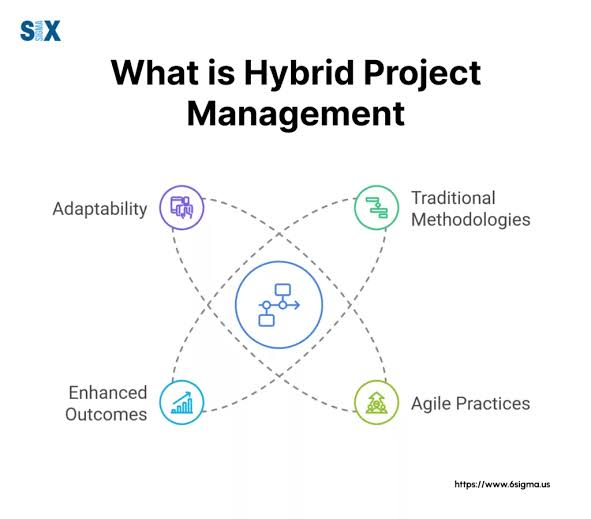
This approach captures the diversification and low-cost benefits of the ETF core while allowing for targeted higher-yield positions in sectors or companies the investor knows well. The ETF acts as a floor; the individual stocks provide incremental yield and personal engagement with specific businesses.
The right split depends entirely on your time availability, research capability, and how much you enjoy the process of analyzing individual companies. There is no universally correct ratio.
Tax Considerations That Change the Math
Individual dividend stocks and dividend ETFs are generally taxed the same way on qualified dividends — at the preferential capital gains rate rather than ordinary income rates — so the tax treatment is largely comparable for most investors in taxable accounts.
Where individual stocks have a meaningful tax advantage is in loss harvesting. If one of your individual positions declines significantly, you can sell it, realize the loss for tax purposes, and use that loss to offset gains elsewhere in your portfolio. ETFs can also be tax-loss harvested, but you cannot harvest losses on individual positions within the fund — the fund handles that internally according to its own rules.
For investors in high tax brackets with significant taxable portfolios, the flexibility to harvest individual losses is a genuine advantage of the stock-picking approach that partially offsets the higher management burden.
The Honest Verdict
For most individual investors — particularly those early in their investing journey, those with limited time for research, or those without deep expertise in financial statement analysis — dividend ETFs are the better choice. They deliver reliable, diversified income at minimal cost with essentially no ongoing management requirement. SCHD in particular has demonstrated that a quality-screened ETF can deliver competitive yields alongside genuine dividend growth without requiring any active decisions from the investor.
Individual dividend stocks are a legitimate and potentially superior approach for investors who genuinely enjoy company analysis, have the time to monitor positions carefully, understand how to evaluate dividend sustainability, and are building a portfolio over a long time horizon where the compounding of great individual businesses can work its full effect. Done well, a curated portfolio of high-quality dividend growers can outperform any ETF over twenty or thirty years. Done poorly — which describes most self-directed individual stock portfolios — it will almost certainly underperform.
The question to ask yourself honestly is not which approach sounds more appealing, but which one you will actually execute with the rigor it requires.
Frequently Asked Questions
Can dividend ETFs beat individual dividend stocks in total return?
Over long periods, the evidence generally favors low-cost index-based ETFs over self-managed individual stock portfolios for the average investor. A small number of skilled stock pickers do outperform, but identifying those individuals in advance — including identifying yourself as one of them — is genuinely difficult.
How many individual stocks do you need for adequate diversification?
Most research suggests that 20–30 stocks across different sectors provides meaningful diversification against individual company risk, though even that level of concentration leaves you far more exposed to single-stock events than a 400-stock ETF. The more concentrated your portfolio, the more important deep research on each position becomes.
Do dividend ETFs automatically reinvest dividends?
Most brokers allow you to set up automatic dividend reinvestment (DRIP) for ETF distributions, which reinvests your dividends into additional shares at no cost. Individual stocks can also be set up for DRIP through most brokers. Neither approach has a structural advantage here.
Is it better to start with ETFs and move to individual stocks later?
Many experienced income investors recommend exactly this progression. Starting with a core ETF position establishes good habits, provides market exposure, and gives you time to develop your research skills before taking on the complexity of individual stock selection.
Which is better for retirement income — ETFs or individual stocks?
For retirement, the reliability and low-maintenance nature of dividend ETFs is generally preferable. In retirement, the last thing most investors want is to be monitoring earnings reports and evaluating dividend sustainability across 30 individual positions. A well-chosen dividend ETF portfolio — particularly SCHD combined with JEPI for monthly income — can deliver dependable retirement income with minimal ongoing effort.