Categoría: Dividend ETFs

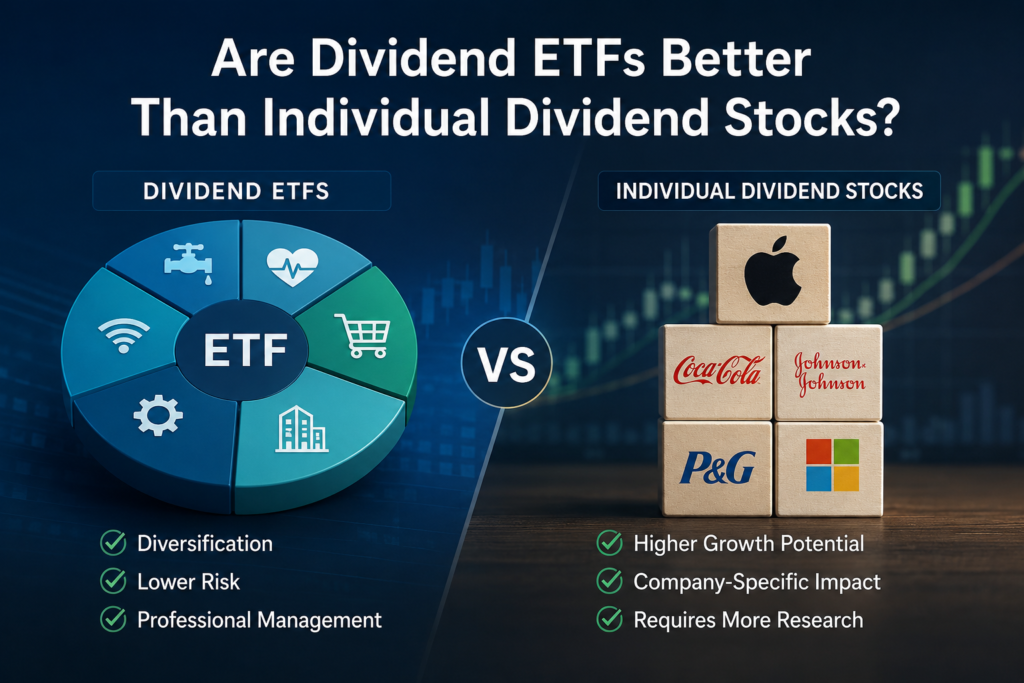
  • Are Dividend ETFs Better Than Individual Dividend Stocks?

    Are Dividend ETFs Better Than Individual Dividend Stocks?

    The short answer is: it depends on your goals, experience level, and how much time you want to spend managing your portfolio. Both dividend ETFs and individual dividend stocks can be excellent income strategies, but they work very differently and come with distinct advantages and trade-offs.

    To understand which is “better,” it helps to break the comparison into diversification, risk, returns, effort, and long-term strategy.

    1. Diversification: ETFs win easily

    Dividend ETFs such as the Schwab U.S. Dividend Equity ETF (SCHD) or the Vanguard High Dividend Yield ETF (VYM) provide instant diversification across dozens or even hundreds of dividend-paying companies.

    This means:

    • You are not overly exposed to a single company cutting its dividend
    • Sector risk is automatically balanced
    • Poor performance from one stock has minimal impact

    In contrast, individual dividend stocks require you to build diversification manually. Even if you own 15–30 stocks, you still face higher concentration risk than a broad ETF.

    For most investors, diversification is the strongest argument in favor of ETFs.

    2. Income stability: ETFs are more consistent

    Dividend ETFs tend to produce smoother, more predictable income streams. For example, funds like SCHD focus on companies with:

    • Consistent dividend histories
    • Strong balance sheets
    • Sustainable payout ratios

    This reduces the risk of sudden dividend cuts.

    Individual stocks, however, can be unpredictable. Even strong dividend companies occasionally cut payouts during recessions or company-specific crises. When that happens, your income can drop significantly if you are overly concentrated.

    ETFs spread that risk across many companies, smoothing out income over time.

    3. Return potential: individual stocks can win—but with more risk

    This is where individual dividend stocks can shine.

    If you pick strong companies early—such as Dividend Aristocrats or high-growth dividend payers—you may outperform ETFs over time. Examples include firms that consistently grow dividends faster than the market.

    However, this comes with two challenges:

    • Stock picking is difficult and time-consuming
    • A few bad picks can drag down overall returns

    Dividend ETFs like SCHD or the iShares Core High Dividend ETF (HDV) aim for steady total returns rather than trying to beat the market aggressively.

    So the trade-off is:

    • ETFs = more consistent, lower effort returns
    • Individual stocks = higher potential upside, higher risk

    4. Risk management: ETFs reduce emotional mistakes

    One of the biggest hidden advantages of dividend ETFs is behavioral.

    Investors often make mistakes with individual stocks:

    • Selling during volatility
    • Chasing high yields that are unsustainable
    • Overweighting favorite companies
    • Ignoring deteriorating fundamentals

    Dividend ETFs reduce these issues by automating selection and rebalancing. For example, funds like SPDR S&P Dividend ETF (SPYD) automatically adjust holdings based on dividend criteria.

    This structure helps investors avoid emotional decision-making, which is often more damaging than market volatility itself.

    5. Yield vs quality: different strategies

    Individual dividend stocks allow you to customize your yield strategy:

    • High yield (utilities, REITs, energy)
    • Dividend growth (tech, consumer staples)
    • Hybrid approaches

    ETFs take a rules-based approach. For example:

    • SCHD emphasizes dividend quality and growth
    • VYM focuses on broad high-dividend exposure
    • JEPI targets income through options strategies

    This means ETFs are more “set and forget,” while individual stocks require ongoing strategy decisions.

    6. Time and effort: ETFs are far simpler

    Managing a dividend stock portfolio properly requires:

    • Researching financial statements
    • Monitoring payout ratios
    • Tracking earnings reports
    • Rebalancing sectors
    • Replacing dividend cutters

    Dividend ETFs eliminate most of this work. You simply buy and hold.

    For many investors, especially beginners or long-term passive investors, this simplicity is a major advantage.

    7. Tax considerations (depending on country)

    In some cases, individual dividend stocks may offer slightly more control over tax timing. However, ETFs are generally efficient and widely used in taxable accounts.

    Funds like SCHD and VYM are structured to minimize turnover, which helps reduce taxable events.

    The difference is usually not large enough to outweigh diversification benefits for most investors.

    8. So which is better?

    It depends on your strategy:

    Dividend ETFs are better if you want:

    • Simplicity
    • Diversification
    • Stable income
    • Low maintenance
    • Long-term passive investing

    Best examples:

    • Schwab U.S. Dividend Equity ETF (SCHD)
    • Vanguard High Dividend Yield ETF (VYM)
    • iShares Core High Dividend ETF (HDV)

    Individual dividend stocks are better if you want:

    • Full control over your portfolio
    • Higher upside potential
    • Ability to target specific sectors or companies
    • Willingness to actively research and manage investments

    Final conclusion

    Dividend ETFs are generally “better” for most investors because they provide diversification, stability, and simplicity—all while delivering competitive long-term returns.

    However, individual dividend stocks can outperform ETFs if you have strong stock-picking skills and are willing to manage risk carefully.

    A common middle-ground strategy is also popular: using dividend ETFs as a core holding, then adding a smaller portfolio of individual dividend stocks for extra yield or growth potential.

    In the end, the best choice is not about which is universally superior, but which fits your time horizon, risk tolerance, and investing style.

  • The Best High-Yield Dividend ETFs This Year

    The Best High-Yield Dividend ETFs This Year

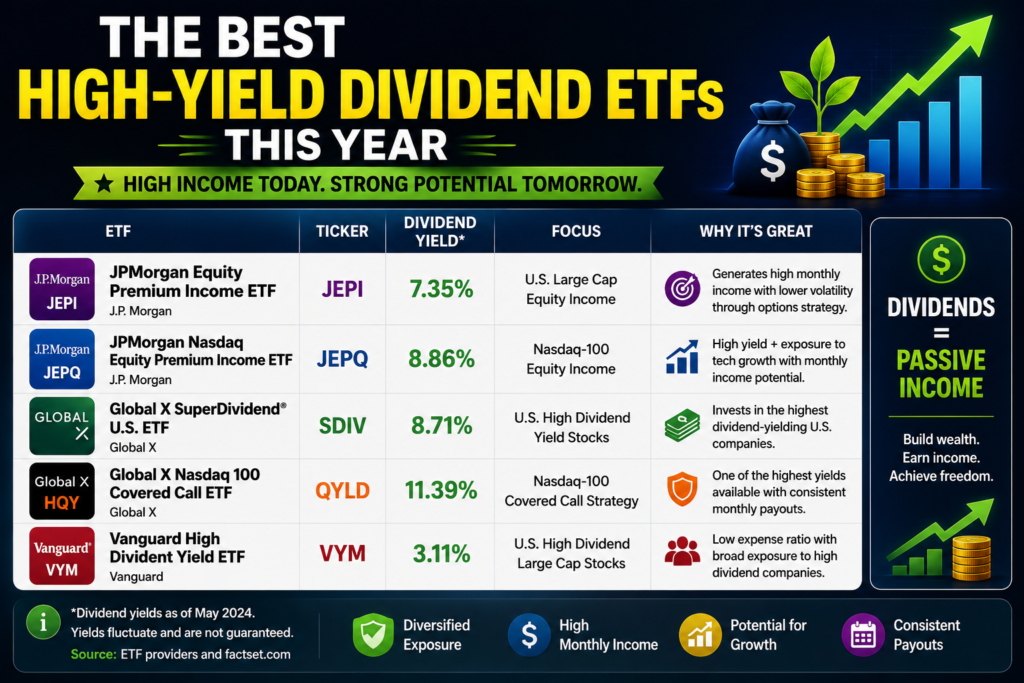
    High-yield dividend ETFs have become one of the most popular ways to generate passive income from the stock market. Instead of picking individual dividend stocks, investors can buy a single fund that distributes income from dozens—or even hundreds—of companies. However, not all high-yield ETFs are created equal. Some focus on stable dividend growth, while others prioritize maximum income, sometimes at the cost of long-term appreciation.

    In this article, we rank and analyze some of the best high-yield dividend ETFs this year based on yield, strategy, risk profile, and expense ratios. The goal is to help you understand not just which ETFs pay the most, but which ones are actually sustainable for long-term investing.

    1. Schwab U.S. Dividend Equity ETF (SCHD) – Best overall balance

    The Schwab U.S. Dividend Equity ETF (SCHD) is widely considered one of the best all-around dividend ETFs in the market today.

    SCHD focuses on high-quality U.S. companies with strong financial health, consistent dividends, and long-term growth potential. Instead of chasing the highest yield, it screens for companies with strong cash flow, return on equity, and a history of dividend payments.

    Typical yield: ~3.3%–3.8%
    Expense ratio: 0.06%

    What makes SCHD stand out is its combination of income and growth. Dividend payments tend to grow over time, meaning investors often see increasing income even if the initial yield is not the highest.

    It is especially attractive for long-term investors who want sustainable income without sacrificing capital appreciation.

    2. JPMorgan Equity Premium Income ETF (JEPI) – High monthly income

    The JPMorgan Equity Premium Income ETF (JEPI) is one of the most popular high-income ETFs due to its large monthly payouts.

    JEPI uses a covered call strategy, meaning it generates income by selling options on its equity portfolio. This allows it to produce much higher yields than traditional dividend ETFs.

    Typical yield: ~7%–9%
    Expense ratio: 0.35%

    The key advantage is consistent monthly cash flow, making JEPI especially attractive for retirees or investors who want regular income.

    However, the trade-off is upside limitation. In strong bull markets, JEPI may underperform the S&P 500 because part of its potential gains is exchanged for income.

    3. JPMorgan Nasdaq Equity Premium Income ETF (JEPQ) – Tech-focused income

    The JPMorgan Nasdaq Equity Premium Income ETF (JEPQ) is similar to JEPI but focuses on Nasdaq-100 stocks, giving it a more technology-heavy exposure.

    Typical yield: ~8%–10%
    Expense ratio: 0.35%

    Because it is more concentrated in growth-oriented tech companies, JEPQ can offer higher income potential but also higher volatility. It also uses a covered call strategy, which caps upside during strong rallies.

    JEPQ is often seen as a “higher risk, higher income” version of JEPI.

    4. Vanguard High Dividend Yield ETF (VYM) – Broad diversification

    The Vanguard High Dividend Yield ETF (VYM) is one of the most diversified high-dividend ETFs available.

    It tracks a broad index of U.S. companies with above-average dividend yields, holding hundreds of stocks across sectors like financials, healthcare, and consumer goods.

    Typical yield: ~2.8%–3.2%
    Expense ratio: 0.06%

    While its yield is lower than JEPI or JEPQ, VYM offers more stability and lower concentration risk. It is often used as a core income ETF in long-term portfolios.

    5. SPDR Portfolio S&P 500 High Dividend ETF (SPYD) – Higher yield at lower cost

    The SPDR Portfolio S&P 500 High Dividend ETF (SPYD) targets the highest-yielding stocks within the S&P 500.

    Typical yield: ~4%–4.5%
    Expense ratio: 0.07%

    SPYD provides a higher income level than VYM or SCHD but tends to be more concentrated in sectors like real estate and utilities. This can make it more sensitive during economic downturns.

    It is a simple, low-cost way to boost yield, but with less emphasis on dividend growth or quality.

    6. iShares Select Dividend ETF (DVY) – High yield with quality tilt

    The iShares Select Dividend ETF (DVY) focuses on companies with consistent dividend history and relatively high yields.

    Typical yield: ~3.5%–4%
    Expense ratio: ~0.38%

    DVY includes utilities, financials, and consumer staples heavily. While it offers attractive income, its higher expense ratio and sector concentration make it less efficient than newer ETFs like SCHD.

    Still, it remains a solid option for investors prioritizing income over growth.

    7. HDV – Defensive, quality-focused dividend ETF

    The iShares Core High Dividend ETF (HDV) screens for financially strong companies with sustainable dividends.

    Typical yield: ~2.8%–3.2%
    Expense ratio: ~0.08%

    HDV is more defensive than most high-yield ETFs, focusing on stable companies in sectors like healthcare and energy. It sacrifices yield for quality and lower volatility.

    Key comparison of top high-yield dividend ETFs

    Here is a simplified breakdown of the main ETFs:

    ETFStrategyYieldExpense RatioRisk Level
    Schwab U.S. Dividend Equity ETF (SCHD)Dividend growth + quality~3–4%0.06%Medium
    JPMorgan Equity Premium Income ETF (JEPI)Covered call income~7–9%0.35%Low–Medium
    JPMorgan Nasdaq Equity Premium Income ETF (JEPQ)Tech income + options~8–10%0.35%Medium–High
    Vanguard High Dividend Yield ETF (VYM)Broad high dividend exposure~3%0.06%Low–Medium
    SPDR Portfolio S&P 500 High Dividend ETF (SPYD)High yield S&P selection~4–4.5%0.07%Medium

    How to choose the right high-yield ETF

    The key mistake many investors make is chasing the highest yield without considering total return or sustainability.

    If your goal is long-term wealth building with steady income growth, SCHD or VYM are usually stronger core holdings. If your goal is immediate monthly cash flow, JEPI or JEPQ may be more appropriate.

    A useful rule of thumb:

    • SCHD / VYM: best for long-term compounding
    • JEPI / JEPQ: best for monthly income
    • SPYD / DVY: best for higher yield but more concentration risk

    Conclusion

    High-yield dividend ETFs offer a convenient way to generate passive income, but the “best” choice depends heavily on your time horizon and income needs.

    Schwab U.S. Dividend Equity ETF (SCHD) stands out as the most balanced long-term option due to its quality focus and low cost. Meanwhile, JPMorgan Equity Premium Income ETF (JEPI) and JPMorgan Nasdaq Equity Premium Income ETF (JEPQ) dominate the high-income space for investors prioritizing monthly cash flow.

    Ultimately, the best ETF is not just the one that pays the highest yield today—but the one that fits your strategy, risk tolerance, and long-term financial goals.

  • How Much Monthly Income Can You Generate With Dividend ETFs?

    How Much Monthly Income Can You Generate With Dividend ETFs?

    Dividend investing has become one of the most popular strategies for people looking to build passive income and achieve long-term financial freedom. Instead of constantly trading stocks or trying to predict short-term market movements, many investors prefer creating a portfolio that generates regular cash flow month after month. Dividend ETFs have made this easier than ever because they allow investors to own a diversified collection of dividend-paying companies through a single investment.

    One of the biggest reasons dividend ETFs have exploded in popularity is the idea of earning money without actively working for it. The concept sounds simple: invest money into dividend-paying assets, collect regular payouts, and slowly grow your income over time. But many beginners still wonder how much income dividend ETFs can realistically generate and whether it’s possible to live entirely from dividends one day.

    What Are Dividend ETFs?

    Dividend ETFs are exchange-traded funds that focus on companies with strong histories of paying dividends. These funds can include large, stable businesses from sectors such as healthcare, consumer goods, energy, financials, and technology. Instead of researching dozens of individual companies, investors can simply buy one ETF and instantly gain exposure to hundreds of dividend-paying stocks.

    This diversification is one of the main reasons dividend ETFs are considered safer than investing in individual dividend stocks. If one company reduces its dividend, the overall impact on the ETF is usually limited because the fund holds many different companies. For beginners, this simplicity is extremely attractive because it removes much of the complexity associated with stock picking.

    Some of the most popular dividend ETFs include SCHD, VYM, DGRO, JEPI, and VIG. Each ETF follows a different strategy. Some prioritize high yields and immediate income, while others focus more on dividend growth and long-term capital appreciation.

    Understanding Dividend Yield

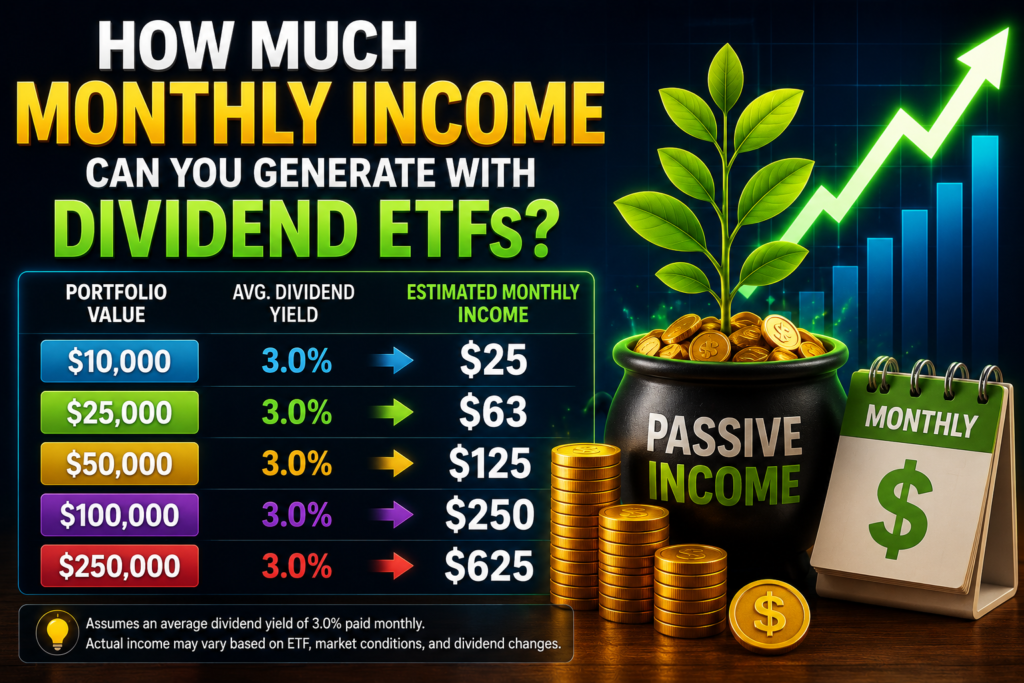
    To understand how much monthly income you can generate, it’s important to understand dividend yield. Dividend yield is the percentage of your investment that gets paid out annually in dividends. For example, if an ETF has a dividend yield of 4%, that means you earn approximately $4 per year for every $100 invested.

    If you invested $10,000 into a dividend ETF yielding 4%, your portfolio would generate around $400 annually in dividends. Dividing that by twelve gives you approximately $33 per month. While that may not seem life-changing at first, the numbers become far more interesting as your portfolio grows.

    A $50,000 portfolio at a 4% yield could generate around $167 per month. A $100,000 portfolio may produce approximately $333 monthly. Once investors reach larger portfolio sizes, the passive income can become significant. For example, a $500,000 portfolio generating a 4% yield could produce roughly $1,667 per month before taxes.

    Of course, these numbers are estimates because dividend payments fluctuate over time. Companies can increase, reduce, or temporarily suspend dividends depending on economic conditions. Market performance also affects ETF prices and overall yields.

    Why Higher Dividend Yields Aren’t Always Better

    One important thing investors quickly discover is that higher dividend yields are not always better. Many beginners get attracted to ETFs offering extremely high yields, sometimes above 10%, believing they’ve found the fastest path to passive income. However, high yields often come with additional risk. In many cases, these ETFs experience slower long-term growth, higher volatility, or unstable payouts.

    This is why many experienced investors prefer dividend growth ETFs instead of simply chasing the highest possible yield. Dividend growth ETFs focus on companies that consistently increase their dividend payments year after year. While these funds may initially offer lower yields, they often produce better long-term results because the income stream continues growing over time.

    For example, an ETF yielding 3% today but increasing dividends annually may eventually generate far more income than a stagnant high-yield ETF. This strategy also helps investors fight inflation because rising dividend payments can offset increasing living costs over time.

    The Power of Compounding

    Another major advantage of dividend ETFs is compounding. Reinvesting dividends instead of withdrawing them can dramatically accelerate portfolio growth. When dividends are reinvested, investors buy additional shares of the ETF, which then generate even more dividends in the future. Over long periods, this creates a powerful snowball effect.

    This is why time is one of the most important factors in dividend investing. Someone investing consistently for twenty years may end up generating far more passive income than someone who invests a larger amount for only a few years. The earlier an investor starts, the more powerful compounding becomes.

    Many long-term investors focus less on short-term income and more on steadily increasing their portfolio size. Over time, this strategy can transform relatively small monthly investments into a substantial passive income stream.

    Monthly Dividend ETFs

    Many investors prefer ETFs that pay monthly dividends because they create more consistent cash flow. Traditional dividend ETFs often pay quarterly, meaning investors receive four payments per year. Monthly dividend ETFs distribute income every month, which feels more similar to earning a paycheck.

    Popular monthly dividend ETFs include JEPI, JEPQ, and QYLD. These funds have become especially popular among retirees and income-focused investors. However, monthly-paying ETFs are not automatically better. Some sacrifice long-term growth in exchange for higher immediate income, so understanding the underlying strategy is important before investing.

    For investors focused on long-term wealth building, combining monthly income ETFs with dividend growth ETFs can sometimes create a more balanced portfolio.

    How Much Money Do You Need to Earn $1,000 Per Month?

    A common question people ask is how much money they need to generate $1,000 per month in passive income. The answer depends entirely on portfolio yield. At a 4% dividend yield, an investor would need approximately $300,000 invested to generate around $12,000 annually, or about $1,000 monthly before taxes.

    At a 5% yield, the required investment drops closer to $240,000. At a 6% yield, the required amount may fall near $200,000. However, higher yields usually involve higher risks, which is why many investors avoid chasing the absolute highest payouts.

    While these numbers may seem intimidating, many investors build these portfolios gradually through consistent monthly investing. Contributing regularly over years or decades can slowly transform a small portfolio into a meaningful passive income machine.

    Risks of Dividend ETFs

    Dividend ETFs are not a guaranteed path to wealth, and they still carry risks. Markets can decline, companies can cut dividends, and economic downturns can temporarily reduce income. Inflation is another challenge because it can reduce the purchasing power of dividend payments over time.

    High-yield ETFs may also experience more volatility or weaker long-term performance compared to broader market funds. This is why diversification and patience remain extremely important for dividend investors.

    Understanding risk is essential because many people assume dividend investing is completely safe. While dividend ETFs are often less risky than individual stock picking, they still require a long-term mindset.

    Are Dividend ETFs Worth It?

    Despite the risks, dividend ETFs remain one of the most attractive strategies for investors seeking passive income and long-term financial stability. They offer diversification, simplicity, and the ability to generate cash flow without needing to constantly trade or monitor the market every day.

    For many investors, dividend ETFs are not about getting rich quickly. They are about building freedom slowly and consistently. The goal is often to create a portfolio that eventually covers expenses, reduces financial stress, or provides greater flexibility in life.

    Whether your goal is earning an extra $100 per month, funding retirement, or eventually replacing your salary entirely, dividend ETFs can play an important role in achieving financial independence.

    Final Thoughts

    Dividend ETFs have become one of the easiest and most accessible ways to build passive income in the stock market. They allow investors to generate regular cash flow while also benefiting from long-term market growth and compounding.

    The amount of monthly income you can generate depends on your investment size, portfolio yield, and how long you stay invested. While the passive income may seem small in the beginning, consistent investing and reinvesting dividends can significantly increase income over time.

    The most important thing is starting early and staying consistent. Many successful dividend investors didn’t begin with huge portfolios. They built them gradually through patience, discipline, and long-term investing.

    Over time, even modest investments can grow into powerful income-producing portfolios capable of supporting financial independence and long-term wealth creation.

  • SCHD vs VYM: Which Dividend ETF Pays Better?

    SCHD vs VYM: Which Dividend ETF Pays Better?

    1. Introduction: The Battle of the Income Titans

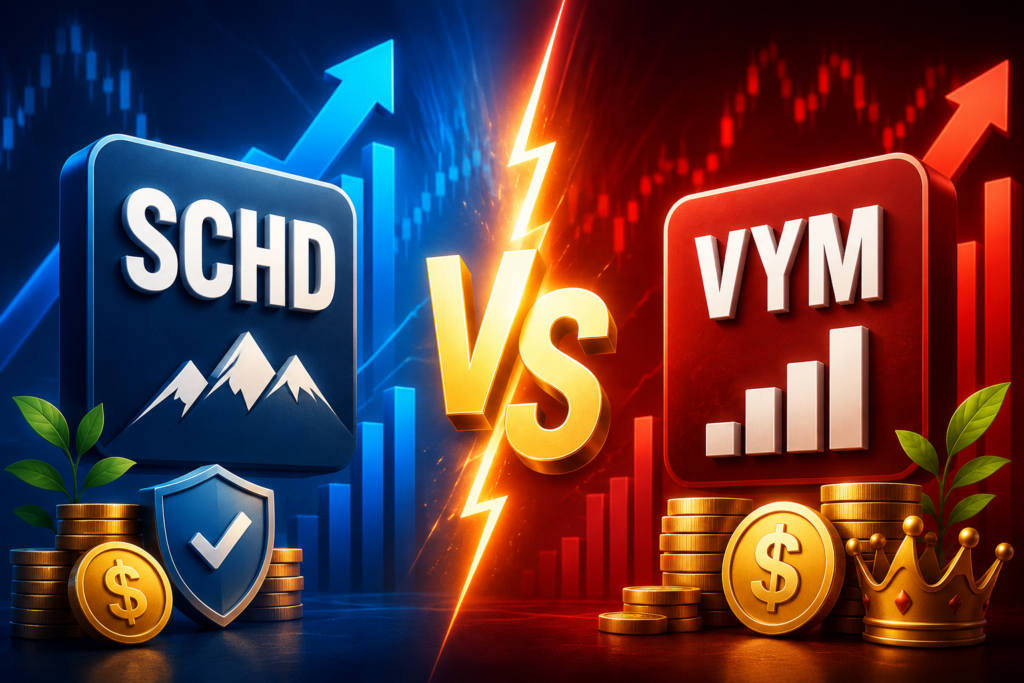
    When building a reliable stream of passive income, two heavyweights consistently dominate the conversation: the Schwab U.S. Dividend Equity ETF (SCHD) and the Vanguard High Dividend Yield ETF (VYM). For years, investors have debated which of these funds deserves the crown as the ultimate income vehicle.

    While both funds are designed to put cash directly into your brokerage account, they achieve this goal using entirely different financial blueprints. To determine which ETF truly «pays better,» we have to look far beyond the current superficial yield. We must analyze how they generate their distributions, how fast those payouts grow, and how sustainable they are against changing macroeconomic cycles.

    2. Under the Hood: Two Contrasting Strategies

    The fundamental difference between these two exchange-traded funds lies in their selection criteria. They view the entire universe of dividend-paying stocks through completely different lenses, resulting in distinct portfolio DNAs.

    SCHD: The Quality Growth Model

    SCHD tracks the Dow Jones U.S. Dividend 100 Index. It does not simply sort the market by the highest available yield. Instead, it filters companies through a strict, multi-layered fundamental quality matrix. To make it into SCHD, a stock must pass through stringent screens evaluating:

    • Cash flow-to-total debt ratios (financial health).
    • Return on Equity (ROE) to measure operational efficiency.
    • Total indicated dividend yield.
    • A mandatory track record of consistent 5-year dividend growth.

    This rigorous process creates a leaner, high-conviction portfolio of roughly 100 stocks. It eliminates distressed companies that are paying out unsustainably high percentages of their earnings—commonly known as dividend traps.

    VYM: The Broad Market Yield Model

    In contrast, Vanguard’s VYM takes a much simpler, more inclusive, and broad-market approach. It tracks the FTSE High Dividend Yield Index, which essentially ranks all dividend-paying US stocks by their yield and purchases the top half of that list (excluding Real Estate Investment Trusts, or REITs).

    Because it is a market-capitalization-weighted fund, the biggest, most mature corporate giants dictate the portfolio’s direction. With over 450 holdings, VYM favors massive diversification over strict quality screening, betting on the aggregate stability of the US mega-cap value sector.

    3. Head-to-Head Metrics Dashboard

    To see how these structural differences play out in real terms, let’s look at the operational breakdown of both funds side by side:

    Financial MetricSchwab U.S. Dividend Equity (SCHD)Vanguard High Dividend Yield (VYM)
    Portfolio Composition~100 highly screened stocks~450+ diversified stocks
    Expense Ratio0.06% (Ultra-low cost)0.06% (Ultra-low cost)
    Top Sector AllocationsFinancials, Healthcare, IndustrialsFinancials, Consumer Staples, Industrials
    Weighting MethodologyFundamental quality & yield modifiedMarket-capitalization weighted
    Concentration RiskHigher (Top 10 holdings make up ~40%)Lower (Highly diversified across mega-caps)
    Dividend Growth RateHistorically higher (Strong double-digit pace)Steady, but more moderate

    4. Evaluating the Payout: Who Wins?

    To answer which ETF «pays better,» we have to define your specific investment timeline, because the winner changes completely depending on when you need to spend the cash.

    The Verdict for Immediate Income Seekers: VYM

    If you are retiring today or need maximum cash flow to cover your current living expenses, VYM often takes the lead. Because its index targets the higher-yielding half of the market without strict historical growth requirements, it frequently offers a slightly higher or more stable baseline starting yield during market transitions.

    Furthermore, because it holds over 450 stocks, its aggregate payout is incredibly well-insulated. If a single corporation suffers a bad year and cuts its dividend, it represents a tiny fraction of VYM’s portfolio. It provides steady, predictable, mega-cap-backed cash flow for immediate consumption.

    The Verdict for Long-Term Compounders: SCHD

    If you have a time horizon of 5, 10, or more years, SCHD is the clear winner. While VYM gives you a solid yield today, SCHD’s strict mandate for 5-year dividend growth means its payout increases at a significantly faster compounding rate.

    Because SCHD selects cash-rich companies that aggressively hike their payouts year after year, your yield-on-cost (the dividend yield relative to the price you originally paid for the shares) will quickly surpass VYM’s. Over a decade, SCHD’s exponential dividend growth rate acts as a massive compounding accelerator, outpacing inflation and building a much larger absolute stream of passive income for the future.

    5. Final Strategic Takeaway

    The choice shouldn’t be based on which fund is popular, but on how its payout matches your financial goals:

    Choose SCHD if: You are in your wealth-accumulation phase, want a growth-tilted dividend portfolio, and want your passive income stream to aggressively compound and outpace inflation over the next decade.

    Choose VYM if: You value maximum diversification, prefer a smoother ride with less top-heavy concentration risk, and need reliable, immediate mega-cap yield to fund your current lifestyle.

    For many sophisticated income investors, the ultimate solution isn’t choosing one over the other, but rather blending both—using VYM as a stable, diversified foundation and SCHD as the dividend growth turbocharger.

  • Best Dividend ETFs for Passive Income in 2026

    Best Dividend ETFs for Passive Income in 2026

    Maximizing Yield and Stability in a Maturing Market Environment

    1. The Passive Income Landscape in the Second Half of 2026

    As we enter the second half of 2026, the global macroeconomic landscape has entered a phase of stabilization. Following years of fluctuating interest rates and tech-driven valuation spikes, the broader market is shifting its focus toward corporate balance sheet health and consistent cash flow generation. High-growth sectors no longer enjoy free-flowing capital based on promises alone; instead, institutional and retail investors alike are demanding tangible returns.

    For income-focused investors, this environment marks a golden era for Dividend Exchange-Traded Funds (ETFs). With corporate cash reserves at healthy levels and traditional fixed-income yields normalizing, dividend growth equities offer a compelling dual advantage: a reliable stream of passive income and a robust hedge against persistent core inflation. Utilizing ETFs allows investors to capture these steady cash flows across hundreds of high-quality corporations while eliminating the single-stock vulnerability inherent in building an isolated portfolio.

    2. Core Pillars of a Winning Dividend ETF Strategy

    Not all dividend yields are created equal. In 2026, chasing the highest absolute percentage yield without looking under the hood can lead investors straight into «dividend traps»—companies paying out unsustainably high percentages of their earnings while their underlying business deteriorates. To build a resilient passive income stream today, a top-tier dividend ETF must rely on three core pillars:

    • Dividend Aristocracy and Continuity: Prioritizing funds that target companies with a proven track record of increasing their dividend payouts consecutively for 10, 25, or even 50 years. This guarantees the underlying businesses possess durable competitive moats.
    • Balance Sheet Quality Filters: Ensuring the fund uses strict screening metrics, such as sustainable payout ratios (typically below 60%) and healthy debt-to-equity metrics, to safeguard the portfolio against sudden dividend cuts during economic slowdowns.
    • Sectoral Diversification: Avoiding heavy overconcentration in a single high-yielding sector, such as regional banking or traditional utilities, by spreading exposure across cash-rich consumer staples, energy, industrials, and mature technology giants.

    3. Top Dividend ETF Picks for the Remainder of 2026

    The following exchange-traded funds represent the most liquid, structurally sound, and strategically diversified vehicles for generating reliable passive income in the current market climate.

    Vanguard Dividend Appreciation ETF (Ticker: VIG)

    • Expense Ratio: 0.06%
    • Primary Focus: Dividend Growth and High-Quality Large-Caps

    VIG remains the gold standard for long-term compounders. Rather than seeking out the highest immediate yields, VIG tracks the S&P U.S. Dividend Growers Index, which requires components to have at least 10 consecutive years of increasing regular dividend payments. The fund completely excludes the top 25% highest-yielding companies to intentionally eliminate dividend traps. Because it filters out highly volatile or distressed firms, VIG tilts toward premium, cash-flow-heavy tech, industrial, and financial giants, making it an exceptional foundational asset for total return and income growth.

    Schwab U.S. Dividend Equity ETF (Ticker: SCHD)

    • Expense Ratio: 0.06%
    • Primary Focus: High Yield and Fundamental Quality Screening

    SCHD is a consensus favorite for a reason. It tracks the Dow Jones U.S. Dividend 100 Index, applying a strict fundamental matrix that evaluates cash flow-to-total debt, return on equity (ROE), indicated dividend yield, and 5-year dividend growth rates. This multi-layered quantitative filter results in a portfolio that boasts an attractive, above-market immediate yield without sacrificing financial quality. Its strong exposure to value-oriented sectors like energy, financials, and consumer defensive stocks provides excellent ballast during market turbulence.

    SPDR S&P Dividend ETF (Ticker: SDY)

    • Expense Ratio: 0.35%
    • Primary Focus: Elite S&P Dividend Aristocrats

    For investors prioritizing pure payout reliability, SDY offers elite peace of mind. The fund tracks the S&P High Yield Dividend Aristocrats Index, selecting companies from the broader S&P Composite 1500 that have followed a controlled policy of increasing dividends every year for at least 20 consecutive years. Furthermore, SDY weights its components by yield rather than market capitalization, giving income seekers enhanced exposure to the cash-generating workhorses of the mid- and large-cap US economy.

    4. Strategic Implementation: Reinvestment vs. Distribution

    When managing a dividend ETF portfolio in the latter half of 2026, your tactical implementation should align perfectly with your current financial lifecycle phase:

    The Accumulation Phase (Wealth Building)

    If you do not currently rely on your portfolio to cover daily living expenses, the optimal path is to activate an automated Dividend Reinvestment Plan (DRIP). Reinvesting your quarterly payouts back into the ETF triggers a powerful compounding loop. You systematically purchase more fractional shares, which in turn generate larger future dividend payouts, exponentially accelerating your wealth building over time.

    The Distribution Phase (Living Off Income)

    For retirees or those utilizing their portfolio as an active secondary income stream, dividends can be directed straight into a cash account. Unlike selling down principal shares to fund lifestyle costs—which exposes you to sequence-of-returns risk during market downturns—living off ETF distributions preserves your underlying shares intact, allowing your capital core to keep growing.

    5. Conclusion

    Securing a stable stream of passive income for the final quarters of 2026 requires a deliberate focus on dividend safety, quality screening, and cost efficiency. Low-cost powerhouses like SCHD provide an ideal combination of immediate yield and quality, while VIG protects your purchasing power against long-term inflation through steady dividend growth. By incorporating these institutional-grade vehicles into your broader financial framework and pairing them with a disciplined dollar-cost averaging approach, you can successfully navigate changing market cycles while watching your automated income streams compound securely.