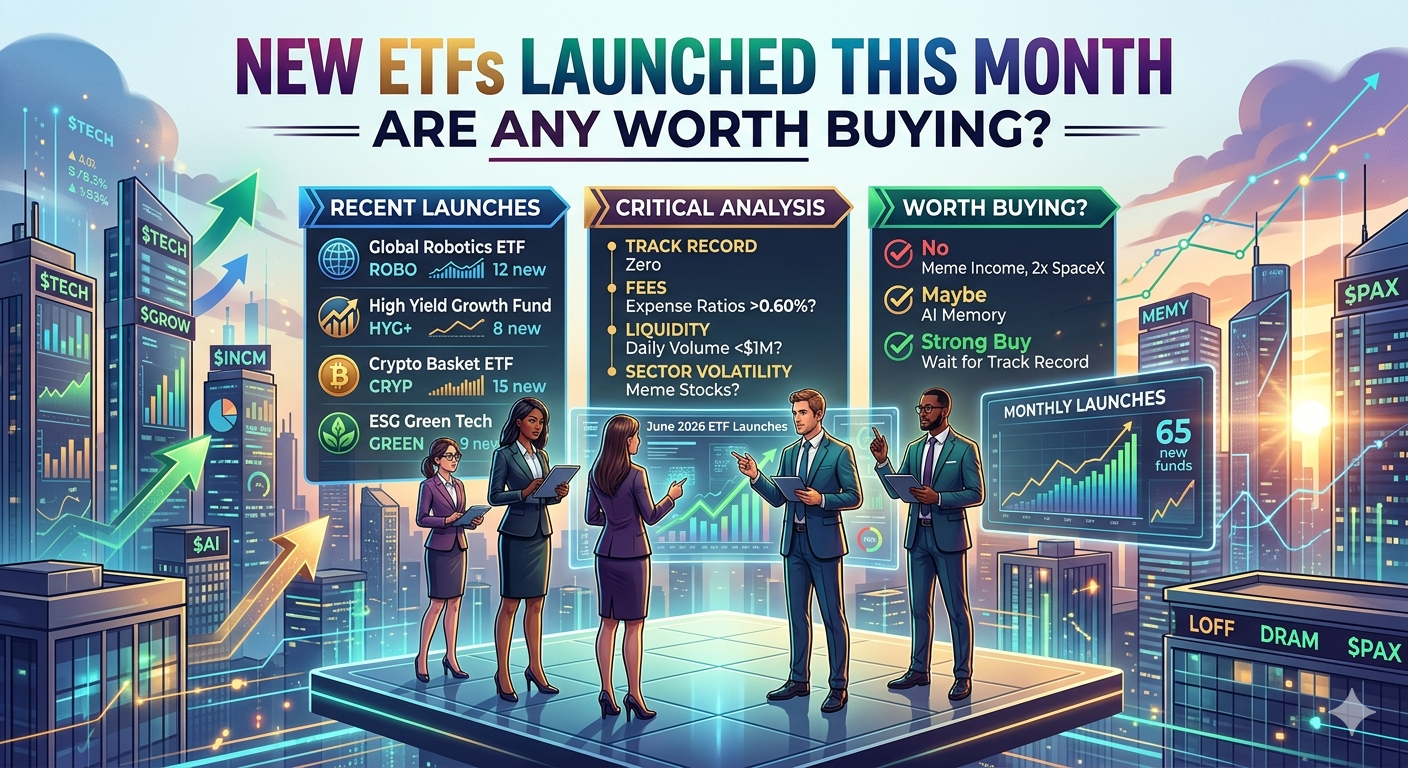
The exchange-traded fund (ETF) industry in 2026 continues to accelerate at a pace that would have been difficult to imagine a decade ago. New products are no longer launched in small, carefully curated batches. Instead, issuers are releasing ETFs in waves—often tied to fast-moving narratives such as artificial intelligence, private-market innovation, space commercialization, and leveraged single-stock speculation.
June 2026 has been particularly active. A wide range of new ETFs has entered the market, reflecting both intense competition among issuers and strong investor appetite for thematic exposure. But this rapid expansion also raises an important question for investors: are any of these newly launched ETFs actually worth buying, or are they mostly marketing-driven products designed for short-term trading flows?
The answer is more nuanced than a simple yes or no. While a handful of new ETFs may have legitimate long-term roles in diversified portfolios, the majority are highly specialized instruments that require careful evaluation before committing capital.
The ETF Boom Has Become a Product Factory
To understand the current environment, it helps to recognize how the ETF industry has evolved. ETFs were originally designed as low-cost, passive vehicles for tracking broad indexes. Today, however, they function more like financial product platforms, where issuers compete to package nearly any investable idea into a tradable fund.
This shift has led to three major structural changes:
First, the cost of launching an ETF has dropped significantly. This has encouraged issuers to experiment aggressively with niche strategies that would previously never have reached market.
Second, investor demand has become increasingly theme-driven. Retail and institutional investors alike are now more willing to allocate capital based on narratives such as AI disruption, defense modernization, or space exploration.
Third, liquidity and trading volume have become more important than long-term fund stability in the early life of many ETFs. As a result, issuers often prioritize attention-grabbing strategies that can quickly gather assets.
This environment naturally produces a high number of speculative or narrowly focused ETFs alongside genuinely useful investment products.
A Wave of Highly Speculative ETF Launches
One of the most visible trends in June 2026 is the rise of single-stock leveraged ETFs, particularly those tied to high-profile private and pre-IPO companies.
A major example is the emergence of leveraged ETFs tied to SpaceX exposure, including both bullish and bearish versions designed to deliver 2x daily returns. These funds are structured for short-term tactical trading rather than long-term investing. They reset daily, which means their performance can diverge significantly from the underlying asset over time, especially in volatile markets.
While these ETFs attract attention due to the popularity of the underlying companies, their structure introduces significant risk. Volatility decay, compounding effects, and rapid directional reversals can erode returns even when the long-term direction of the underlying asset is correct.
In practical terms, these ETFs behave more like short-term derivatives than traditional investment vehicles. They are best understood as high-risk trading instruments rather than portfolio allocations.
The Continued Dominance of Artificial Intelligence Themes
Despite the rise of speculative products, the most influential thematic driver in 2026 remains artificial intelligence. Nearly every ETF launch cycle this year has included some variation of AI exposure, ranging from semiconductor supply chain funds to broader “AI infrastructure” baskets.
The reason for this persistent focus is straightforward: AI is not a single industry but a multi-layered economic transformation. It spans hardware manufacturing, cloud computing, enterprise software, energy consumption, and even data center real estate.
As a result, ETF issuers have created increasingly granular products to capture different segments of the AI value chain. Some funds focus narrowly on chipmakers and semiconductor equipment providers. Others include hyperscale cloud providers, networking infrastructure, or even power grid modernization companies supporting data center expansion.
However, this proliferation creates a new challenge: overlap and redundancy. Many AI ETFs now hold extremely similar underlying positions, particularly in dominant mega-cap companies. This reduces diversification benefits and increases concentration risk across multiple products that appear distinct on the surface.
For investors, the key question is no longer whether AI ETFs are relevant, but whether a new ETF offers genuinely differentiated exposure or simply repackages existing holdings.
Fixed Income ETFs Quietly Become the Most Practical Launches
While thematic ETFs dominate headlines, some of the most structurally useful new products in 2026 are found in fixed income.
New bond ETFs launched this month include short-duration income strategies, securitized credit exposure funds, and tax-advantaged municipal bond ETFs. These products are not as attention-grabbing as AI or space-themed ETFs, but they serve a more stable and predictable role in portfolios.
The appeal of these ETFs lies in their ability to provide yield while managing interest rate risk. After several years of volatility in global bond markets, investors have become more selective about duration exposure. As a result, short-duration and flexible income strategies have seen steady inflows.
Unlike speculative thematic ETFs, fixed income ETFs tend to have clearer investment objectives. They are designed to generate income, reduce volatility, or provide liquidity rather than capitalize on narrative-driven growth themes.
In many ways, these funds represent the most “traditional” use of ETFs in today’s market, even as the broader industry moves toward increasingly complex strategies.
The Rise of Impact and Niche Thematic Funds
Another notable development in June 2026 is the continued expansion of highly specialized thematic and impact-focused ETFs. These include funds targeting social outcomes, specific demographic themes, or narrow segments of the global economy.
While these ETFs often attract attention for their uniqueness, their investment case is more complicated. Many of these funds are built around narrow universes of companies, which can lead to concentration risk and limited liquidity. Additionally, thematic durability is not guaranteed. A strong narrative today may lose relevance as market attention shifts elsewhere.
That said, certain niche ETFs can play a useful role in a broader portfolio when used selectively. For example, infrastructure-related ETFs tied to long-term government spending cycles or demographic trends may offer more stable thematic exposure than highly specialized or single-issue funds.
The key distinction is whether the ETF is anchored in a structural economic trend or a short-term narrative cycle. Only the former tends to hold up over longer investment horizons.
Why New ETFs Are Often Not Ideal Core Holdings
One of the most important realities for investors to understand is that newly launched ETFs are rarely designed as core portfolio holdings. Instead, they are typically built to capture interest in emerging trends or to test market demand for new strategies.
There are several reasons for this.
New ETFs often have limited track records, which makes it difficult to assess performance across different market environments. They may also have smaller asset bases, leading to higher trading spreads and less efficient price discovery.
Additionally, many new ETFs are designed around very specific themes or strategies that may not provide broad diversification benefits. While they can offer targeted exposure, they rarely function as standalone portfolio foundations.
As a result, financial advisors typically recommend treating new ETFs as satellite positions, if they are used at all.
So, Are Any of the New ETFs Worth Buying?
The answer depends on how “worth buying” is defined.
If the goal is long-term portfolio construction, only a limited subset of new ETFs meet the criteria for consideration. These generally fall into three categories:
First, broad fixed income ETFs, which offer income stability and risk management benefits.
Second, carefully constructed AI infrastructure ETFs, provided they avoid excessive overlap and concentration in a handful of mega-cap stocks.
Third, broad market diversification funds, such as regional or small-cap index ETFs that expand exposure beyond dominant large-cap indices.
By contrast, leveraged single-stock ETFs, narrowly focused thematic funds, and narrative-driven speculative products are generally more appropriate for short-term trading strategies rather than long-term investment portfolios.
Final Perspective: Innovation vs. Discipline
The ETF market in 2026 reflects a broader tension in modern investing. On one hand, innovation has made it easier than ever to access targeted exposures, reduce costs, and diversify across asset classes. On the other hand, the sheer volume of new products has made it harder to distinguish between durable investment tools and short-lived financial experiments.
In this environment, the key skill for investors is not simply selecting ETFs, but filtering them. Understanding what problem an ETF is actually solving—whether it is income generation, diversification, thematic exposure, or speculation—is more important than the narrative surrounding it.
New ETFs will continue to flood the market throughout 2026. Some will grow into important long-term investment vehicles. Many will fade into obscurity. The challenge for investors is not to chase every new launch, but to identify the few that meaningfully improve portfolio construction.
Deja una respuesta