
Last updated: June 2026
BOTZ, AIQ, and ROBO are the three most-searched AI and robotics ETFs on the market, and for good reason — each one gives investors a different way to play the artificial intelligence boom. But «different» doesn’t mean «interchangeable.» One is built around mega-cap concentration, another spreads risk across dozens of mid-cap names, and the third blends software with hardware in a way the others don’t.
This article puts all three head-to-head using the same data points — returns, cost, holdings, and risk — so you can see exactly where each one wins and where it falls short.
Disclaimer: This article is for informational and educational purposes only and does not constitute financial advice. Past performance does not guarantee future results. Thematic ETFs like these are concentrated and can be highly volatile. Always do your own research and consider speaking with a licensed financial advisor before investing.
The three funds at a glance
| BOTZ | AIQ | ROBO | |
|---|---|---|---|
| Full name | Global X Robotics & AI ETF | Global X AI & Technology ETF | ROBO Global Robotics & Automation ETF |
| Issuer | Global X (Mirae Asset) | Global X (Mirae Asset) | ROBO Global |
| Focus | Industrial robotics + AI hardware | Broad AI ecosystem (software + hardware) | Global robotics & automation, equal-weighted |
| Expense ratio | 0.68% | 0.68% | 0.95% |
| AUM | ~$3.5B | ~$10.8–10.9B | ~$1.5–2B |
| Number of holdings | ~63–67 | ~85–90 | ~80–90 |
| Weighting method | Market-cap | Market-cap | More evenly weighted |
Source: ETF.com comparison tool, Global X official fund pages, ROBO Global official fund page. Figures reflect data available as of June 2026 and change daily.
Performance: how have they actually done?
This is where the three funds really separate. According to ETF.com’s side-by-side comparison data:
- BOTZ: roughly 3.75% over 1 year, 22.91% annualized over 3 years, and 8.67% annualized over 5 years
- AIQ: roughly 26.48% over 1 year, 53.73% annualized over 3 years, and 16.94% annualized over 5 years
- ROBO: roughly 27.9% YTD in 2026, with longer-term annualized returns historically trailing AIQ but, in some recent stretches, outpacing BOTZ
AIQ has been the standout performer on a multi-year basis. Its broader exposure to AI software and infrastructure — not just robotics hardware — has captured more of the run-up in enterprise AI spending than the more industrial, hardware-heavy BOTZ portfolio.
That said, short-term snapshots can flip quickly. Independent trackers comparing the two funds over shorter windows have shown periods where BOTZ outperformed AIQ on a year-to-date basis, and vice versa — a reminder that these are volatile, fast-moving funds where the «winner» depends heavily on which exact period you measure.
Risk-adjusted performance: which fund rewards you for the risk you’re taking?
Returns alone don’t tell the whole story — a fund that returns more but swings wildly isn’t necessarily «better» on a risk-adjusted basis. Using Sharpe ratio data (which measures return relative to volatility) from independent trackers:
- AIQ has shown a noticeably higher Sharpe ratio than BOTZ in recent 12-month windows, suggesting its returns have come with comparatively less volatility per unit of return.
- BOTZ has a longer history of sharper drawdowns — its maximum drawdown since inception has exceeded -55% at points, reflecting how punishing thematic, concentrated funds can be during tech corrections.
- ROBO’s more diversified, equal-weighted approach across small- and mid-cap names has historically produced smoother — but not necessarily better — long-term returns than BOTZ’s mega-cap concentration.
Holdings: what are you actually buying?
BOTZ — concentrated in robotics hardware
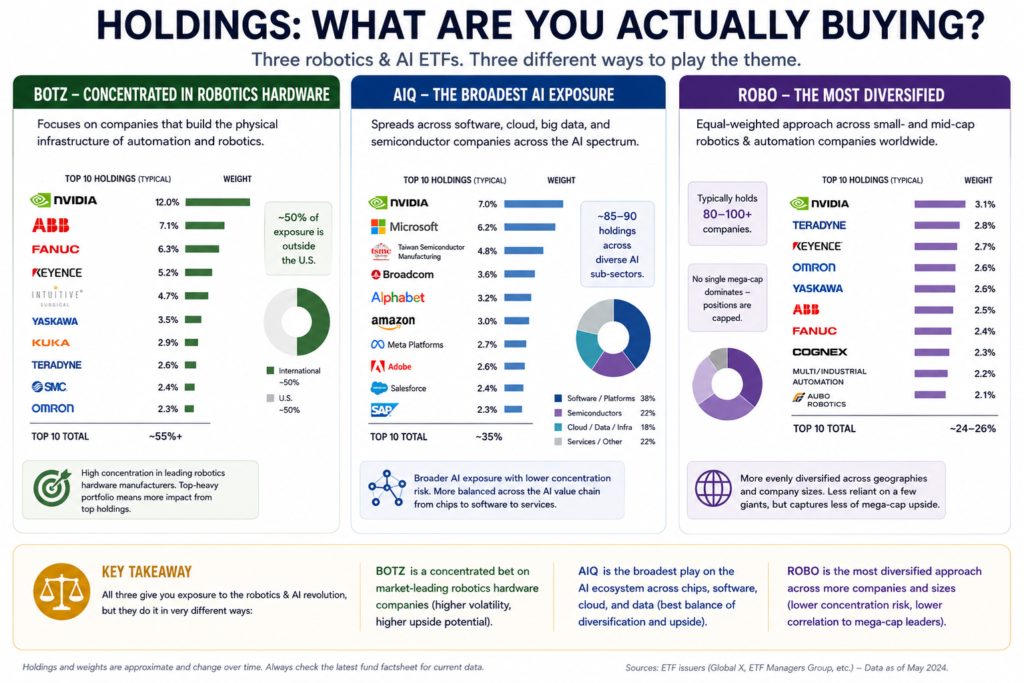
BOTZ’s portfolio centers on companies that build the physical infrastructure of automation: NVIDIA, ABB, Fanuc, Keyence, and Intuitive Surgical typically dominate the top of the list, with the top 10 holdings often accounting for more than half the fund. Roughly half of BOTZ’s exposure sits outside the U.S., particularly in Japan and Switzerland — home to several of the world’s leading industrial robotics manufacturers.
(Because BOTZ leans so heavily on the physical and hardware layer to power its robotics thesis, many investors find themselves wondering if they should target the chip supply chain directly. If you want to bypass the robotics side and focus purely on the silicon powering these engines, see our breakdown of The Top Semiconductor ETFs Benefiting From the AI Boom to compare the industry’s heaviest hitters).
AIQ — the broadest AI exposure of the three
AIQ spreads its roughly 85–90 holdings across software, cloud computing, big data, and semiconductor companies, including names like major chipmakers alongside enterprise software platforms. Its top 10 holdings make up a smaller share of the total fund than BOTZ’s — around 35% versus BOTZ’s 55%+ — meaning a single stock’s bad quarter has comparatively less impact on AIQ.
ROBO — the most diversified of the three
ROBO takes a different construction approach entirely: rather than market-cap weighting, it spreads exposure more evenly across small- and mid-cap robotics and automation companies globally. This reduces reliance on any single mega-cap name but also means ROBO captures less of the upside when a handful of giants (like NVIDIA) are driving most of the sector’s gains.
Cost: the one number that never changes in your favor
| Fund | Expense ratio | Annual cost on $10,000 |
|---|---|---|
| BOTZ | 0.68% | $68 |
| AIQ | 0.68% | $68 |
| ROBO | 0.95% | $95 |
BOTZ and AIQ are priced identically since both come from the same issuer, Global X. ROBO carries the highest cost of the three by a meaningful margin — nearly 40% more expensive annually than its two competitors. That gap compounds over a 10-20 year holding period, so ROBO needs to deliver a real diversification benefit to justify the extra cost.
So, which one is actually «winning» in 2026?
It depends on what you’re measuring:
- Best multi-year returns: AIQ, by a clear margin over both 3-year and 5-year windows.
- Best risk-adjusted returns: Also AIQ, based on recent Sharpe ratio data.
- Lowest cost: A tie between BOTZ and AIQ at 0.68%.
- Best diversification within robotics specifically: ROBO, thanks to its equal-weighted, small/mid-cap approach — though you pay for it with a higher expense ratio and historically more muted upside capture.
- Most direct exposure to humanoid robotics and industrial automation: BOTZ, given its concentration in pure-play robotics manufacturers.
For investors who want the single most efficient way to capture the broad AI trade, AIQ has the strongest combination of performance, lower concentration risk, and reasonable cost among the three. For investors who specifically want robotics and automation exposure as a standalone thematic bet — rather than broad AI — BOTZ remains the more direct, liquid choice. ROBO is harder to justify unless diversification within the robotics sub-sector specifically matters more to you than cost or recent performance.
Can you hold more than one?
Yes, but check for overlap first. BOTZ and AIQ are both issued by Global X and share some of the same mega-cap names — NVIDIA shows up near the top of both. Combining them doesn’t necessarily double your diversification; it can simply double your exposure to the same handful of companies. If you want true diversification across this theme, pairing AIQ (broad AI) with ROBO (small/mid-cap robotics) avoids more overlap than pairing AIQ with BOTZ.
Frequently asked questions
Is BOTZ or AIQ better for beginners? Neither fund is designed as a «starter» holding — both are concentrated, thematic ETFs best used as a smaller satellite position (commonly cited around 5–10% of a portfolio) alongside a diversified core like a total market or S&P 500 fund. Between the two, AIQ’s broader holdings base and lower historical volatility make it the somewhat gentler option of the two.
Why does ROBO cost more than BOTZ and AIQ? ROBO’s higher 0.95% expense ratio partly reflects its more labor-intensive, equal-weighted index construction across a global universe of small- and mid-cap companies, compared to the simpler market-cap-weighted approach used by BOTZ and AIQ.
Has AIQ always outperformed BOTZ? No. Over short-term windows, the order has flipped multiple times — there have been year-to-date and even 1-year stretches where BOTZ has outpaced AIQ. The multi-year trend (3-year and 5-year annualized returns) has favored AIQ, but past performance over any specific window is not a reliable predictor of future results.