
Last updated: June 2026 | Reading time: 9 min
Disclaimer: This article is for informational and educational purposes only. Nothing here constitutes financial advice. Past performance is not a guarantee of future results. Always consult a licensed financial advisor before making investment decisions.
ETF Portfolio for Beginners: $1,000 Is More Than Enough to Start
One of the most persistent myths in personal finance is that you need a large amount of money to start investing seriously. Building an ETF portfolio for beginners, however, requires far less than most people think. A $1,000 ETF portfolio, built correctly and added to consistently over time, can grow into a life-changing amount of wealth over 20 or 30 years. The math of compounding does not care how small your starting balance is — it only cares how long you let it run and how much of your return you keep by minimizing fees.
Furthermore, the challenge with $1,000 is not finding the money. Instead, it is resisting the temptation to overcomplicate things. With a small initial investment, the single most important decision is not which ETF is theoretically optimal — it is starting at all, choosing a simple structure you will actually stick with, and adding to it regularly.
This guide shows you exactly how to build a simple, globally diversified ETF portfolio for beginners with $1,000, which accounts to use, which ETFs to buy, and how to think about growing it from there.
Step One: Choose the Right Account
Before you buy a single ETF, the account you hold it in matters enormously — often more than which specific ETF you choose. Additionally, the right account type can save you thousands of dollars in taxes over a lifetime of investing.
For most U.S. investors starting with $1,000, there are two primary options worth considering before opening a standard taxable brokerage account.
Roth IRA
A Roth IRA is the single best account for most people starting to invest in their 20s or 30s. You contribute after-tax dollars, your investments grow completely tax-free, and qualified withdrawals in retirement are also tax-free. The 2026 annual contribution limit is $7,000 (or $8,000 if you are 50 or older). Starting with $1,000 in a Roth IRA and adding to it regularly is, therefore, one of the most powerful long-term wealth-building moves available to retail investors.
Traditional IRA
A Traditional IRA allows pre-tax contributions that reduce your taxable income now, with taxes paid on withdrawal in retirement. If you expect to be in a lower tax bracket in retirement than you are today, a Traditional IRA may be more advantageous than a Roth. However, if you are early in your career and currently in a low tax bracket, the Roth almost always wins.
Taxable Brokerage Account
A taxable brokerage account has no contribution limits and no restrictions on withdrawals, making it the right choice for money you may need before retirement or for contributions beyond the IRA limit. The tax treatment is less favorable than retirement accounts, but it is still far better than leaving money in a savings account earning below-inflation rates.
The best platforms for beginner ETF investors in 2026 are Fidelity, Schwab, and Vanguard — all offer commission-free ETF trading, fractional shares (which is critical when working with $1,000), and no account minimums. Robinhood is accessible and user-friendly but, in contrast, lacks some of the research tools and customer service depth of the traditional brokerages.
Step Two: Understand What You Are Building
A simple ETF portfolio for beginners with $1,000 should do three things: provide broad diversification across hundreds or thousands of companies, keep costs as low as possible, and require minimal ongoing maintenance.
You do not need ten ETFs. Moreover, you do not need to cover every sector, factor, and geography with a separate fund. The research on portfolio construction is clear: most of the diversification benefit of owning stocks is captured with a broad market fund covering hundreds of companies. Adding more funds beyond a certain point adds complexity without meaningfully improving outcomes.
The goal with a $1,000 starting portfolio is a structure you can replicate with your next $500, and the $1,000 after that — a foundation that grows seamlessly as you add to it without requiring you to relearn your allocation every time.
The Three Portfolio Options by Risk Level
Option 1: The One-Fund Portfolio (Simplest Possible)
100% Vanguard Total World Stock ETF (VT)
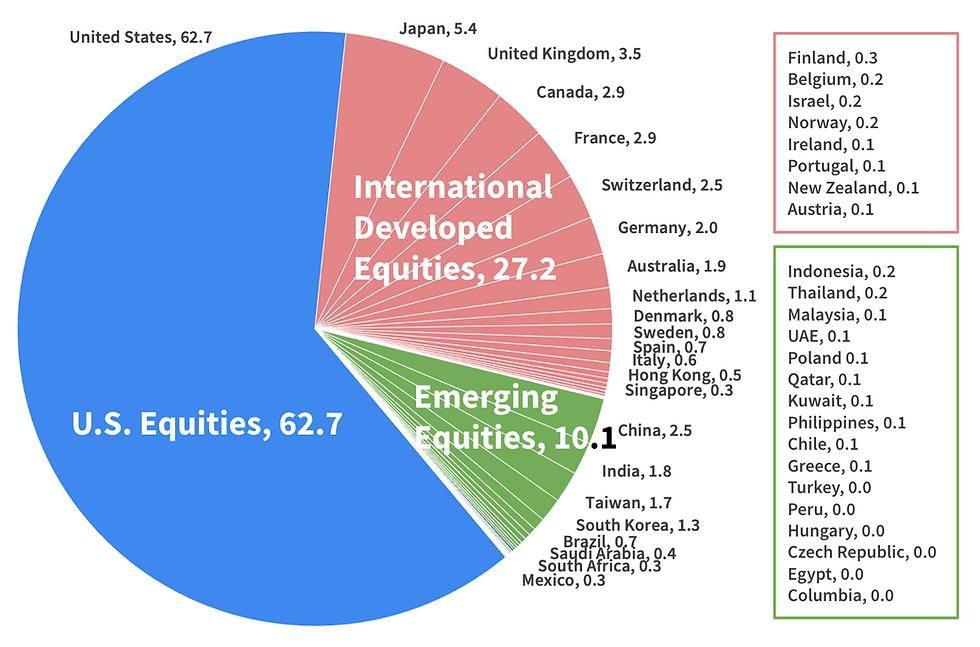
VT holds over 9,800 companies across more than 50 countries — the United States, Europe, Japan, emerging markets, and everything in between — in a single fund that costs 0.07% per year. You buy one ETF and you own a slice of the global economy. As a result, there is nothing to rebalance, no allocation decisions to make, and no ongoing management required.
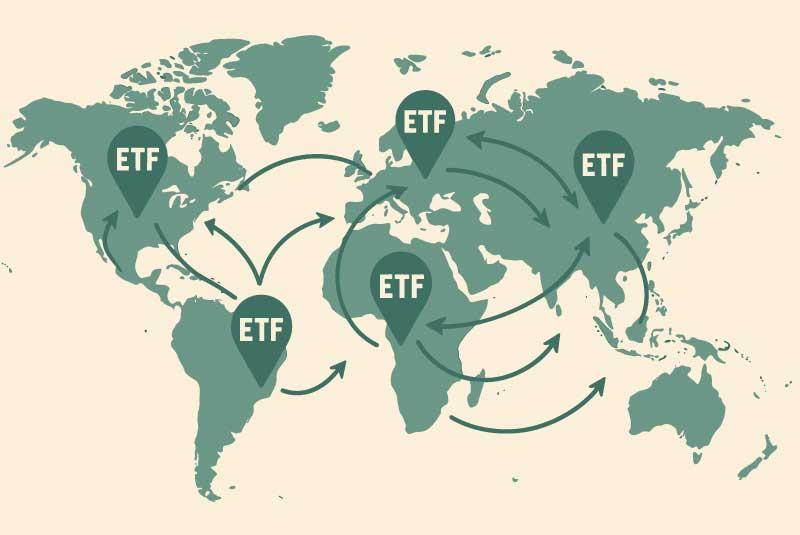
With $1,000, you buy however many shares or fractional shares of VT your brokerage allows. Every month you add more. Every year the fund automatically rebalances to reflect changes in global market values. In 30 years, you have participated in the growth of the global economy at a total cost of 0.07% per year.
This is not a beginner’s portfolio that you will eventually outgrow. In fact, it is the portfolio that most investors — including many professional ones — cannot beat over long periods. Warren Buffett famously recommended that the trustee of his estate invest 90% in a low-cost S&P 500 index fund. VT is a more globally diversified version of that same philosophy.
The one downside of a 100% equity portfolio is volatility. In a bad year — 2022, 2008, 2001 — a fully invested stock portfolio can fall 30–50%. If that would cause you to sell in a panic, you need to add some bonds. However, if you can hold through those drawdowns without touching the portfolio, the one-fund all-equity approach historically produces the best long-term returns.
Allocation with $1,000: $1,000 in VT
Option 2: The Two-Fund Portfolio (Balanced Growth)
70% Vanguard S&P 500 ETF (VOO) + 30% Vanguard Total International Stock ETF (VXUS)
This portfolio separates U.S. and international exposure, giving you control over your geographic allocation while keeping the structure simple. VOO tracks the 500 largest U.S. companies — Apple, Microsoft, NVIDIA, Amazon, Meta, and hundreds more — at a fee of 0.03%. VXUS, meanwhile, covers over 8,600 international stocks across 47 countries at 0.07%.
The 70/30 split between U.S. and international is a common and defensible allocation for long-term investors who believe in the U.S. market’s long-term strength while wanting meaningful international diversification. You can adjust this to 60/40 or 80/20 depending on your own view of relative valuations and how much currency risk you are comfortable holding.
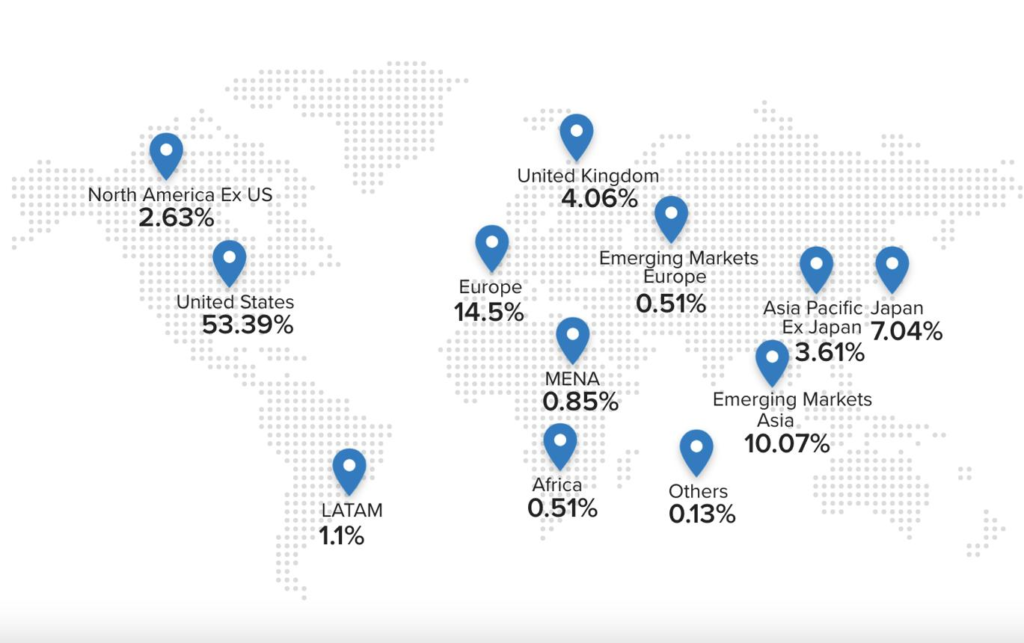
With $1,000, you put $700 in VOO and $300 in VXUS. Most major brokerages now support fractional shares, so you are not constrained by the share price of either fund.
Allocation with $1,000: $700 in VOO + $300 in VXUS
Option 3: The Three-Fund Portfolio (Complete and Balanced)
60% VOO + 20% VXUS + 20% Vanguard Total Bond Market ETF (BND)
The three-fund portfolio is the gold standard of simple, long-term investing. It covers U.S. equities, international equities, and U.S. bonds in three low-cost funds with a blended expense ratio of under 0.05% per year. It has been endorsed by Vanguard’s founder John Bogle, countless financial economists, and generations of successful retail investors.
The bond allocation serves two purposes. First, it reduces the volatility of the overall portfolio — when stocks fall, bonds typically hold their value or rise, cushioning the blow. Second, it gives you something to rebalance into when stocks fall, allowing you to systematically buy more equities at lower prices by selling bonds that have held up better.
The 60/20/20 allocation shown here is appropriate for investors with a medium time horizon — roughly 10–20 years — who want growth but also want to reduce the volatility of a 100% equity portfolio. Younger investors might reduce bonds to 10% or eliminate them entirely. Investors closer to retirement, on the other hand, might increase bonds to 30–40%.
Allocation with $1,000: $600 in VOO + $200 in VXUS + $200 in BND
(Note: If you choose this classic approach and want a complete masterclass on ticker selection, tracking error, and precise execution, don’t miss our detailed playbook on The Ultimate 3-ETF Portfolio for Beginners).
Which Portfolio Should You Choose?
The honest answer is that all three portfolios are good choices for a beginner ETF portfolio. The differences in long-term outcomes between a one-fund VT portfolio and a three-fund VOO/VXUS/BND portfolio are small compared to the difference between investing at all versus not investing.
Choose the one-fund portfolio if you value maximum simplicity and never want to think about rebalancing or allocation. Choose the two-fund portfolio if you want to set your own U.S./international split and are comfortable with full equity exposure. Choose the three-fund portfolio if you want the classic approach that balances growth with stability.
What matters more than the specific choice is committing to the one you pick and adding to it consistently. The investor who puts $1,000 into VT today and adds $200 every month will almost certainly end up wealthier than the investor who spends six months researching the optimal allocation and never starts.
The Power of Regular Contributions
Starting with $1,000 is the beginning, not the destination. The real power of an ETF portfolio for beginners comes from consistent, regular contributions over time — a strategy called dollar-cost averaging that automatically has you buying more shares when prices are low and fewer when prices are high.
To illustrate what consistent investing does over time, consider an investor who starts with $1,000 and adds $300 per month to a portfolio growing at 7% annually — roughly the historical real return of a diversified global equity portfolio after inflation:
- After 10 years: approximately $52,000
- After 20 years: approximately $158,000
- After 30 years: approximately $378,000
The $1,000 starting balance becomes almost irrelevant. Instead, the monthly contributions and time compound into a genuinely significant amount of wealth. This is the math that makes starting early — even with a small amount — one of the most important financial decisions a person can make.
Setting Up Automatic Investments
All three major brokerages — Fidelity, Schwab, and Vanguard — allow you to set up automatic monthly purchases of ETFs. Once configured, a fixed dollar amount is pulled from your bank account and invested in your chosen ETFs on a schedule you set. Consequently, you never have to remember to invest, never have to time the market, and never have to overcome the psychological friction of manually transferring money each month.
This automation is not a minor convenience. Behavioral finance research consistently shows that automatic investment plans produce better outcomes than manual investing, because they remove the temptation to pause contributions during market downturns — precisely when continued buying is most valuable.
Set it up once, check it quarterly to make sure the contributions are going through, and then largely ignore the day-to-day movements of your portfolio. That combination of automation and patience is what turns a $1,000 starting ETF portfolio into meaningful long-term wealth.
What to Do When Your Portfolio Grows
As your ETF portfolio for beginners grows from $1,000 toward $10,000, $50,000, and beyond, two additional considerations become worth thinking about: rebalancing and tax optimization.
Rebalancing
Rebalancing means periodically returning your portfolio to its target allocation. If stocks have a great year and your equity allocation grows from 80% to 88% of your portfolio, selling some equities and buying bonds brings you back to target. Most investors rebalance annually or when any allocation drifts more than 5–10 percentage points from target. With a simple three-fund portfolio, this takes about 15 minutes per year.
Tax-Loss Harvesting
Tax-loss harvesting becomes relevant in taxable accounts once your portfolio reaches a meaningful size. When an ETF is down from your purchase price, you can sell it, immediately buy a similar (but not identical) fund, and realize a tax loss that offsets gains elsewhere in your portfolio. For example, selling VTI at a loss and buying VOO maintains your market exposure while generating a tax benefit. This is a more advanced strategy but worth understanding as your portfolio grows.
Common Mistakes to Avoid
Checking Your Portfolio Too Frequently
Checking your portfolio too frequently is the most common behavioral mistake for new investors. Daily price movements are noise. A portfolio that falls 15% in a bad month is functioning exactly as designed — equity markets are volatile, and that volatility is the price of the long-term returns that make equity investing worthwhile. Therefore, checking your balance weekly or monthly rather than daily reduces the emotional response to short-term movements.
Buying Too Many ETFs
Buying too many ETFs is the second most common mistake beginners make. Investors who start with three ETFs often end up with eight or ten as they read about new funds, sector opportunities, and thematic trends. More ETFs do not mean better diversification once you already own a broad market fund. VT alone holds over 9,800 stocks. Adding a technology ETF on top of it, for instance, just concentrates your portfolio more heavily in tech — the opposite of what you probably intended.
Stopping Contributions During Downturns
Stopping contributions during downturns is the mistake that most damages long-term outcomes. When markets fall 20–30% and every financial news outlet is predicting further doom, the correct response for a long-term investor is to keep buying — or ideally to increase contributions. The shares you buy during downturns at lower prices produce the highest returns when markets recover.
Bottom Line
Building a simple ETF portfolio for beginners with $1,000 requires four decisions: which account to use, which portfolio structure to follow, which specific ETFs to buy, and how much to add each month going forward. Everything else is noise.
Open a Roth IRA if you qualify. Choose one of the three portfolios above based on your time horizon and risk tolerance. Set up automatic monthly contributions. Finally, check in quarterly and rebalance annually if needed.
The investor who does those four things consistently over 20 or 30 years — starting with just $1,000 — will almost certainly end up in a better financial position than the vast majority of people who spend those same years trying to pick stocks, time the market, or find the next great investment theme. Simplicity, consistency, and low costs win over time. Every time.
Frequently Asked Questions
Can I really start an ETF portfolio for beginners with just $1,000?
Yes. All three major brokerages — Fidelity, Schwab, and Vanguard — have no account minimums and offer fractional share investing, meaning you can invest any dollar amount regardless of a fund’s share price. $1,000 is more than enough to build a properly diversified ETF portfolio for beginners.
Should I put my $1,000 in all at once or spread it out over time?
Academic research consistently shows that investing a lump sum immediately outperforms spreading it out over time in approximately two-thirds of historical scenarios, because markets trend upward over time and being invested earlier captures more of that upward trend. However, spreading contributions over 3–6 months reduces the risk of investing right before a significant downturn and is psychologically easier for most investors. Either approach is defensible.
What if I can only add $50 or $100 per month after my initial $1,000?
That is perfectly fine and still enormously valuable over time. $100 per month added to a portfolio growing at 7% annually produces approximately $121,000 after 30 years. The amount of your regular contribution matters less than the consistency of making it.
Is a Roth IRA better than a regular brokerage account for ETF investing?
For most people under 50 who qualify, yes. The tax-free growth and tax-free withdrawals in retirement make a Roth IRA dramatically more valuable than a taxable brokerage account for long-term investing. The annual contribution limit ($7,000 in 2026) means you may need a taxable account as well once you are contributing more than that, but in general, it is best to max out your Roth IRA first.
How do I know when to rebalance my ETF portfolio?
A simple rule: rebalance once per year on a fixed date, or whenever any allocation drifts more than 5 percentage points from its target. For a $1,000 starting portfolio, rebalancing is less urgent because the dollar amounts involved are small. As the portfolio grows, however, consistent rebalancing becomes more important for managing risk and maintaining your intended asset allocation.