
Last updated: June 2026 | Reading time: 9 min
Disclaimer: This article is for informational and educational purposes only. Nothing here constitutes financial advice. Past performance is not a guarantee of future results. Always consult a licensed financial advisor before making investment decisions.
The Best Investment Strategy Requires Almost No Effort
There is a paradox at the heart of investing that the financial industry works hard to obscure: the less you do, the better you tend to perform. Investors who check their portfolios daily, rotate between sectors, chase last year’s winners, and constantly tinker with their allocation consistently underperform investors who buy a small number of low-cost funds and largely leave them alone.
This is not a fringe opinion. It is one of the most thoroughly documented findings in financial economics. S&P’s SPIVA report — which compares actively managed funds to their benchmark indexes — consistently shows that over 80% of actively managed U.S. equity funds underperform their benchmark over a 15-year period. The reason is straightforward: active management costs money in fees and transaction costs, and those costs compound into a significant performance drag over time that most managers cannot overcome.
The lazy investor’s portfolio exploits this reality deliberately. It holds the fewest possible funds needed to achieve genuine global diversification, minimizes fees to near zero, requires rebalancing once per year at most, and outperforms most actively managed alternatives precisely because it does nothing clever.
What Makes a Portfolio Genuinely «Lazy»
The term lazy portfolio was popularized by financial writer Paul Merriman and the Bogleheads community — a group of index investing advocates inspired by Vanguard founder John Bogle. In this context, lazy does not mean careless or uninformed. It means deliberately simple: structured to require minimal ongoing decisions, resistant to behavioral mistakes, and optimized for the long-term investor who has better things to do than watch financial markets every day.
A genuine lazy portfolio has four characteristics. It holds a small number of funds — typically two to four. It covers all major asset classes needed for a complete portfolio — U.S. equities, international equities, and bonds. It uses the lowest-cost funds available in each category. And it is designed to be held through market cycles without modification, because the temptation to adjust during downturns is where most investors destroy value.
The Portfolios
The One-Fund Lazy Portfolio
100% Vanguard Total World Stock ETF (VT) TER: 0.07%
This is as lazy as investing gets. One fund. One ticker. One annual fee of 0.07%. VT holds over 9,800 companies across more than 50 countries — every major publicly traded business in the world, weighted by market capitalization. You own Apple and Microsoft. You own ASML and TSMC. You own Novo Nordisk and Toyota and Samsung. All of it, automatically rebalanced, for seven basis points per year.
The one-fund portfolio removes every allocation decision from the equation. You never have to decide how much to put in U.S. versus international, when to rebalance, or whether to add bonds. The fund reflects the market’s own collective answer to those questions, updated continuously without any action on your part.
The trade-off is that VT is 100% equities. In a severe bear market — 2008, 2022 — a 100% equity portfolio can fall 35–50%. Investors who can genuinely hold through that without selling are rewarded over time. Investors who discover during a downturn that they cannot stomach the volatility need to add bonds, which means moving to a two or three-fund structure.
For investors in their 20s and 30s with decades until retirement who are confident in their ability to stay the course, the one-fund VT portfolio is a completely legitimate long-term strategy. It is not a beginner’s starting point you will eventually outgrow. It is a permanent solution that most active managers cannot beat.
The Two-Fund Lazy Portfolio
80% Vanguard Total Stock Market ETF (VTI) + 20% Vanguard Total Bond Market ETF (BND) Blended TER: approximately 0.025%
The two-fund portfolio adds one bond fund to a core equity position, introducing a stability buffer that reduces volatility without meaningfully sacrificing long-term returns at reasonable bond allocations.
VTI covers the entire U.S. stock market — over 3,600 companies from the largest S&P 500 giants to small-cap businesses — at 0.03%. BND covers the entire U.S. investment-grade bond market — over 10,000 bonds across Treasuries, corporates, and mortgage-backed securities — at 0.03%.
The 80/20 equity/bond split shown here is aggressive — appropriate for investors with 15 or more years until they need the money. More conservative investors might use 60/40 or 70/30. The specific split matters less than the discipline of maintaining it through market cycles.
What makes the two-fund portfolio powerful in its simplicity is the rebalancing mechanism. When equities fall sharply, your bond allocation holds up relatively well — its share of the portfolio grows as equities shrink. Rebalancing back to 80/20 means selling bonds and buying equities at lower prices. This systematic, emotionless process of buying low is one of the most valuable things a long-term investor can do, and the two-fund structure makes it straightforward to execute once per year.
The main limitation is that this portfolio holds no international stocks. U.S. equities have outperformed international markets for the past decade, making this omission seem reasonable in retrospect. But a portfolio entirely in U.S. stocks carries concentration risk that a globally diversified portfolio does not. For investors comfortable with that concentration, the two-fund portfolio is elegantly simple. For those who want global coverage, the three-fund version below is the better choice.
The Three-Fund Lazy Portfolio (The Gold Standard)
60% Vanguard S&P 500 ETF (VOO) + 30% Vanguard Total International Stock ETF (VXUS) + 10% Vanguard Total Bond Market ETF (BND) Blended TER: approximately 0.04%
The three-fund portfolio is the most widely recommended lazy portfolio structure and the one with the longest advocacy from serious investors and financial economists. It covers U.S. equities, international equities, and bonds — the three major asset classes needed for a complete, globally diversified portfolio — in three low-cost funds with a blended fee of approximately 0.04% per year.
At that cost, on a $100,000 portfolio, you pay $40 per year in total fees. The average actively managed mutual fund charges 0.60–1.00%, which on the same $100,000 costs $600–$1,000 per year. Over 30 years, assuming 7% annual returns, that fee difference alone — $40 versus $800 per year — compounds into over $150,000 in additional wealth. The lazy portfolio wins before a single investment decision is made simply by keeping more of its returns.
The allocation shown — 60% VOO, 30% VXUS, 10% BND — is appropriate for a moderate investor with a 15–20 year horizon. Younger investors might hold 70% VOO, 25% VXUS, and 5% BND. Investors closer to retirement might shift toward 40% VOO, 20% VXUS, and 40% BND. The structure scales to any allocation without adding complexity.
Rebalancing once per year — returning each fund to its target percentage — is the only ongoing maintenance required. Most investors find this takes less than 20 minutes annually. Direct new contributions to whichever fund is below its target weight, which achieves rebalancing without triggering capital gains in taxable accounts. (If you’ve decided this is the right strategy for you and want a deep, step-by-step breakdown on how to construct and select the exact fund share classes for this setup, explore The Ultimate 3-ETF Portfolio for Beginners).
The Four-Fund Lazy Portfolio (For the Slightly Less Lazy)
50% Vanguard S&P 500 ETF (VOO) + 20% Vanguard Total International Stock ETF (VXUS) + 20% Vanguard Total Bond Market ETF (BND) + 10% Vanguard Real Estate ETF (VNQ) Blended TER: approximately 0.06%
The four-fund portfolio adds real estate — through VNQ, which holds over 150 U.S. REITs — to the three-fund structure. Real estate has historically provided inflation protection, higher income than broad equities, and a return stream with lower correlation to both stocks and bonds. For long-term investors who want real asset exposure beyond what is already embedded in broad market funds, a 10% REIT allocation is a defensible enhancement.
The caveat is that REITs are already included in VOO and VTI at their market-cap weight — roughly 3–4% of the S&P 500. Adding VNQ separately overweights real estate beyond its natural market weight, which is an active tilt rather than purely passive investing. Whether that tilt adds value depends on your view of real estate’s long-term return premium and your desire for inflation protection and income.
This is the most complex portfolio in the lazy category — four funds rather than one — but it still requires only annual rebalancing and costs under 0.10% per year in total fees. Most investors will find the three-fund version sufficient. The four-fund version is for those who specifically want the real estate income component and are comfortable with the modest additional complexity.
Why Lazy Portfolios Beat Most Active Funds
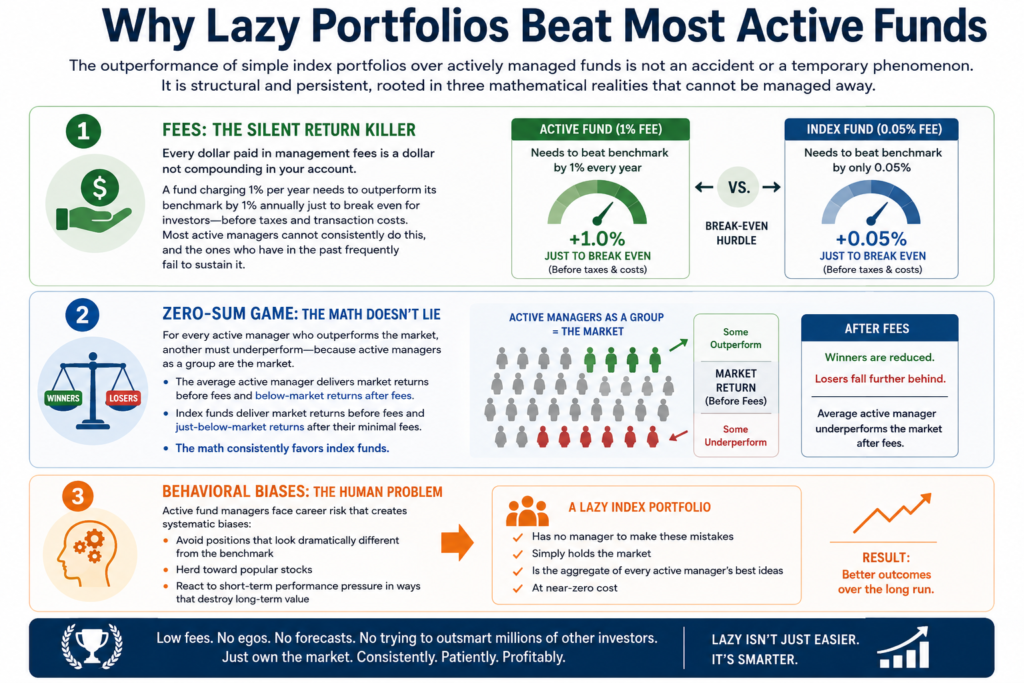
The outperformance of simple index portfolios over actively managed funds is not an accident or a temporary phenomenon. It is structural and persistent, rooted in three mathematical realities that cannot be managed away.
The first is fees. Every dollar paid in management fees is a dollar not compounding in your account. A fund charging 1% per year needs to outperform its benchmark by 1% annually just to break even for investors — before taxes and transaction costs. Most active managers cannot consistently do this, and the ones who have in the past frequently fail to sustain it.
The second is the zero-sum nature of active management. For every active manager who outperforms the market, another must underperform — because active managers as a group are the market. The average active manager delivers market returns before fees and below-market returns after fees. Index funds deliver market returns before fees and just-below-market returns after their minimal fees. The math consistently favors index funds.
The third is behavioral. Active fund managers face career risk that creates systematic biases — they tend to avoid positions that look dramatically different from the benchmark, herd toward popular stocks, and react to short-term performance pressure in ways that destroy long-term value. A lazy index portfolio has no manager to make these mistakes. It simply holds the market, which is the aggregate of every active manager’s best ideas, at near-zero cost.
The Biggest Threat to a Lazy Portfolio
The strategy is simple. The execution is harder than it sounds, and the difficulty has nothing to do with financial complexity. It is entirely psychological.
When markets fall 30% — and they will, multiple times over a 30-year investment horizon — every instinct tells you to do something. Financial news coverage amplifies the fear. Social media fills with predictions of further declines. Friends and family who pay attention to markets start talking about moving to cash. The lazy portfolio’s response to all of this is to do nothing, or ideally to add more — which feels profoundly wrong at the time and is almost always the right move in retrospect.
The investors who hold through the 2008 crash, the 2020 COVID collapse, the 2022 rate shock, and every correction in between are the ones who capture the long-term returns that make equity investing worthwhile. The investors who sell during downturns lock in losses and frequently miss the recovery, which often happens quickly and without warning.
Automating contributions removes one layer of this behavioral risk. When a fixed amount leaves your bank account and buys ETF shares every month regardless of what the market is doing, you are dollar-cost averaging mechanically rather than deciding whether to invest based on how the market feels. This automation — combined with a deliberate commitment to not check the portfolio more than quarterly — is what makes the lazy portfolio actually work in practice rather than just in theory.
Comparing the Four Lazy Portfolios
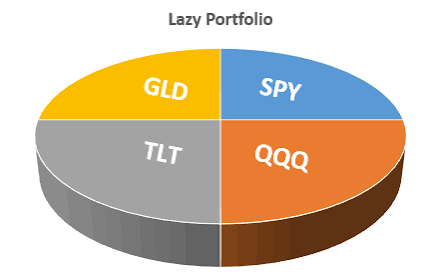
The one-fund portfolio with VT is the simplest possible structure and appropriate for investors who want zero ongoing decisions. The two-fund VOO plus BND portfolio sacrifices international diversification for simplicity and is best for investors with a strong conviction in U.S. equities. The three-fund portfolio of VOO, VXUS, and BND is the gold standard — globally diversified, ultra-low cost, and requiring one annual rebalancing. The four-fund portfolio adds real estate exposure through VNQ for investors who want income and inflation protection beyond what the three-fund covers.
All four portfolios share the same core properties: low cost, broad diversification, minimal maintenance, and a structural advantage over most actively managed alternatives. The differences between them are less important than the decision to start, contribute consistently, and never sell during a downturn.
Building Your Lazy Portfolio Step by Step
Open the right account first. A Roth IRA is the best account for most investors starting out — tax-free growth, tax-free withdrawals in retirement, and the discipline of an annual contribution limit that encourages consistent investing. Fidelity, Schwab, and Vanguard all offer Roth IRAs with no account minimums and commission-free ETF trading.
Choose your portfolio structure based on your time horizon and risk tolerance. If you are in your 20s or 30s with decades until retirement, the one-fund or three-fund structure at an aggressive allocation is appropriate. If you are in your 50s approaching retirement, the three-fund or four-fund structure at a more conservative allocation makes sense.
Buy the funds in your chosen proportions. With fractional shares available at Fidelity and Schwab, you can invest any dollar amount regardless of share price. Set up automatic monthly contributions from your bank account and configure them to purchase each fund in your target proportions.
Set a calendar reminder to rebalance once per year. On that date, check the current allocation of each fund, calculate how much each has drifted from its target, and either redirect new contributions or make small trades to return to target. Document your target allocation somewhere you will not lose it, because rebalancing requires knowing what you are rebalancing toward.
Then close the app and live your life. Check in quarterly to confirm contributions are going through. Review annually to rebalance. Increase contributions when your income grows. That is the entire active management requirement of a lazy portfolio — less than two hours per year.
Bottom Line
The lazy investor’s ETF portfolio beats most funds not because it is clever, but because it is consistent, low-cost, and immune to the behavioral mistakes that derail most investors. The three-fund portfolio of VOO, VXUS, and BND at your appropriate equity/bond allocation is the version most investors should start with and never need to graduate from.
The hardest part is not the strategy. It is resisting the continuous noise of financial media, social media, and well-meaning friends who will always have a reason why now is a bad time to stay invested. The lazy portfolio’s answer to all of that noise is always the same: hold, contribute, rebalance once a year, and let decades of compounding do what no active manager consistently can.
Frequently Asked Questions
Does a lazy portfolio actually outperform active funds over time? Yes, by a wide and consistent margin over long periods. S&P’s SPIVA report shows that over any 15-year period, more than 80% of actively managed U.S. equity funds underperform their benchmark index. The primary driver is fees — active funds charge 10 to 30 times more than the ETFs in a lazy portfolio, and that cost compounds into a significant performance gap over decades.
Do I need to change my lazy portfolio as I get older? You should gradually shift toward a more conservative allocation as retirement approaches — increasing your bond allocation and potentially reducing equities. This does not require changing the funds you hold, only the proportions. A three-fund portfolio of VOO, VXUS, and BND works at any age; only the percentages change over time.
What if the market crashes right after I start my lazy portfolio? This is the scenario every new investor fears and very few experience in a way that permanently damages long-term outcomes. If markets fall 30% shortly after you start, your contributions in subsequent months buy shares at 30% lower prices — which turns out to be very beneficial over the long term. The investors permanently harmed by crashes are those who sell during them, not those who hold and continue contributing.
Is the lazy portfolio appropriate if I have a large lump sum to invest? Yes. Invest the lump sum according to your chosen allocation and begin regular monthly contributions. Research consistently shows that investing a lump sum immediately outperforms spreading it out over time in the majority of historical scenarios, because markets trend upward over time and being invested earlier captures more of that upward trend. If the volatility of investing all at once is psychologically difficult, spreading the lump sum over three to six months is a reasonable compromise.
Can I use iShares or Schwab ETFs instead of Vanguard for a lazy portfolio? Absolutely. The lazy portfolio concept is fund-family agnostic. IVV replaces VOO, IXUS replaces VXUS, and AGG replaces BND with functionally identical results. SCHB, SCHI, and SCHZ from Schwab work equally well. The index tracked and the expense ratio charged matter — the brand name on the fund does not.