
Last updated: June 2026 | Reading time: 13 min
Disclaimer: This article is for informational and educational purposes only. Nothing here constitutes financial advice. Past performance is not a guarantee of future results. Asset allocation should be personalized to your individual financial situation, risk tolerance, and goals. Always consult a qualified financial advisor before making investment decisions.
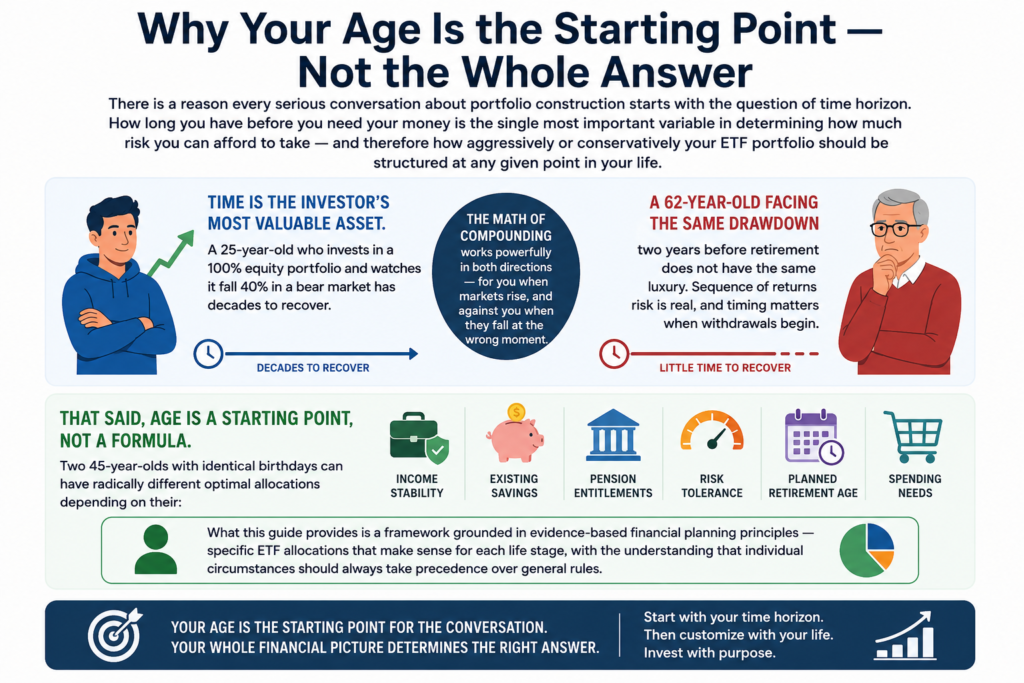
Why Your Age Is the Starting Point — Not the Whole Answer
There is a reason every serious conversation about portfolio construction starts with the question of time horizon. How long you have before you need your money is the single most important variable in determining how much risk you can afford to take — and therefore how aggressively or conservatively your ETF portfolio should be structured at any given point in your life.
Time is the investor’s most valuable asset. A 25-year-old who invests in a 100% equity portfolio and watches it fall 40% in a bear market has decades to recover. A 62-year-old facing the same drawdown two years before retirement does not. The math of compounding works powerfully in both directions — for you when markets rise, and against you when they fall at the wrong moment. Age-based allocation is fundamentally about managing that asymmetry.
That said, age is a starting point, not a formula. Two 45-year-olds with identical birthdays can have radically different optimal allocations depending on their income stability, existing savings, pension entitlements, risk tolerance, planned retirement age, and spending needs. What this guide provides is a framework grounded in evidence-based financial planning principles — specific ETF allocations that make sense for each life stage, with the understanding that individual circumstances should always take precedence over general rules.
The Core Principle: The Glide Path
The concept underlying age-based ETF allocation is called the glide path — the gradual shift from growth-oriented assets (primarily equities) toward more defensive, income-generating assets (primarily bonds and dividend stocks) as retirement approaches. Target-date funds automate this process for investors who prefer a hands-off approach. Building it manually with individual ETFs gives you more control, lower costs, and more transparency about exactly what you own.
The traditional rule of thumb was «100 minus your age in stocks» — a 30-year-old would hold 70% equities and 30% bonds. In the current environment of longer life expectancies and lower expected bond returns, most financial planners have moved toward more aggressive versions: «110 minus age» or even «120 minus age» — meaning a 30-year-old would hold 80–90% in equities and relatively little in bonds until their late 40s or 50s.
The specific ETF framework in this guide reflects that updated thinking: heavily equity-weighted in early decades, introducing bonds and dividend income progressively from the 40s onward, and building a more balanced, income-generating portfolio through the 50s and into retirement.
Your 20s: Maximum Growth, Minimum Complexity
The single most important financial decision most 20-somethings can make is simply to start investing — and to invest in something broadly diversified rather than speculating on individual stocks, meme coins, or leveraged ETFs. The power of compounding means that money invested at 25 has 40+ years to grow before a conventional retirement age. A dollar invested at 25 growing at 7% annually becomes roughly $15 by age 65. A dollar invested at 35 becomes roughly $7.60. Starting a decade earlier nearly doubles the outcome.
In your 20s, the appropriate ETF allocation is almost entirely equities. The rationale is straightforward: you have more time to recover from drawdowns than at any other point in your life, your human capital — your future earning potential — is at its highest and acts as a natural bond-like stabilizer in your overall financial position, and the expected return premium of equities over bonds over long periods is substantial enough that holding significant bond allocations at this age is genuinely suboptimal for most investors.
The portfolio does not need to be complex. Two or three ETFs cover the full global equity market at minimal cost and require almost no active management.
| ETF | Allocation | What It Does | Expense Ratio |
|---|---|---|---|
| VTI | 60–70% | Total U.S. stock market — 3,700+ companies | 0.03% |
| VXUS | 30–40% | Total international stocks — 8,000+ companies | 0.07% |
| BND | 0–5% | Optional small bond allocation for stability | 0.03% |
For the investor who wants a single-fund solution, VT — the Vanguard Total World Stock ETF — holds both U.S. and international equities in one fund at 0.07%, weighted by global market capitalization. It is the simplest possible implementation of a globally diversified equity portfolio and requires no rebalancing between U.S. and international allocations.
The most important behaviors in your 20s are not allocation-related — they are contribution-related. Maximizing your Roth IRA contribution ($7,000 per year in 2026 for those under 50), contributing enough to your 401(k) to capture any employer match, and automating contributions so that market volatility does not interrupt your investment schedule will do more for your long-term outcome than any optimization of the specific ETFs you choose.
One satellite addition worth considering in your 20s: a small allocation to QQQ or QQQM (5–10% of the portfolio) for additional technology and growth exposure. Your long time horizon means you can tolerate the higher volatility of a growth-tilted position, and the compounding of higher returns in your 20s and 30s has an outsized impact on your final outcome. This is entirely optional — VTI already includes significant technology exposure — but for growth-oriented investors in their 20s, a modest technology tilt is reasonable.
Your 30s: Growth With a Foundation
The 30s are typically the decade when financial life gets meaningfully more complex. Career earnings accelerate, but so do financial obligations: mortgages, families, childcare, and the realization that retirement is no longer entirely abstract. The investment priority remains growth — you still have 25–35 years of potential compounding ahead of you — but a few structural additions make sense.
The core equity allocation should remain the dominant position, but this is a good decade to begin introducing a small allocation to dividend-growth ETFs. Not because you need the income — you almost certainly do not — but because dividend-growth companies tend to be higher-quality businesses with stronger balance sheets, and beginning to build that quality tilt in your 30s creates a position that will grow in yield and relevance as you move toward retirement. SCHD is the natural choice for this role.
| ETF | Allocation | What It Does | Expense Ratio |
|---|---|---|---|
| VTI | 50–60% | Total U.S. stock market core | 0.03% |
| VXUS | 25–30% | International diversification | 0.07% |
| SCHD | 10–15% | Dividend growth quality tilt | 0.06% |
| BND | 5–10% | Bond buffer for volatility management | 0.03% |
The bond allocation in the 30s is modest but not zero. A small fixed-income position serves two purposes beyond income: it provides dry powder to rebalance into equities during significant market drawdowns, and it slightly reduces portfolio volatility in ways that help investors stay the course rather than panic-selling during bear markets. The behavioral benefit of a smoother ride — meaning investors actually hold their positions through downturns — can be worth more in long-term outcomes than the slightly lower expected return from holding some bonds.
The 30s are also the decade to think seriously about emergency funds, term life insurance, and disability coverage as financial foundations — not because they are investment topics, but because adequate protection means you never have to sell investments at the wrong moment to cover an unexpected expense. The investment portfolio and the insurance portfolio work together, and getting both right in your 30s sets up the rest of your financial life.
Your 40s: The Pivot Decade
The 40s are where the glide path begins to matter in a more tangible way. Retirement is no longer a distant abstraction — it is 20–25 years away for most people in this decade, close enough to plan concretely but far enough away that growth remains the primary objective. The key shift in the 40s is a meaningful increase in the bond allocation and a deliberate build-up of the income-generating portion of the portfolio.
This is also the decade when the sequence-of-returns risk starts to become a genuine planning consideration. If a large market drawdown occurs in the five years immediately before your planned retirement date, your ability to recover before you need to start drawing income is significantly reduced. Beginning to de-risk in your early 40s — rather than waiting until your 50s — provides a longer runway to reduce that vulnerability gradually rather than abruptly.
| ETF | Allocation | What It Does | Expense Ratio |
|---|---|---|---|
| VTI | 40–50% | Total U.S. stock market core | 0.03% |
| VXUS | 20–25% | International diversification | 0.07% |
| SCHD | 15–20% | Dividend growth — building future income | 0.06% |
| BND | 10–15% | Investment-grade bonds for stability | 0.03% |
| VNQ | 5% | Real estate exposure and income | 0.12% |
Real estate investment trust ETFs like VNQ make their first appearance in the 40s allocation. REITs provide income, inflation sensitivity, and diversification relative to the broader equity market — characteristics that become increasingly valuable as the portfolio transitions from pure growth toward a balance of growth and income. The Roth IRA or traditional IRA is the right place to hold VNQ given its high non-qualified dividend distributions, but as a portfolio allocation it earns its place in the 40s framework.
The 40s are also when many investors become aware of how their 401(k) investment options compare to the ETF universe. Most 401(k) plans do not offer the specific ETFs discussed in this guide — they offer mutual fund equivalents, often with higher expense ratios. The strategy of maximizing tax-advantaged contributions (401(k), IRA, HSA) and holding the most tax-efficient ETFs in the taxable account remains the right framework, even when the specific fund names inside the 401(k) differ.
Your 50s: Income Building and Risk Reduction
The 50s represent the most consequential decade for retirement portfolio construction. Peak earning years for many professionals coincide with the final push of accumulation before retirement, and the decisions made in this decade — particularly around sequence-of-returns risk and income generation — have an outsized impact on retirement outcomes.
Catch-up contributions become available at age 50: an additional $1,000 per year to IRAs (bringing the total to $8,000 in 2026) and an additional $7,500 to 401(k) plans (bringing the total to $30,500). Using these limits fully during the 50s can add meaningful capital to the retirement portfolio at exactly the moment when compounding still has a decade or more to work.
The portfolio in your 50s should shift meaningfully toward income generation and capital preservation while maintaining enough equity exposure to continue growing the portfolio over what could be a 30–40 year retirement. The old approach of moving heavily into bonds in your 50s has been revisited by many financial planners — a retiree at 65 today has an average life expectancy into their mid-80s, meaning the portfolio needs to sustain itself for two decades or more. Excessive conservatism in the 50s and 60s creates its own risk: the risk of outliving your money.
| ETF | Allocation | What It Does | Expense Ratio |
|---|---|---|---|
| VTI | 30–40% | Core U.S. equity growth | 0.03% |
| SCHD | 20–25% | Dividend growth — now generating real income | 0.06% |
| VXUS | 15% | International diversification | 0.07% |
| BND | 15–20% | Investment-grade bonds — stability and income | 0.03% |
| JEPI | 10% | Monthly income via covered calls | 0.35% |
| VNQ | 5–10% | Real estate income and inflation hedge | 0.12% |
JEPI makes its first appearance in the 50s allocation as a dedicated income generator. At this stage, the transition from pure growth to a balance of growth and income is underway, and JEPI’s monthly distributions — typically in the 7–9% yield range — provide genuine cash flow that can either be reinvested during the remaining accumulation years or used to reduce the need to sell equities in early retirement. Its position in the Roth IRA shelters the non-qualified income from current taxation.
The 50s are also the decade to run serious retirement income projections. Tools like the 4% withdrawal rule — the research-supported guideline that a portfolio can sustain 4% annual withdrawals in inflation-adjusted terms for 30 years — give you a target portfolio size. If your current trajectory does not reach that target by your planned retirement date, the 50s are the time to course-correct through higher contributions, adjusting the retirement timeline, or modestly revising spending expectations. Making those adjustments in your 50s is far less painful than discovering the gap in your 60s.
Retirement and Beyond: Income, Preservation, and Longevity
Retirement does not mean stopping investing — it means shifting the portfolio’s primary objective from growing capital to generating sustainable income while preserving enough capital to last two or three decades. The specific ETF allocation in retirement depends heavily on individual factors: Social Security income, pension income, spending needs, health considerations, and legacy goals. But the general framework follows recognizable principles.
The equity allocation in retirement should be higher than most people expect. A 65-year-old with a 25-year life expectancy and a portfolio that needs to sustain real purchasing power through age 90 needs meaningful equity exposure to outpace inflation over that period. Holding 40–50% in equities in early retirement is not reckless — it is actuarially appropriate for most people retiring today.
| ETF | Allocation | Role in Retirement Portfolio | Expense Ratio |
|---|---|---|---|
| SCHD | 25–30% | Core income engine — growing dividend stream | 0.06% |
| VTI | 20–25% | Growth and inflation protection | 0.03% |
| JEPI | 15–20% | Monthly income — covers regular expenses | 0.35% |
| BND | 15–20% | Stability buffer — 2–3 years of expenses | 0.03% |
| VYM | 10% | Broad dividend income — supplements SCHD | 0.06% |
| VNQ | 5–10% | Real estate income and inflation hedge | 0.12% |
The retirement portfolio has three distinct jobs to do simultaneously. The income layer — SCHD, JEPI, VYM — generates the cash flow to cover living expenses without requiring the sale of equity positions. The growth layer — VTI — ensures the portfolio continues growing in real terms over a potentially decades-long retirement, protecting against the erosion of purchasing power that inflation would otherwise cause. The stability layer — BND and cash equivalents — provides a buffer of two to three years of expenses in lower-volatility assets, so that a market downturn does not force the sale of equities at depressed prices to fund living expenses.
This bucket structure — income, growth, stability — is a robust framework for managing retirement portfolios precisely because it prevents the most damaging retirement mistake: selling growth assets during market downturns because you need cash for living expenses. With two to three years of expenses covered by the bond buffer and monthly income from SCHD and JEPI, a retiree can ride out most market downturns without touching the growth portion of the portfolio.
The Full Glide Path at a Glance
| Life Stage | Equities | Bonds | Income ETFs | REITs | Primary Focus |
|---|---|---|---|---|---|
| 20s | 90–100% | 0–5% | 0% | 0% | Maximum compounding |
| 30s | 80–90% | 5–10% | 10–15% | 0% | Growth + quality tilt |
| 40s | 70–80% | 10–15% | 15–20% | 5% | Growth with de-risking |
| 50s | 55–65% | 15–20% | 20–25% | 5–10% | Income building |
| Retirement | 40–50% | 15–20% | 30–40% | 5–10% | Sustainable income |
Common Allocation Mistakes at Every Age
In your 20s, the most common mistake is not starting — followed closely by choosing overly complex or speculative portfolios when simple broad-market index ETFs would serve far better. The second most common mistake is holding too much cash earning low yields because markets feel uncertain. Every year of delay in investing is a year of compounding lost permanently.
In your 30s, the most common mistake is lifestyle inflation crowding out investment contributions. Income rises significantly for many people in their 30s, but so do mortgage payments, childcare costs, and spending on consumer goods. The investors who build serious wealth tend to be those who automate contributions before lifestyle inflation can consume the additional income.
In your 40s, the most common mistake is the opposite: excessive conservatism driven by awareness that retirement is approaching. Investors who panic-shift to heavy bond allocations in their early 40s after a bear market give up decades of potential equity growth. The 40s are not retirement — 20+ years of investing runway remains, and the portfolio should reflect that.
In your 50s, the most common mistake is failing to run concrete retirement income projections and discovering the savings gap too late to address it effectively. The 50s are the time to stress-test your retirement plan — to calculate how your planned portfolio size, withdrawal rate, Social Security income, and spending needs interact under realistic scenarios.
In retirement, the most common mistake is holding too little in equities out of an abundance of caution, which creates inflation risk and longevity risk that can be just as damaging over a 25-year retirement as sequence-of-returns risk in the first few years. A 65-year-old who moves entirely into bonds is making a long-term bet that their expenses in 2046 will be manageable on a fixed income eroded by two decades of inflation.
Frequently Asked Questions
Should I own bonds in my 20s and 30s?
Most evidence-based financial planners suggest very small or zero bond allocations in your 20s and early 30s. Your human capital — your future earnings — acts as a bond-like asset that stabilizes your overall financial position, and your long time horizon means equity drawdowns are recoverable. A small bond allocation of 5–10% in your late 30s can help behavioral discipline — it provides something to rebalance from into equities during downturns — but it is not necessary for most young investors.
How often should I rebalance my ETF portfolio?
Annual rebalancing is sufficient for most investors and minimizes transaction costs and tax events. A common approach is to rebalance whenever an asset class drifts more than 5 percentage points from its target allocation — whichever comes first, the annual date or the threshold breach. In tax-advantaged accounts, rebalancing is simpler because there are no tax consequences for selling.
Is the 4% withdrawal rule still valid in 2026?
The 4% rule — derived from the Trinity Study — remains a reasonable starting point for retirement planning, though many financial planners now use 3.5% as a more conservative baseline given current bond yields and valuation levels. The rule assumes a 30-year retirement; for people retiring at 60 or earlier with potentially 35–40 year retirements, a lower initial withdrawal rate provides more safety margin.
Can I use target-date ETFs instead of building my own allocation?
Target-date funds automate the glide path described in this article and are an excellent choice for investors who prefer simplicity over control. Vanguard’s Target Retirement funds and iShares’ LifePath ETFs are low-cost, well-managed options. The trade-off is less flexibility — you cannot customize the allocation, the specific funds held, or the pace of the glide path. For investors willing to do minimal annual rebalancing, building the allocation manually with the ETFs in this guide gives more control at comparable or lower cost.
What if I am starting to invest late — in my 40s or 50s?
Starting later does not mean starting wrong. The appropriate adjustment is to maximize catch-up contributions as soon as you are eligible at 50, consider a slightly more aggressive equity allocation than the age-based framework suggests given your need to grow capital faster, and run honest projections about retirement timing. Some investors who start late choose to work a few additional years, which both extends the accumulation period and shortens the distribution period — a powerful combination that can partially offset a late start.