
Last updated: June 2026 | Reading time: 9 min
Disclaimer: This article is for informational and educational purposes only. Nothing here constitutes financial advice. Past performance is not a guarantee of future results. Always consult a licensed financial advisor before making investment decisions.
The Question Every New Investor Eventually Asks
At some point in the journey from financial novice to informed long-term investor, almost everyone arrives at the same fork in the road. You have learned that low-cost index ETFs beat most active funds over time. You know that broad diversification is better than stock picking. You understand that keeping fees near zero matters enormously over decades.
And then you face the practical question: do you buy one ETF and be done with it, or do you build a portfolio of three funds that gives you more control over your allocation?
Both approaches work. Both have serious advocates. Both will, if followed consistently over decades, produce far better outcomes than the alternatives most retail investors end up with — expensive actively managed funds, stock picking, market timing, or doing nothing at all.
The difference between them is not primarily about returns. It is about control, simplicity, and what kind of investor you actually are — not in theory, but in practice, on the day the market falls 25% and every instinct tells you to do something different.
The Case for One ETF
The one-ETF approach is built on a single insight: the global stock market, weighted by market capitalization, is the most efficient aggregator of investment information in human history. Every piece of publicly available information about every publicly traded company is already reflected in prices. Trying to improve on that aggregate through active selection or tactical allocation is, for most investors over most time periods, a losing game.
One fund captures that entire market at once.
Vanguard Total World Stock ETF (VT) TER: 0.07% AUM: Over $40 billion Holdings: Over 9,800 stocks across 50+ countries
VT holds approximately 62% U.S. stocks and 38% international stocks, reflecting the current global market capitalization split. When U.S. companies become more valuable relative to international companies, VT automatically increases its U.S. weight. When emerging markets grow faster, their weight in VT increases. The rebalancing happens continuously inside the fund at no cost to you.
The practical implication is radical simplicity. You make one decision — to own the global market — and then you never have to make another allocation decision again. There is nothing to rebalance because there is only one fund. There is no U.S. vs international decision because VT makes it for you based on market values. There is no drift to correct because the fund corrects itself.
For investors who genuinely want to minimize the number of financial decisions they make — and who understand that minimizing decisions also minimizes the opportunity to make behavioral mistakes — VT is a complete long-term solution.
The limitation of the one-ETF approach is that VT is 100% equities. It holds no bonds, no real estate, no inflation protection. For investors with long time horizons and high risk tolerance, this is appropriate — equities have historically delivered the best long-term real returns of any major asset class. For investors who need some stability in their portfolio, who are closer to retirement, or who genuinely cannot sleep through a 40% drawdown, a bond allocation needs to be added — which immediately moves you toward two or three funds.
An alternative one-fund option worth knowing is a target-date fund — such as Vanguard Target Retirement 2050 (VFIFX) — which holds stocks and bonds in proportions that automatically become more conservative as the target date approaches. Target-date funds are technically one-fund solutions but hold the equivalent of four or five underlying index funds internally. They cost slightly more than VT — typically 0.08–0.15% — but handle the equity-to-bond glide path automatically, making them genuinely hands-off for investors who want both stocks and bonds without any ongoing allocation management.
The Case for Three ETFs
The three-ETF approach gives you control over two allocation decisions that the one-fund approach makes automatically: how much to hold in U.S. versus international stocks, and how much to hold in stocks versus bonds.
The standard three-fund portfolio: 60% Vanguard S&P 500 ETF (VOO) — TER 0.03% 30% Vanguard Total International Stock ETF (VXUS) — TER 0.07% 10% Vanguard Total Bond Market ETF (BND) — TER 0.03% Blended TER: approximately 0.04%
The three-fund portfolio is slightly cheaper than VT on a fee basis — 0.04% blended versus 0.07% — though the difference on a $50,000 portfolio amounts to $15 per year, which is genuinely negligible.
The real advantage of three funds is not cost. It is the ability to set allocations that differ from global market weights when you have a reasoned view that those weights do not serve your specific situation.
The most common reason investors prefer three funds over one is the U.S. versus international split. VT currently allocates approximately 62% to U.S. stocks and 38% to international. Many U.S. investors are more comfortable with 70–80% U.S. allocation — a modest home country bias that reflects real practical advantages: familiarity with U.S. businesses, no currency risk on the domestic portion, and the historical dominance of U.S. equity returns. With three funds, you can set that split precisely. With VT, you accept whatever the market says.
The second reason is bonds. VT holds zero bonds. An investor who wants a 10%, 20%, or 40% bond allocation alongside their equity exposure cannot achieve it with VT alone. With three funds, you dial in exactly the equity-to-bond ratio that matches your time horizon and risk tolerance, and you can adjust it gradually over time as retirement approaches.
The third reason is rebalancing as an active tool. With three separate funds, you can rebalance deliberately — selling whatever has run up and buying whatever has lagged — which enforces a systematic buy-low, sell-high discipline. With VT, the internal rebalancing happens automatically but you cannot use it as a tool to increase your allocation to whichever market has become cheaper.
The Performance Question
Investors naturally want to know which approach produces better returns. The honest answer is that the difference in long-term returns between a one-fund VT portfolio and a well-constructed three-fund portfolio is very small — and which comes out ahead depends almost entirely on two variables: the U.S.-international performance gap over your specific holding period, and how much of the return difference fees capture.
Over the past decade, investors who held VT underperformed those who held a heavily U.S.-weighted three-fund portfolio because U.S. stocks dramatically outperformed international markets. VT’s 38% international weight was a drag on returns during that period.
Over the 2000s, the opposite was true. U.S. stocks had a lost decade while international markets significantly outperformed. A VT-like global allocation would have substantially outperformed a U.S.-heavy portfolio during that period.
No one reliably knows in advance which decade we are entering. Investors who built a U.S.-heavy three-fund portfolio in 2010 did not know they were at the start of a decade of U.S. dominance. Investors who held VT during the 2000s did not know they were avoiding a U.S.-specific underperformance cycle.
VT essentially bets that the global market is the best allocator of capital between U.S. and international stocks. The three-fund portfolio bets that you know better than the market what the right allocation is. Neither bet is obviously correct, and the humility to acknowledge that should inform which approach you choose.
On pure cost, the three-fund portfolio has a minor edge — 0.04% blended versus 0.07% for VT. Over 30 years on a $200,000 portfolio, that 0.03% difference amounts to approximately $8,000 in additional wealth — real but not transformative.
Where Each Approach Breaks Down in Practice
The one-fund approach breaks down when investors treat VT’s simplicity as permission to ignore their portfolio entirely. Checking in once a year, confirming contributions are going through, and reviewing whether your allocation still matches your life stage requires minimal effort but cannot be skipped indefinitely. A 35-year-old who puts everything in VT and genuinely never looks at it again until age 65 has the right long-term instinct but needs to ensure they are still contributing consistently and that their tax situation is being managed appropriately.
The three-fund approach breaks down when investors use the additional complexity as an excuse to tinker. The investor who adjusts their U.S.-international split every year based on recent performance, who shifts their bond allocation in response to interest rate predictions, or who replaces one of their three funds with a supposedly better alternative every few years is not running a lazy three-fund portfolio — they are running an active strategy disguised as a passive one. The behavioral discipline required by a three-fund portfolio is the same as for a one-fund portfolio: set the allocation, automate contributions, rebalance annually, and do not touch it between rebalancing dates.
The Decision Framework
Rather than declaring a winner — because there is not one — here is a practical framework for deciding which approach fits your situation.
Choose one fund if you genuinely value maximum simplicity above all else, if you have a very long time horizon (20+ years) and are comfortable with 100% equity volatility, if you want the allocation decision permanently removed from your hands, and if you are confident you will not be tempted to switch to a different approach when markets are turbulent.
Choose three funds if you want control over your U.S.-international split and have a reasoned view on what that split should be, if you need a bond allocation to manage portfolio volatility and match your risk tolerance, if you want to use deliberate rebalancing as an investment discipline, and if you are comfortable with one annual maintenance task without letting it become an excuse to over-manage.
Choose a target-date fund if you want one-fund simplicity that includes bonds and an automatic glide path toward more conservative allocation as retirement approaches, and if you are willing to pay a slightly higher fee — typically 0.08–0.15% — for that automation.
There is no wrong answer among these three options. The wrong answer is holding an expensive actively managed fund, picking individual stocks without edge, or keeping long-term savings in cash because you have not yet decided.
What Both Approaches Have in Common
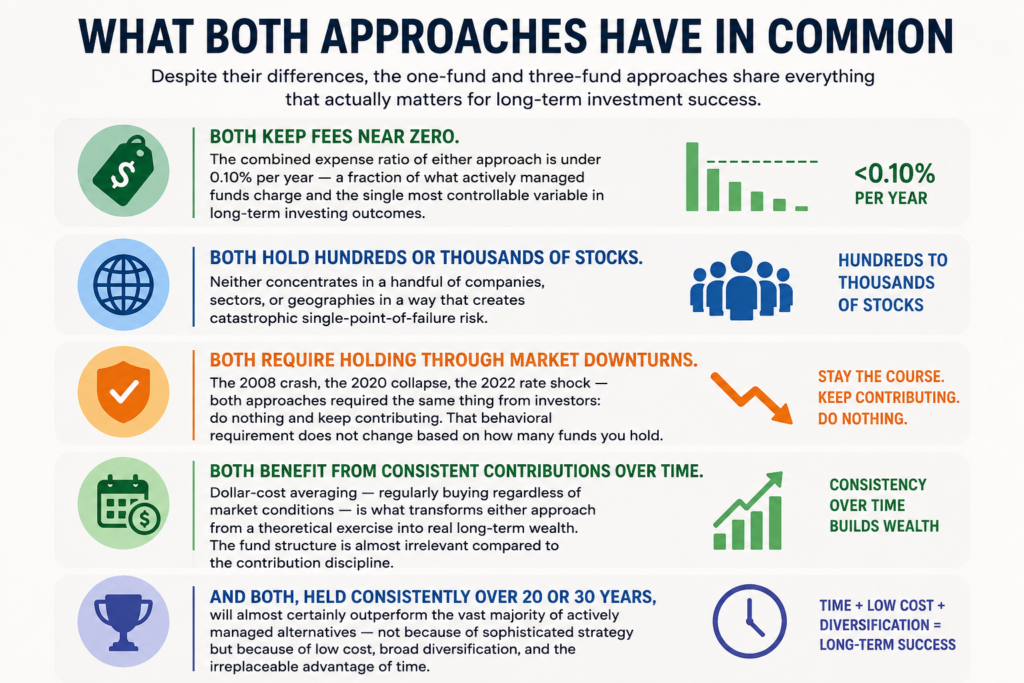
Despite their differences, the one-fund and three-fund approaches share everything that actually matters for long-term investment success.
Both keep fees near zero. The combined expense ratio of either approach is under 0.10% per year — a fraction of what actively managed funds charge and the single most controllable variable in long-term investing outcomes.
Both hold hundreds or thousands of stocks. Neither concentrates in a handful of companies, sectors, or geographies in a way that creates catastrophic single-point-of-failure risk.
Both require holding through market downturns. The 2008 crash, the 2020 collapse, the 2022 rate shock — both approaches required the same thing from investors: do nothing and keep contributing. That behavioral requirement does not change based on how many funds you hold.
Both benefit from consistent contributions over time. Dollar-cost averaging — regularly buying regardless of market conditions — is what transforms either approach from a theoretical exercise into real long-term wealth. The fund structure is almost irrelevant compared to the contribution discipline.
And both, held consistently over 20 or 30 years, will almost certainly outperform the vast majority of actively managed alternatives — not because of sophisticated strategy but because of low cost, broad diversification, and the irreplaceable advantage of time.
A Practical Starting Point
For investors who genuinely cannot decide between one fund and three, here is a concrete starting recommendation that serves most people well in 2026. (To see how these choices map out perfectly across your entire investing lifecycle, check out our comprehensive guide on the best ETF allocation by age: 20s, 30s, 40s, and beyond).
If you are under 40 and have a Roth IRA or taxable account with a long time horizon: start with VT. One fund, one decision, maximum simplicity. If you find yourself wanting more control over your allocation after a year or two of experience, switching to a three-fund structure is straightforward and inexpensive.
If you are between 40 and 55 and want some bond exposure: use the three-fund structure with VOO, VXUS, and BND at an allocation appropriate for your age — roughly your age in bonds as a starting point, adjusted down 10–20 points if you have a high risk tolerance.
If you are over 55 approaching retirement: the three-fund or four-fund structure with a meaningful bond allocation gives you more control over risk management as the retirement date approaches, which matters more as the consequence of a poorly timed downturn increases.
In all cases, the most important step is the first one — opening the account, buying the funds, and setting up automatic contributions. Every day that passes without starting is a day of compounding lost. The difference between VT and VOO plus VXUS plus BND is genuinely small. The difference between starting today and waiting another year is not.
Bottom Line
One ETF versus three ETFs is not a question with a correct answer. It is a question about the kind of investor you are and the kind of portfolio you can maintain through decades of market volatility without making behavioral mistakes.
VT wins on simplicity. The three-fund portfolio wins on control and flexibility. Both win decisively over the actively managed, high-fee, behaviorally compromised alternatives that most investors end up with by default.
Pick the approach you will actually stick with. That is the one that wins.
Frequently Asked Questions
Is VT really enough for a complete long-term portfolio? For the equity portion of a portfolio, yes. VT holds over 9,800 stocks across 50+ countries and provides genuine global diversification at 0.07% per year. For investors who also need bond exposure — to reduce volatility or generate income — VT alone is not sufficient and needs to be paired with a bond fund like BND, which immediately creates a two-fund structure.
If the three-fund portfolio is slightly cheaper than VT, why would anyone choose VT? The fee difference is so small — approximately $15 per year on a $50,000 portfolio — that it should not be the deciding factor. Investors choose VT primarily for simplicity and the removal of the ongoing U.S.-international allocation decision. For investors who value that simplicity, the minor fee disadvantage is worth it.
Can I switch from VT to a three-fund portfolio later? Yes, but consider the tax implications if you are in a taxable account. Selling VT at a gain to buy VOO, VXUS, and BND separately triggers a capital gains tax event. Inside a Roth IRA or Traditional IRA, switching is tax-free and straightforward. If you think you may eventually want a three-fund structure, starting with three funds from the beginning avoids this issue.
Does holding three funds mean I am actively managing my portfolio? No. A three-fund portfolio with annual rebalancing is still a passive index strategy. The funds themselves are passive — they track indexes rather than making active stock selections. Rebalancing once per year to maintain your target allocation is maintenance, not active management. Active management involves frequent trading, market timing, or stock selection, none of which are part of a three-fund index approach.
What if my brokerage does not offer VT or one of the three-fund ETFs? Most major brokerages offer all of these funds commission-free. If your 401(k) does not offer VT or VXUS specifically, look for the lowest-cost S&P 500 index fund, international index fund, and bond index fund available in your plan. The brand name does not matter — the index tracked and the expense ratio charged are what determine outcomes.