
Last updated: July 2026 | Reading time: 11 min
Disclaimer: This article is for informational and educational purposes only. Nothing here constitutes financial advice. Cryptocurrency and crypto-linked ETFs are highly volatile and carry substantial risk of loss. Past performance is not a guarantee of future results. Always do your own research and consider speaking with a licensed financial advisor before making investment decisions.
Crypto ETFs in 2026 are no longer just Bitcoin. In two years, the market went from a handful of spot Bitcoin and Ether funds to a genuine altcoin gold rush, with over 100 new crypto ETFs expected to launch this year alone. At the same time, the SEC just hit the brakes on the newest, most complex products. Here’s exactly what changed, which funds actually matter, and how to tell a durable crypto ETF from one that won’t survive 2027.
If you’ve read our piece on the broader active ETF boom in 2026, this is the most extreme version of that same trend: faster approvals, more products, and a much bigger gap between winners and funds that quietly fail.
Why the Crypto ETFs 2026 Pipeline Suddenly Opened Up
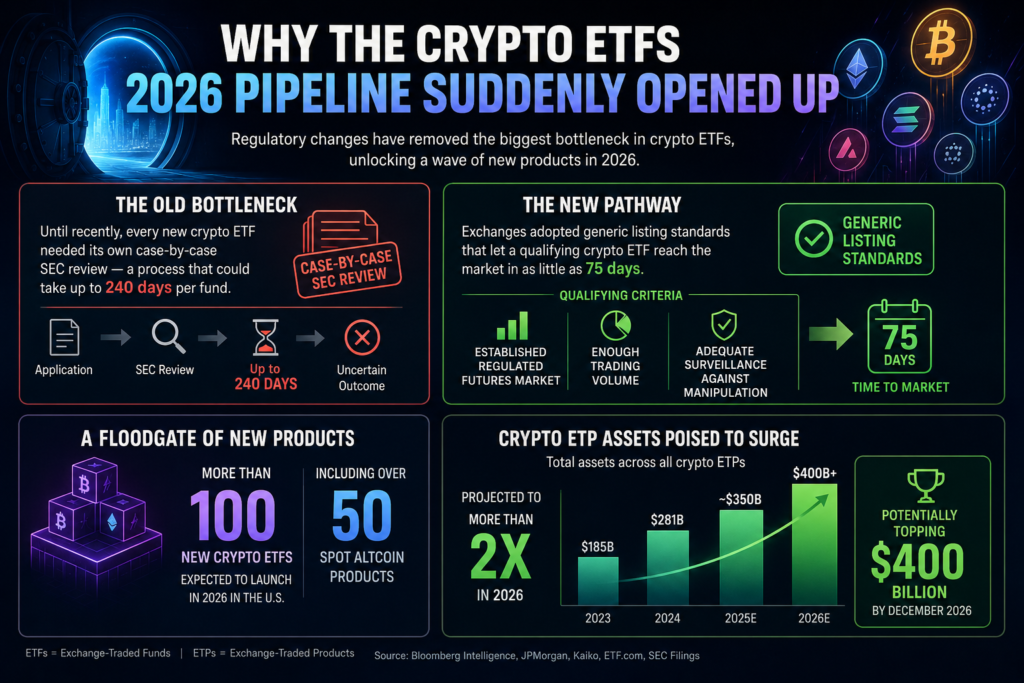
Until recently, every new crypto ETF needed its own case-by-case SEC review — a process that could take up to 240 days per fund. That bottleneck is gone. Exchanges adopted generic listing standards that let a qualifying crypto ETF reach the market in as little as 75 days. Instead of fighting an individual regulatory battle, an asset just needs to meet pre-set criteria: an established regulated futures market, enough trading volume, and adequate surveillance against manipulation.
The result: more than 100 new crypto ETFs are expected to launch in the U.S. in 2026, including over 50 spot altcoin products. Total assets across all crypto ETPs are projected to more than double this year, potentially topping $400 billion by December.
What this means for you: more options is not the same as more quality. The more funds competing for the same attention, the more it matters that you know how to filter out which ones actually have substance behind them.
Which Crypto ETFs Actually Matter Right Now
Bitcoin and Ether still hold the majority of crypto ETF assets, but here’s where the real action is:
| Asset | Status in 2026 | What to know |
|---|---|---|
| Bitcoin (BTC) | Mature, multiple spot ETFs trading since 2024 | Still absorbs the largest share of all ETF inflows; the «safe» entry point into crypto ETFs |
| Ether (ETH) | Mature, spot ETFs plus new staking versions (e.g., ETHB) | Staking versions stake 70–95% of holdings through a custodian for extra yield, but add operational risk |
| Solana (SOL) | Multiple spot ETFs launched late 2025–2026 (funds like BSOL, GSOL, VSOL) | Attracted the fiercest issuer competition of any altcoin — over 20 filings |
| XRP | First spot ETFs approved after its SEC lawsuit was resolved | Long-awaited approval; still building a track record |
| Litecoin (LTC) | First spot altcoin ETF (LTCC), plus commodity classification | Price fell ~89% from its all-time high even after both wins — proof an ETF alone doesn’t move price |
| Dogecoin (DOGE) | ETF approved/listed by Bitwise; NYSE Arca cleared listing | Tests whether institutional money follows meme coins |
Direct takeaway: approval and price movement are two separate things. Don’t buy a crypto ETF just because it «finally got approved» — check whether real trading volume and assets are actually following it.
The SEC’s New Rulebook: What Actually Changed
On June 30, 2026, the SEC opened a 60-day public comment period on how to regulate «novel» ETF structures — staking-yield funds, prediction-market ETFs, and complex altcoin baskets. About two dozen event-contract ETF filings were paused in May, and staking ETF applications from major asset managers are stuck in review rather than moving toward approval.
What this does not affect: existing spot Bitcoin and Ether ETFs keep trading normally.
What it does affect: the next generation of products that go beyond simply holding a token — staking rewards, derivatives, and other mechanics the SEC’s current rules weren’t built for. Regulators say they’re building a record before writing new rules, not shutting the door.
Practical effect for you: if you’re eyeing a staking ETF or anything tied to a prediction-market or basket structure, expect slower approvals for the rest of 2026. Plain spot ETFs for already-cleared assets (Bitcoin, Ether, Solana, Litecoin, XRP) are not affected by this pause.
The Risk Nobody’s Advertising: A Coming Wave of Closures
Bloomberg Intelligence has flagged over 125 pending crypto ETP filings as of mid-2026, and analysts expect a wave of liquidations later this year or into 2027 as under-subscribed funds fail to gather enough assets to stay open. This is the same pattern playing out across the wider ETF industry: issuers rush a product to market to catch a narrow window of attention, and when the hype fades, the fund gets wound down.
The risk is amplified in crypto specifically because demand is so concentrated. Bitcoin and Ether products absorb the overwhelming majority of flows, while dozens of altcoin funds fight over what’s left. Litecoin’s ETF, for example, saw its first meaningful net inflows — just over $260,000 in a single day — a full month after launch. That’s a tiny number for a fund competing in a field of 100+ new products.
How to Evaluate Any Crypto ETF Before Buying
Skip the marketing and check these five things directly on the issuer’s website or a data source like ETF.com:
- Assets under management (AUM). Under $20-30 million after several months of trading is a warning sign — the fund may struggle to stay open.
- Average daily trading volume. Low volume means wider bid-ask spreads, so you lose money just entering and exiting.
- Structure: spot, futures, or staking. A spot ETF simply holds the asset. A futures-based ETF can drift from the spot price over time. A staking ETF adds yield but also custody and smart-contract risk.
- Expense ratio. Newer altcoin ETFs often charge 0.30%–0.95%, sometimes with a temporary fee waiver to attract early assets — check what the fee reverts to once the waiver ends.
- Issuer track record. BlackRock, Fidelity, Bitwise, VanEck, and Grayscale have the strongest history of keeping funds open even through slow periods. Smaller, newer issuers close funds faster when demand doesn’t materialize.
Direct Answers to Common Questions
Is a crypto ETF safer than buying the token directly? It removes wallet and exchange custody risk, and it’s easier to buy through a normal brokerage account. It does not remove price volatility — you still fully own the ups and downs of the underlying asset.
Does ETF approval mean the price will go up? No. Litecoin is the clearest example: it got a spot ETF and a commodity classification in the same window, and its price still sits roughly 89% below its all-time high. Approval creates access, not demand.
Are staking ETFs worth the extra risk? Only if you understand what you’re trading off. You get extra yield from staking rewards, but you add a layer of custodial and smart-contract risk that a plain spot ETF doesn’t have. For most investors, a plain spot ETF in a large, established asset is the simpler and lower-risk starting point.
Should I buy a new altcoin ETF right after it launches? Generally, no. Let it trade for at least a few months and check whether AUM and volume are actually growing. Early hype often fades fast, and a fund that can’t attract lasting assets is a candidate for the closures analysts are expecting later in 2026.
Which crypto ETFs are the lowest-risk way to start? Spot Bitcoin and Ether ETFs remain the most established, most liquid, and most likely to still exist in five years. Everything further down the list — altcoins, staking funds, meme-coin ETFs — carries progressively more risk and less certainty.
The Bottom Line
Crypto ETFs in 2026 sit at the intersection of two forces pulling in opposite directions: a regulatory framework that’s finally opening the door to a much wider range of digital assets, and an industry racing to fill that door with as many products as possible before investor attention moves on. The funds tied to the largest, most liquid tokens with real institutional demand are likely to become durable holdings. Many of the rest are competing for a shrinking pool of investor dollars and may not exist in a year or two.
The rule of thumb is simple: newly approved is not the same as worth buying. Check the numbers — AUM, volume, structure, fees — before the marketing convinces you otherwise. We’ll keep tracking which crypto ETFs are actually gathering assets versus which ones are just adding to an increasingly crowded shelf.