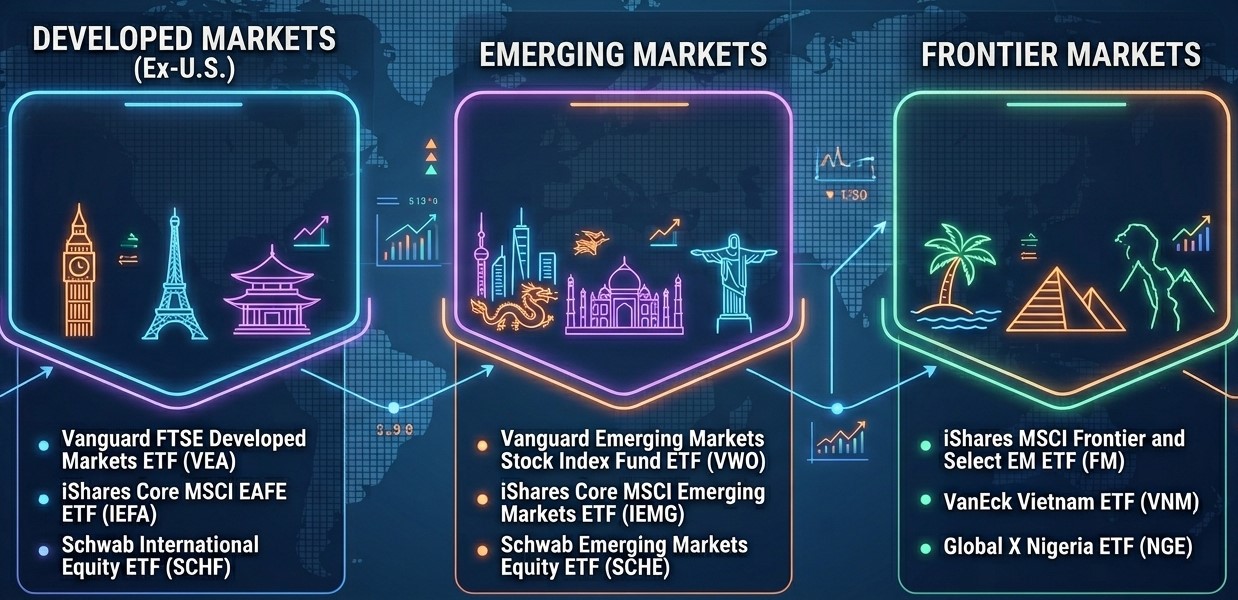
Many investors naturally focus on U.S. stocks because they are familiar, accessible, and have delivered exceptional returns over the past decade. However, limiting your portfolio to a single country can expose you to unnecessary concentration risk. International ETFs offer a simple way to diversify across different economies, currencies, industries, and growth opportunities around the world.
While the U.S. remains the largest stock market globally, international markets still account for a significant share of global economic activity. By adding international ETFs to your portfolio, you gain exposure to thousands of companies outside the United States and reduce your dependence on the performance of a single market.
Here are some of the best international ETFs for investors looking to build a more globally diversified portfolio.
Why International Diversification Matters
Investing internationally provides several potential benefits:
- Exposure to global economic growth
- Reduced reliance on the U.S. economy
- Access to industries less represented in U.S. indexes
- Currency diversification
- Potential opportunities when international markets outperform U.S. stocks
Although U.S. stocks have dominated recent years, history shows that leadership rotates between regions. International diversification helps investors avoid concentrating all their risk in one market.
1. Vanguard Total International Stock ETF (VXUS)
The Vanguard Total International Stock ETF (VXUS) is often considered the gold standard for international diversification.
VXUS provides exposure to thousands of companies across both developed and emerging markets outside the United States.
Key features:
- Broad global diversification
- Exposure to Europe, Asia, Canada, Australia, and emerging markets
- Thousands of holdings
- Low expense ratio
Because of its broad reach, VXUS is frequently used as the international component of a long-term ETF portfolio.
Best For
Investors seeking a single ETF that covers nearly the entire non-U.S. stock market.
2. iShares Core MSCI Total International Stock ETF (IXUS)
The iShares Core MSCI Total International Stock ETF (IXUS) is one of the closest competitors to VXUS.
Like VXUS, IXUS provides exposure to developed and emerging markets worldwide while excluding U.S. stocks.
Advantages include:
- Broad international exposure
- Large number of holdings
- Low-cost structure
- Strong diversification across regions
Performance differences between IXUS and VXUS are generally small because both funds track similar global markets.
Best For
Investors looking for a broad international ETF outside the Vanguard ecosystem.
3. Vanguard FTSE Developed Markets ETF (VEA)
The Vanguard FTSE Developed Markets ETF (VEA) focuses exclusively on developed markets outside the United States.
Major country exposures include:
- Japan
- United Kingdom
- Canada
- France
- Switzerland
- Germany
- Australia
Unlike VXUS, VEA excludes emerging markets.
Many investors prefer this approach because developed markets tend to be less volatile than emerging economies.
Best For
Investors who want international exposure while avoiding emerging-market risk.
4. iShares MSCI EAFE ETF (EFA)
The iShares MSCI EAFE ETF (EFA) is one of the oldest and most established international ETFs.
EAFE stands for:
- Europe
- Australasia
- Far East
The fund focuses on developed markets and excludes both the United States and emerging markets.
Although newer ETFs often offer lower fees, EFA remains popular due to its long track record and liquidity.
Best For
Investors seeking established exposure to developed international markets.
5. Vanguard FTSE Emerging Markets ETF (VWO)
The Vanguard FTSE Emerging Markets ETF (VWO) provides targeted exposure to emerging economies.
Countries typically represented include:
- China
- India
- Taiwan
- Brazil
- Saudi Arabia
- South Africa
Emerging markets often offer higher growth potential but can also experience greater volatility and political risk.
For investors with a long time horizon, adding a dedicated emerging-market allocation can increase diversification and growth opportunities.
Best For
Investors seeking higher-growth international exposure.
6. iShares Core MSCI Emerging Markets ETF (IEMG)
The iShares Core MSCI Emerging Markets ETF (IEMG) is another leading emerging-markets ETF.
Compared with VWO, IEMG offers slightly different country and company weightings but serves a similar purpose.
Benefits include:
- Broad emerging-market exposure
- Access to fast-growing economies
- Large number of holdings
- Competitive expense ratio
Many investors choose between VWO and IEMG based primarily on provider preference.
Best For
Investors looking for diversified emerging-market exposure.
7. Vanguard Total World Stock ETF (VT)
Some investors prefer not to separate U.S. and international investments at all.
The Vanguard Total World Stock ETF (VT) combines both U.S. and international stocks into a single fund.
VT includes:
- U.S. large-cap stocks
- U.S. small-cap stocks
- Developed international markets
- Emerging markets
This makes VT one of the simplest globally diversified investment solutions available.
Best For
Investors who want worldwide diversification through a single ETF.
Developed Markets vs Emerging Markets
One important decision investors face is how much exposure to allocate between developed and emerging markets.
Developed Markets
Advantages:
- More stable economies
- Lower volatility
- Strong regulatory systems
- Established corporations
Examples include Japan, the United Kingdom, Germany, and Canada.
Emerging Markets
Advantages:
- Higher growth potential
- Younger populations
- Expanding middle classes
- Faster economic development
Examples include India, Brazil, Indonesia, and Mexico.
Many investors combine both for balanced international exposure.
Sample International ETF Allocations
Simple Global Portfolio
- 80% U.S. stocks
- 20% VXUS
A common allocation for investors seeking moderate international diversification.
Developed + Emerging Split
- 70% U.S. stocks
- 20% VEA
- 10% VWO
This allows investors to control emerging-market exposure separately.
Global Stock Portfolio
- 100% VT
The ultimate one-fund global solution.
Common Mistakes to Avoid
When investing internationally, investors should avoid:
- Ignoring international markets entirely
- Overweighting a single country
- Chasing recent performance trends
- Assuming the U.S. will always outperform
- Taking excessive emerging-market risk
A diversified approach is usually more effective than making large bets on individual regions.
Final Thoughts
International ETFs play an important role in building a diversified investment portfolio. While U.S. stocks remain a powerful engine of growth, adding global exposure can reduce concentration risk and provide access to opportunities beyond American markets.
For most investors, the Vanguard Total International Stock ETF (VXUS) stands out as the best all-around international ETF due to its broad diversification, low cost, and exposure to both developed and emerging markets. Investors seeking additional customization can combine developed-market funds such as Vanguard FTSE Developed Markets ETF (VEA) with emerging-market funds like Vanguard FTSE Emerging Markets ETF (VWO).
Ultimately, international investing is not about replacing U.S. stocks—it’s about complementing them. A globally diversified portfolio can help investors navigate changing market conditions while positioning themselves for long-term growth across the world economy.
Deja una respuesta