
Last updated: June 2026
Artificial intelligence has stopped being a «theme» and become one of the main engines of the stock market. Semiconductor demand, enterprise AI spending, and robotics adoption have pushed AI-focused ETFs to the top of watchlists for both new and experienced investors heading into the second half of 2026.
(Before looking at specific funds, if you are still questioning the long-term fundamentals of the sector, you might want to start with our comprehensive market study: Is AI still a good investment? The ETFs leading the revolution).
This guide breaks down the AI ETFs that are actually worth comparing right now — not based on hype, but on hard numbers: expense ratio, assets under management, holdings, and historical performance. We’ll also cover who each fund is realistically built for, and what risks come with that kind of concentrated, fast-moving exposure.
Disclaimer: This article is for informational and educational purposes only and does not constitute financial advice. Past performance does not guarantee future results. AI-themed ETFs are concentrated and can be highly volatile. Always do your own research and consider speaking with a licensed financial advisor before investing.
How we evaluate these ETFs
Before ranking anything, we pulled current data directly from each fund’s official factsheet, prospectus, or a recognized financial data provider (VanEck, Global X, ETF.com, Morningstar). For every ETF compared on this site, we look at the same five data points:
- Expense ratio (TER): the annual cost you pay as a shareholder, taken directly out of returns
- AUM (Assets Under Management): a proxy for liquidity and investor confidence
- Historical performance: YTD and multi-year annualized returns
- Top holdings: what companies actually drive the fund’s performance
- Dividend yield and distribution frequency: relevant for income-focused investors, even in growth-oriented funds
See our [Methodology page] for the full breakdown of how we source and verify this data, and how often we update it.
Quick comparison: Best AI ETFs in 2026
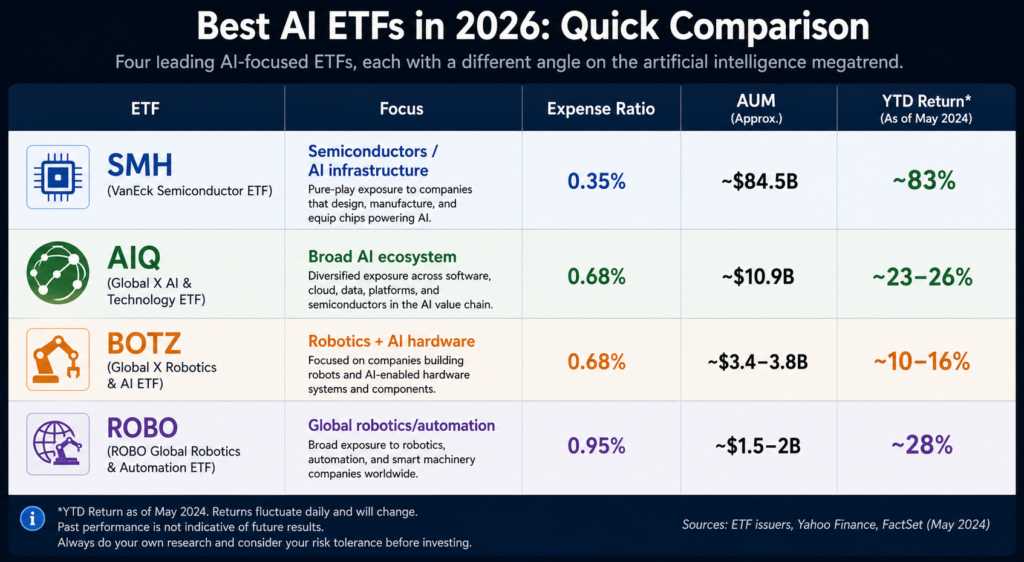
1. VanEck Semiconductor ETF (SMH) — Best for pure AI infrastructure exposure
If you believe AI growth is fundamentally a hardware story — chips, GPUs, and the companies that manufacture them — SMH is the most direct way to express that view.
Key facts (as of June 18, 2026, source: VanEck):
- Expense ratio: 0.35%
- Total net assets: approximately $84.5 billion
- YTD return: approximately 83%
- Strategy: tracks the MVIS US Listed Semiconductor 25 Index, holding the 25 largest U.S.-listed semiconductor companies
SMH is heavily concentrated in a handful of chip giants, which is exactly why it’s moved so aggressively in both directions over the past few years. Its three-month worst stretch has seen losses near -24%, and its best three-month stretch has topped +60%. This is not a «set it and forget it» core holding — it’s a high-conviction bet on the semiconductor supply chain that powers AI.
Good for: investors who already have broad market exposure (like an S&P 500 or total market fund) and want to add a concentrated tilt toward the hardware side of AI.
Be cautious if: you’re not comfortable with double-digit swings in a single quarter, or if semiconductors already make up a large slice of your portfolio through other tech holdings.
2. Global X Artificial Intelligence & Technology ETF (AIQ) — Best for broad AI exposure
AIQ takes a wider view than SMH. Instead of betting purely on chipmakers, it blends software, cloud computing, big data, and semiconductor companies into one fund — giving you exposure to the full AI stack rather than just the hardware layer.
Key facts (as of June 2026, source: Global X / fund data providers):
- Expense ratio: 0.68%
- AUM: approximately $10.9 billion
- YTD return: roughly 23–26%, with 3-year annualized returns above 30%
- Holdings: around 90 companies, with the top 10 making up roughly 35% of the fund
- Dividend yield: modest, around 0.14%, paid semi-annually
AIQ’s broader diversification means it tends to be somewhat less volatile than a pure-play semiconductor or robotics fund, while still giving meaningful upside exposure to the AI trade.
Good for: investors who want «AI exposure» without picking a single sub-sector winner — software vs. hardware vs. robotics.
Be cautious if: you’re expecting dividend income — this is a growth fund first, income is incidental.
3. Global X Robotics & Artificial Intelligence ETF (BOTZ) — Best for the robotics angle
BOTZ leans into the physical side of AI: industrial robotics, automation, and surgical robotics, alongside chipmakers like NVIDIA that enable them.
Key facts (as of June 2026, source: Global X / fund data providers):
- Expense ratio: 0.68%
- AUM: approximately $3.4–3.8 billion
- Top holdings: NVIDIA, ABB, Fanuc, Keyence, and Intuitive Surgical typically make up the largest positions
- Geographic mix: significant exposure outside the U.S., particularly Japan and Switzerland, given the concentration of leading robotics manufacturers there
- Performance: more muted than SMH or AIQ in 2026 so far, reflecting the more industrial, less software-driven nature of its holdings
BOTZ is a genuinely different bet than AIQ or SMH — it’s less about generative AI software and more about automation hardware, industrial robots, and the humanoid robotics theme that’s picked up institutional attention this year.
Good for: investors who specifically want exposure to robotics and automation as a long-term industrial trend, not just generative AI software.
Be cautious if: you want pure-play AI software exposure — BOTZ’s industrial tilt means it won’t move in lockstep with names like the big AI software platforms.
4. ROBO Global Robotics & Automation Index ETF (ROBO) — Best for diversified, small/mid-cap robotics exposure
ROBO takes a different construction approach than BOTZ: rather than market-cap weighting, it spreads exposure more evenly across small- and mid-cap automation companies globally.
Key facts (as of mid-2026, source: ROBO Global / fund data providers):
- Expense ratio: 0.95% (the highest of the four funds compared here)
- AUM: approximately $1.5–2 billion
- YTD return: approximately 28%
- Holdings: around 80–90 companies, more evenly weighted than BOTZ
The higher expense ratio is a real drag over the long term — on a $10,000 investment, that’s roughly $95 a year just in fees, before any other costs. ROBO can make sense for investors who specifically want broader small/mid-cap diversification within robotics, but the cost needs to be weighed against that benefit.
Good for: investors who want diversified exposure to the robotics theme beyond the same five or six mega-cap names that dominate BOTZ and AIQ.
Be cautious if: fees matter to you — at 0.95%, this is nearly triple the cost of SMH.
So, which AI ETF should you actually buy?
There’s no single «best» answer — it depends on what part of the AI trade you want exposure to:
- Want the hardware/chips story? → SMH offers the most direct, lowest-cost exposure.
- Want the broadest AI exposure in one fund? → AIQ blends software, cloud, and hardware.
- Want the robotics and automation angle specifically? → BOTZ or ROBO, depending on whether you prefer concentrated mega-caps (BOTZ) or broader small/mid-cap diversification (ROBO).
- Not sure, and want simplicity? Many investors choose to hold a small position (5–10% of their portfolio) in one broad AI ETF like AIQ, layered on top of a core index fund, rather than trying to pick the «winning» sub-sector.
The risk side nobody should skip
AI-themed ETFs are thematic and concentrated by design. That means:
- They can fall as fast as they rise. SMH’s worst three-month stretch on record is close to -24%. These are not bond-like, low-volatility holdings.
- A handful of stocks drive most of the return. In several of these funds, the top 10 holdings account for a third or more of total assets. If a couple of those companies stumble, the whole fund feels it.
- Expense ratios compound. A 0.68% or 0.95% fee may look small, but over 10–20 years it meaningfully reduces your total return compared to a 0.03–0.10% broad index fund.
- «AI ETF» doesn’t mean «safe bet.» These funds are best used as a satellite position alongside a diversified core portfolio — not as someone’s only holding.
Frequently asked questions
Is it too late to invest in AI ETFs in 2026? Nobody can answer that with certainty, and any source claiming otherwise should be treated with skepticism. What’s true is that valuations across AI-related stocks have risen sharply, and that increases both the potential reward and the potential downside. Dollar-cost averaging — investing a fixed amount regularly rather than all at once — is one common approach investors use to manage entry-point risk in fast-moving sectors.
What’s the difference between an AI ETF and a tech ETF like QQQ? A broad tech ETF like QQQ holds a wide mix of technology companies, many with limited direct AI exposure. AI-specific ETFs like AIQ, BOTZ, or SMH concentrate more narrowly on companies whose revenue is more directly tied to AI, semiconductors, or robotics — which means more concentrated upside, but also more concentrated risk.
Can I hold more than one of these AI ETFs at once? Yes, but check for overlap first. SMH, AIQ, and BOTZ all hold NVIDIA, for example, so combining them doesn’t necessarily multiply your diversification — it can just multiply your exposure to the same handful of mega-cap names.