
Last updated: June 2026 | Reading time: 9 min
Disclaimer: This article is for informational and educational purposes only. Nothing here constitutes financial advice. Cryptocurrency is a highly volatile and speculative asset class. Past performance is not a guarantee of future results. Always consult a licensed financial advisor before making investment decisions.
A Question That Did Not Exist Three Years Ago
Until early 2024, retail investors in the United States who wanted Bitcoin exposure essentially had one option: open an account on a crypto exchange, buy Bitcoin directly, and figure out how to store it safely. The arrival of spot Bitcoin ETFs in January 2024 — approved by the SEC after years of rejections — changed that calculus entirely. For the first time, investors could get direct Bitcoin price exposure through a standard brokerage account, the same way they buy shares of Apple or a Vanguard index fund.
By mid-2026, spot Bitcoin ETFs have accumulated tens of billions of dollars in assets and become some of the most successful ETF launches in history. But the existence of a new option does not automatically make it the right option. Whether a Bitcoin ETF or direct spot ownership makes more sense depends on your priorities around cost, convenience, tax efficiency, custody, and how you think about the broader purpose of holding Bitcoin in the first place.
This article lays out the honest case for both approaches so you can make that decision with a clear understanding of what you are actually choosing between.
What Spot Bitcoin ETFs Actually Are
A spot Bitcoin ETF holds actual Bitcoin — not futures contracts, not derivatives, but the underlying asset itself — in custody on behalf of its shareholders. When you buy a share of a spot Bitcoin ETF, the fund manager purchases a corresponding amount of Bitcoin and holds it in cold storage through an institutional custodian. The ETF share price tracks the Bitcoin spot price closely, with the small divergences kept tight by authorized participant arbitrage mechanisms similar to those used in traditional equity ETFs.
The major spot Bitcoin ETFs currently available in the United States include the iShares Bitcoin Trust (IBIT) from BlackRock, the Fidelity Wise Origin Bitcoin Fund (FBTC), the ARK 21Shares Bitcoin ETF (ARKB), and the Bitwise Bitcoin ETF (BITB), among others. BlackRock’s IBIT has become the dominant fund by assets, reflecting the institutional credibility that BlackRock’s involvement brought to a product category that regulators had resisted for years.
These funds charge annual expense ratios that have settled in the range of 0.19% to 0.25% for the major providers after an initial fee war following launch. That cost is deducted from the fund’s Bitcoin holdings over time, meaning shareholders receive slightly less than pure Bitcoin price appreciation.
The Case for Bitcoin ETFs
The strongest argument for Bitcoin ETFs is simplicity and accessibility. Most investors already have brokerage accounts — at Fidelity, Schwab, Vanguard, or a similar provider. Buying IBIT or FBTC requires no new accounts, no learning curve around wallets and private keys, no risk of sending funds to the wrong address, and no interaction with crypto exchanges whose regulatory status and financial stability vary considerably.
For investors who hold Bitcoin inside a tax-advantaged account, the ETF structure is the only practical option. You cannot hold actual Bitcoin in a traditional IRA or Roth IRA through most custodians, but you can hold a Bitcoin ETF the same way you hold any other fund. The tax benefits of holding a volatile, potentially high-returning asset like Bitcoin inside a Roth IRA — where gains are never taxed — are substantial, and the ETF structure is what makes that possible.
Custody is another major practical advantage. The institutional custodians used by BlackRock, Fidelity, and the other major Bitcoin ETF providers — primarily Coinbase Custody — hold Bitcoin in cold storage with security infrastructure that is genuinely beyond what most retail investors can replicate on their own. The history of crypto is littered with individual investors who lost Bitcoin to exchange hacks, forgotten passwords, damaged hardware wallets, and phishing attacks. An ETF eliminates all of those risks at the cost of giving up direct ownership.
Finally, Bitcoin ETFs fit seamlessly into standard portfolio management workflows. They appear on brokerage statements alongside other holdings, can be included in rebalancing calculations, and can be transferred or inherited through standard estate planning mechanisms without the complexity that direct Bitcoin ownership introduces.
The Case for Buying Bitcoin Directly
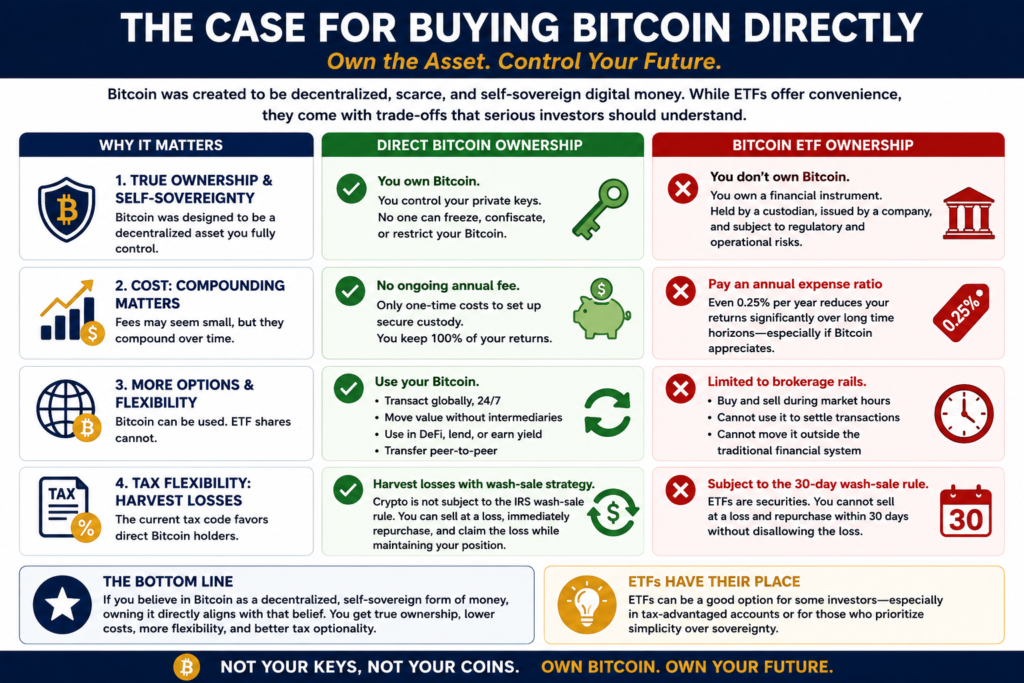
The philosophical case for owning Bitcoin directly rather than through an ETF begins with the original purpose of the asset. Bitcoin was designed to be a decentralized, self-sovereign form of money that no institution can freeze, confiscate, or inflate. When you hold Bitcoin in an ETF, you do not actually own Bitcoin — you own a financial instrument that tracks Bitcoin’s price, issued by a company, held by a custodian, and subject to the regulatory and operational risks of both. For investors who hold Bitcoin because they believe in its properties as a non-custodial asset, an ETF fundamentally misses the point.
The cost argument also favors direct ownership over sufficiently long time horizons. A 0.25% annual expense ratio sounds trivial, but on a $100,000 Bitcoin position held for twenty years, the compounding cost is meaningful — particularly if Bitcoin appreciates significantly over that period. Direct ownership has no ongoing annual cost beyond the one-time expense of setting up secure custody.
Direct ownership also provides options that ETF shareholders do not have. Bitcoin held in self-custody can be used in transactions, moved internationally without intermediaries, lent on decentralized finance platforms, or transferred peer-to-peer. An ETF share can only be bought and sold through a brokerage account during market hours — you cannot use it to settle a transaction or move it outside the traditional financial system.
The tax treatment of direct Bitcoin ownership also offers a flexibility that ETFs do not. When Bitcoin falls in price, direct holders can harvest tax losses by selling and immediately rebuying — a strategy called wash-sale harvesting that currently applies to crypto but not to securities. Because the IRS wash-sale rule does not yet apply to cryptocurrency, direct Bitcoin holders can sell at a loss, immediately repurchase, and claim the tax loss while maintaining their position. ETF holders cannot do this because ETFs are securities and subject to the 30-day wash-sale rule.
The Custody Question Is More Important Than Most Investors Realize
The single most consequential practical difference between owning Bitcoin directly and owning it through an ETF is custody — and most investors do not think carefully enough about what each option actually involves.
Holding Bitcoin directly means being responsible for the private keys that control your coins. The most secure approach — hardware wallet cold storage — is genuinely secure when done correctly, but it requires understanding how to set up a hardware wallet, how to back up seed phrases securely, and how to plan for the possibility that you become incapacitated or die without leaving your heirs a way to access the funds. Getting any of these details wrong can result in permanent, unrecoverable loss of your Bitcoin.
Holding Bitcoin on an exchange — which is what most retail crypto investors actually do despite the security risks — is categorically different from true self-custody. Exchange-held Bitcoin is subject to exchange insolvency risk (FTX being the most dramatic recent example), exchange hacks, withdrawal freezes during periods of market stress, and regulatory actions that can prevent access to funds. The crypto industry phrase «not your keys, not your coins» exists precisely because exchange custody has failed so many investors in so many ways.
A Bitcoin ETF with institutional custody is significantly more secure than exchange-held Bitcoin for most retail investors, while being less sovereign than true self-custody done correctly. For investors who are not prepared to manage hardware wallets and seed phrase backups with genuine discipline, the ETF’s institutional custody is not a compromise — it is the superior security arrangement.
Tax Considerations That Genuinely Differ
Both Bitcoin ETFs and direct Bitcoin are treated as property by the IRS for tax purposes, meaning gains and losses are subject to capital gains tax. Short-term gains on positions held less than one year are taxed as ordinary income. Long-term gains on positions held more than one year benefit from the preferential capital gains rate. This basic framework is the same for both.
The differences emerge in the details. As noted above, direct Bitcoin benefits from wash-sale flexibility that ETF holders do not currently have. Direct Bitcoin can also be donated directly to charitable organizations at fair market value, potentially avoiding capital gains tax entirely on appreciated positions — a strategy that works the same way for Bitcoin ETF shares, so this advantage is not exclusive to direct ownership.
The most significant tax advantage of Bitcoin ETFs is the ability to hold them in tax-advantaged accounts. A Bitcoin position that doubles in a Roth IRA generates no tax liability whatsoever on withdrawal in retirement. For younger investors with long time horizons who believe Bitcoin has substantial upside, this tax-free compounding effect can dwarf the 0.25% annual expense ratio many times over.
Which Approach Fits Which Investor
The right choice depends on what you are actually trying to accomplish with Bitcoin exposure and how seriously you engage with the self-custody question.
Investors who want Bitcoin exposure as part of a diversified portfolio, who value simplicity and integration with existing brokerage accounts, who want to hold Bitcoin in a tax-advantaged account, or who are not prepared to manage hardware wallet security with genuine discipline — these investors are better served by a spot Bitcoin ETF. IBIT and FBTC are the strongest options given their low expense ratios, institutional backing, and liquidity.
Investors who hold Bitcoin because they believe in its properties as a self-sovereign, censorship-resistant asset, who are genuinely committed to learning and maintaining proper self-custody, who want to avoid ongoing annual fees over a multi-decade holding period, or who want to use the wash-sale flexibility for tax management — these investors have legitimate reasons to prefer direct ownership with proper cold storage.
A middle path that many informed investors use is to hold a core Bitcoin position in a spot ETF within a Roth IRA for tax efficiency, while maintaining a smaller self-custodied position in cold storage for the sovereignty and optionality that direct ownership provides. This approach captures the tax advantages of the ETF structure while preserving some exposure to Bitcoin’s original value proposition as a non-custodial asset.
The Bottom Line
For most retail investors in 2026, a spot Bitcoin ETF is the more practical, safer, and tax-efficient way to hold Bitcoin exposure — particularly for anyone who does not have a clear, specific reason to prefer direct ownership. The institutional custody, brokerage account integration, and Roth IRA eligibility are genuine advantages that the modest 0.19–0.25% annual expense ratio does not come close to offsetting for most use cases.
Direct spot Bitcoin ownership remains the more philosophically coherent choice for investors who hold Bitcoin specifically for its properties as a self-sovereign asset, who are prepared to manage cold storage security properly, and who want to maximize tax flexibility through wash-sale harvesting. Done correctly, direct ownership is also the lower-cost option over very long holding periods.
The question worth asking yourself honestly is not which option sounds more sophisticated, but which one you will actually manage with the care it requires — and which one aligns with the real reason you want Bitcoin exposure in the first place.
Frequently Asked Questions
Is a Bitcoin ETF safer than buying Bitcoin on an exchange?
For most retail investors, yes. Spot Bitcoin ETFs use institutional-grade cold storage custodians like Coinbase Custody with security infrastructure that significantly exceeds what most exchanges provide. The collapse of FTX demonstrated that exchange custody carries real counterparty risk. An ETF from BlackRock or Fidelity carries the institutional credibility and regulatory oversight of those organizations, which is meaningfully different from keeping Bitcoin on a crypto exchange.
Can I hold a Bitcoin ETF in a Roth IRA?
Yes, and this is one of the most compelling reasons to use the ETF structure. Spot Bitcoin ETFs like IBIT and FBTC can be held in traditional IRAs, Roth IRAs, and 401(k) accounts that offer brokerage windows, just like any other ETF. Gains inside a Roth IRA grow completely tax-free, which is a substantial advantage for a volatile, potentially high-returning asset like Bitcoin.
What happens to a Bitcoin ETF if the custodian is hacked?
The major Bitcoin ETF custodians hold assets in cold storage — offline, air-gapped systems that are not accessible via the internet and therefore not vulnerable to remote hacking. In the highly unlikely event of a custodial failure, the ETF structure includes insurance arrangements and legal protections that do not exist for retail investors holding Bitcoin on exchanges. The prospectus of each fund details the specific custody and insurance arrangements.
Does the IRS wash-sale rule apply to Bitcoin ETFs?
Yes. Bitcoin ETFs are securities and are subject to the standard 30-day wash-sale rule that applies to stocks and funds. If you sell a Bitcoin ETF at a loss and repurchase it within 30 days, the loss is disallowed for tax purposes. Direct Bitcoin does not currently have this restriction, which gives direct holders more tax-loss harvesting flexibility.
Which Bitcoin ETF has the lowest fees?
As of mid-2026, the lowest-cost spot Bitcoin ETFs in the United States include Bitwise’s BITB and Franklin Templeton’s EZBC, which have competed aggressively on fees since launch. BlackRock’s IBIT and Fidelity’s FBTC sit slightly higher but offer the largest AUM and liquidity. Always verify current expense ratios on the fund issuer’s website before investing, as fee structures in this space have continued to evolve.