
Last updated: June 2026 | Reading time: 9 min
Disclaimer: This article is for informational and educational purposes only. Nothing here constitutes financial advice. Tax laws are subject to change and individual circumstances vary significantly. Always consult a licensed tax professional or financial advisor before making tax-related investment decisions.
The Strategy That Turns Losses Into Money
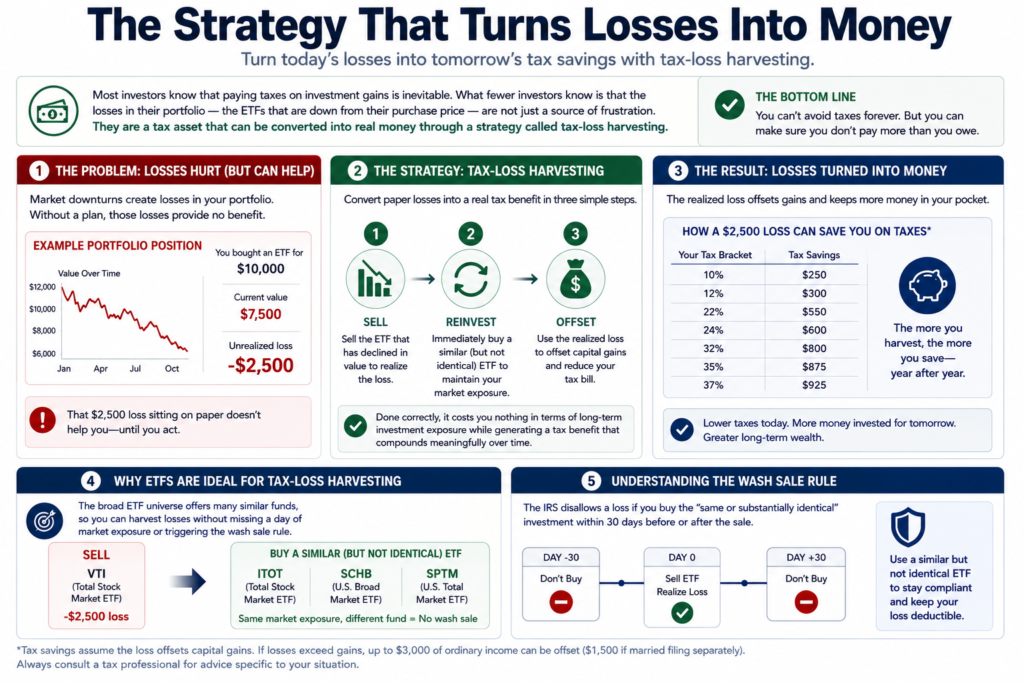
Most investors know that paying taxes on investment gains is inevitable. What fewer investors know is that the losses in their portfolio — the ETFs that are down from their purchase price — are not just a source of frustration. They are a tax asset that can be converted into real money through a strategy called tax-loss harvesting.
Tax-loss harvesting is the practice of selling an investment that has declined in value to realize a capital loss, then immediately reinvesting the proceeds in a similar but not identical fund to maintain your market exposure. The realized loss offsets capital gains elsewhere in your portfolio, reducing your tax bill for the year. Done correctly, it costs you nothing in terms of long-term investment exposure while generating a tax benefit that compounds meaningfully over time.
ETFs are particularly well-suited to tax-loss harvesting because the broad market offers multiple funds tracking similar indexes — which means you can sell one and buy another without missing a day of market exposure or triggering the IRS’s wash sale rule.
The Tax Rules You Need to Understand
Before explaining how to execute tax-loss harvesting with ETFs, it is essential to understand the tax framework it operates within.
Capital gains are the profits you earn when you sell an investment for more than you paid. Short-term capital gains — on assets held for one year or less — are taxed as ordinary income, at rates up to 37% depending on your tax bracket. Long-term capital gains — on assets held more than one year — are taxed at preferential rates of 0%, 15%, or 20% depending on income. For most middle and upper-middle income investors, the long-term rate is 15%.
Capital losses offset capital gains dollar for dollar. If you have $10,000 in realized capital gains and $6,000 in realized capital losses, you pay tax only on the net $4,000. If your losses exceed your gains in a given year, you can deduct up to $3,000 of net losses against ordinary income — and carry any remaining losses forward to future tax years indefinitely.
The wash sale rule is the critical constraint that makes tax-loss harvesting with ETFs require careful execution. The IRS prohibits claiming a capital loss if you buy a «substantially identical» security within 30 days before or after the sale — the 30-day window applies in both directions. If you sell VOO at a loss and buy VOO back the next day, the loss is disallowed. The key to tax-loss harvesting is identifying replacement funds that maintain your desired market exposure without being substantially identical to what you sold.
How the Wash Sale Rule Applies to ETFs
The IRS wash sale rule was designed with individual stocks in mind, but it applies to ETFs as well. The IRS has not provided definitive guidance on exactly which ETF pairs qualify as substantially identical, which creates both uncertainty and opportunity.
The practical standard that most tax professionals and financial advisors apply is this: ETFs tracking different indexes from different index providers are generally not considered substantially identical, even if they cover very similar markets. ETFs tracking the same index — for example, VOO and IVV, which both track the S&P 500 — are almost certainly substantially identical and should not be used as harvest pairs.
This is where the structure of the ETF market becomes strategically useful. Vanguard and iShares often offer funds covering nearly identical markets but tracking different indexes — FTSE versus MSCI — which provides a clear basis for treating them as not substantially identical.
Common and widely-used ETF harvest pairs include VOO (Vanguard S&P 500, tracks S&P 500) swapped for SCHB (Schwab U.S. Broad Market ETF, tracks Dow Jones U.S. Broad Stock Market Index) or VTI (Vanguard Total Stock Market, tracks FTSE USA All Cap). VTI can be swapped for ITOT (iShares Core S&P Total U.S. Stock Market ETF, tracks S&P TMI Index). VXUS can be swapped for IXUS (iShares Core MSCI Total International). BND can be swapped for AGG (iShares Core U.S. Aggregate Bond ETF).
The important caveat is that the IRS has not formally ruled on which specific ETF pairs are or are not substantially identical. Tax-loss harvesting with ETFs operates in a zone of informed judgment rather than absolute certainty. Consulting a tax professional before executing a harvest is advisable, particularly for large positions.
A Step-by-Step Example
Walking through a concrete example makes the mechanics clearer than any abstract description.
Suppose it is October 2026 and you hold $50,000 in VOO in a taxable brokerage account. You bought it in January 2026 at $480 per share, and the current price is $408 — a 15% decline. You hold 104 shares worth approximately $42,400, representing an unrealized loss of $7,600.
You also have $12,000 in realized capital gains from selling a rental property earlier in the year.
Step one: Sell your 104 shares of VOO, realizing a capital loss of approximately $7,600.
Step two: Immediately use the $42,400 proceeds to buy SCHB or VTI — a fund that covers essentially the same U.S. market but tracks a different index. You are back in the market within minutes of selling, maintaining your equity exposure throughout.
Step three: Hold the replacement fund for at least 31 days to clear the wash sale window. After 31 days, you can switch back to VOO if you prefer, or simply continue holding the replacement fund indefinitely — the investment thesis is the same either way.
The result: your $7,600 capital loss offsets $7,600 of the $12,000 in property sale gains, reducing your taxable capital gain from $12,000 to $4,400. At a 15% long-term capital gains rate, that saves you $1,140 in taxes. At a 20% rate for higher-income investors, the savings are $1,520. You maintained full market exposure the entire time and generated over $1,000 in tax savings from an otherwise painful market decline.
When Tax-Loss Harvesting Generates the Most Value
The tax benefit of harvesting is real but not permanent — it is a deferral, not an elimination. When you eventually sell the replacement fund, you will have a lower cost basis (because you bought it after selling at a loss), which means you will owe more tax at that point. The value of harvesting comes from the time value of money: a tax you do not pay today is worth more than the same tax paid in ten or twenty years, because the money you kept can compound in the meantime.
This means tax-loss harvesting generates more value in specific circumstances. High tax brackets amplify the benefit — an investor in the 37% ordinary income bracket or the 20% long-term capital gains bracket saves more absolute dollars than one in a lower bracket. Long time horizons amplify the benefit because the deferred tax has more years to compound. Large portfolios generate more harvesting opportunities in absolute dollar terms. And years with significant realized gains — from selling property, a business, or highly appreciated securities — make harvesting especially valuable because the losses directly offset those gains.
Harvesting generates less value for investors in the 0% long-term capital gains bracket, those who plan to hold their ETFs until death (at which point heirs receive a stepped-up cost basis that eliminates the embedded gain entirely), and those investing primarily in tax-advantaged accounts where capital gains are already sheltered.
The Accounts Where Tax-Loss Harvesting Applies
Tax-loss harvesting only applies to taxable brokerage accounts. It has no relevance inside Roth IRAs, Traditional IRAs, 401(k) plans, or any other tax-advantaged account because gains and losses inside those accounts do not generate current-year tax consequences.
This is a critical point that many investors miss. If all of your investments are in a Roth IRA or 401(k), tax-loss harvesting is not available to you — and there is no action required. The strategy is exclusively for taxable accounts where every sale has a tax consequence.
For investors with both taxable and tax-advantaged accounts, the optimal long-term strategy is to hold tax-efficient assets — broad market equity ETFs like VOO and VTI that generate minimal dividends and capital gains distributions — in taxable accounts, and to hold less tax-efficient assets — bond ETFs, REITs, high-dividend funds — inside retirement accounts. This asset location strategy works in conjunction with tax-loss harvesting to minimize the overall tax drag on long-term wealth building.
Automated Tax-Loss Harvesting: Robo-Advisors
For investors who want the benefits of tax-loss harvesting without executing it manually, robo-advisors like Betterment, Wealthfront, and Schwab Intelligent Portfolios offer automated tax-loss harvesting as part of their service.
These platforms monitor your portfolio daily, identify harvesting opportunities when they arise, execute the trades automatically using pre-selected ETF pairs, and manage the 30-day wash sale window without any action required from you. For investors with taxable accounts who do not want to track market movements and manually execute harvests, this automation is genuinely valuable.
The trade-off is cost and control. Betterment charges 0.25% per year for its standard service; Wealthfront charges 0.25% as well. These fees are modest but not zero — they represent a meaningful portion of the tax benefit for smaller accounts. Investors with larger taxable accounts — $200,000 and above — may find that manually executing harvests a few times per year generates similar or better tax alpha than an automated service at lower total cost.
Schwab Intelligent Portfolios offers automated tax-loss harvesting with no advisory fee, which makes it the most cost-efficient automated option for investors comfortable with Schwab’s platform and investment methodology.
Common Mistakes That Eliminate the Tax Benefit
Violating the wash sale rule is the most consequential mistake. Buying back the same ETF you sold within 30 days — even inadvertently through automatic dividend reinvestment — disallows the loss. Turn off automatic dividend reinvestment in your taxable account if you are actively harvesting, and track the 31-day window carefully before repurchasing your original fund.
Ignoring transaction costs and bid-ask spreads can erode the tax benefit for small positions. If you are harvesting a $2,000 loss to save $300 in taxes but paying $25 in transaction costs and losing $15 to bid-ask spreads on both the sale and the purchase, your net benefit is closer to $260 — still positive, but worth calculating rather than assuming.
Harvesting short-term losses when you have short-term gains is more valuable than harvesting long-term losses to offset long-term gains, because short-term gains are taxed at ordinary income rates while long-term gains are taxed at preferential rates. Prioritize harvesting positions held less than one year when you have significant short-term gains to offset.
Forgetting state taxes is an oversight that affects the calculation. Most states tax capital gains at ordinary income rates without the federal preferential rate for long-term gains. In a high-tax state like California or New York, where state income tax rates are 9–13%, the total tax savings from harvesting are significantly higher than the federal benefit alone would suggest.
Harvesting inside retirement accounts is a mistake based on misunderstanding the strategy. Capital losses inside an IRA or 401(k) have no tax value — they cannot be used to offset gains or reduce ordinary income. Never sell at a loss inside a retirement account for tax-loss harvesting purposes.
Tax-Loss Harvesting and the Long-Term Cost Basis Consequence
The most important long-term consideration in tax-loss harvesting is cost basis management. Every time you harvest a loss, you purchase a replacement fund at a lower cost basis than your original holding. This lower cost basis means that when you eventually sell, your taxable gain will be larger — you are not eliminating tax, you are deferring it.
For investors who hold ETFs until death, this deferral becomes permanent because heirs receive a stepped-up cost basis equal to the market value at the date of death, eliminating any embedded gain. Tax-loss harvesting is therefore most powerful as a long-term strategy for investors who plan to hold their portfolios for decades and potentially pass them to heirs.
For investors who plan to sell their entire portfolio at some point — to fund retirement spending, purchase a property, or other purposes — the deferred gains will eventually be realized and taxed. The benefit is the time value of the deferral: the longer you hold before realizing those gains, the more value you extracted from the strategy.
Tracking cost basis carefully across all harvesting transactions is essential. Most brokerages now do this automatically using specific identification accounting, which allows you to choose which specific shares to sell when you have multiple lots at different prices — a tool that significantly enhances the flexibility and effectiveness of tax-loss harvesting over time.
Bottom Line
Tax-loss harvesting with ETFs is one of the most practical and accessible tax optimization strategies available to retail investors. It requires no investment acumen, no market timing, and no complex financial products — only the discipline to recognize a loss, understand the wash sale rule, and execute a straightforward swap between similar funds.
The annual tax savings from consistent harvesting in a sizeable taxable account — $500 to $2,000 or more depending on market conditions, portfolio size, and tax bracket — compound significantly over decades. The strategy is not glamorous and does not require predicting market movements. It simply converts the inevitable volatility of market investing into a concrete, recurring tax benefit.
ETFs make it uniquely practical because the depth and breadth of the ETF market provides harvest pairs for virtually every major asset class — U.S. equities, international stocks, bonds, sectors — at low cost and with full liquidity. No other investment vehicle offers the same combination of broad diversification, low fees, and harvest flexibility that ETFs provide.
Frequently Asked Questions
Can I harvest losses in my IRA or 401(k)? No. Tax-loss harvesting only applies to taxable brokerage accounts. Gains and losses inside tax-advantaged accounts like IRAs and 401(k)s have no current-year tax consequences, so harvesting losses in those accounts generates no tax benefit. The strategy is exclusively for taxable accounts.
How do I know if two ETFs are «substantially identical» for wash sale purposes? The IRS has not published a definitive list, but the practical standard applied by most tax professionals is that ETFs tracking different indexes from different providers are generally not substantially identical. VOO (S&P 500, Vanguard/S&P) and SCHB (Dow Jones U.S. Broad Market, Schwab) are widely considered acceptable harvest pairs. VOO and IVV (both tracking the S&P 500) are almost certainly substantially identical. When in doubt, consult a tax professional.
How much money do I need before tax-loss harvesting makes sense? There is no hard threshold, but the strategy generates more value as portfolio size and tax rates increase. For taxable accounts under $50,000 in a moderate tax bracket, the annual tax savings may be modest enough that the effort of manual harvesting is not worthwhile. Automated harvesting through a robo-advisor makes the strategy accessible regardless of account size. For accounts over $200,000, manual harvesting a few times per year can generate meaningful annual savings.
Does tax-loss harvesting reduce my long-term returns? No, when executed correctly. You maintain continuous market exposure by immediately reinvesting in a similar fund, so you do not miss any market gains during the harvesting process. The only long-term effect is a lower cost basis in the replacement fund, which creates a larger gain when you eventually sell — but that gain is deferred, and the time value of that deferral is the source of the strategy’s value.
When is the best time of year to harvest losses? Opportunities arise throughout the year whenever an ETF falls below your cost basis. Many investors conduct a deliberate review in October and November to identify harvesting opportunities before year-end, since losses must be realized in the tax year you want to claim them. However, waiting until year-end means missing opportunities that may close as markets recover. The best practice is to monitor regularly and harvest whenever a meaningful loss opportunity presents itself, rather than limiting harvesting to a single annual review.