
Last updated: August 2026 | Reading time: 10 min
Disclaimer: This article is for informational and educational purposes only. Nothing here constitutes financial advice. Alternative asset ETFs can carry higher fees, lower liquidity, and different risk profiles than traditional equity or bond funds. Always consult a licensed financial advisor before making investment decisions.
Alternative asset ETFs in 2026 are becoming the retail investor’s main entry point into a part of the market that used to require a pension fund’s balance sheet to access. Private equity, infrastructure, and real estate have historically been reserved for institutions and accredited investors writing large checks with long lock-up periods. A new generation of ETFs is packaging pieces of that world into products anyone can buy with a normal brokerage account. This article covers what these funds actually hold, what makes them different from a standard stock or bond ETF, and where the real tradeoffs are hiding.
If you’ve read our guide on uranium and clean energy ETFs or our breakdown of crypto ETFs, this article covers a different corner of the «alternative» label — instead of a new asset class like digital assets, these are funds trying to democratize access to asset classes that have existed for decades but stayed institutional-only until recently.
Why «Alternative Assets» Went Mainstream
For most of the last thirty years, private equity, infrastructure debt, and direct real estate ownership generated strong risk-adjusted returns that were structurally unavailable to individual investors. Minimum investments often started in the millions of dollars, lock-up periods ran five to ten years, and the reporting requirements were minimal compared to public markets.
Two things changed that. First, regulators in the U.S. and Europe gradually opened the door to «interval funds» and ETF wrappers that can hold less liquid underlying assets while still offering periodic (though not always daily) liquidity to shareholders. Second, large private equity firms like Blackstone, KKR, and Apollo actively pushed into the retail channel, recognizing that the pool of institutional capital was becoming saturated while trillions of dollars sat in ordinary brokerage and retirement accounts.
What this means for you: you can now get exposure to asset classes that were previously unavailable at the retail level, but the ETF wrapper doesn’t erase the underlying characteristics of those assets — some of these funds are far less liquid than a normal stock ETF, even if they trade on an exchange every day.
Private Equity ETFs: What You’re Actually Buying
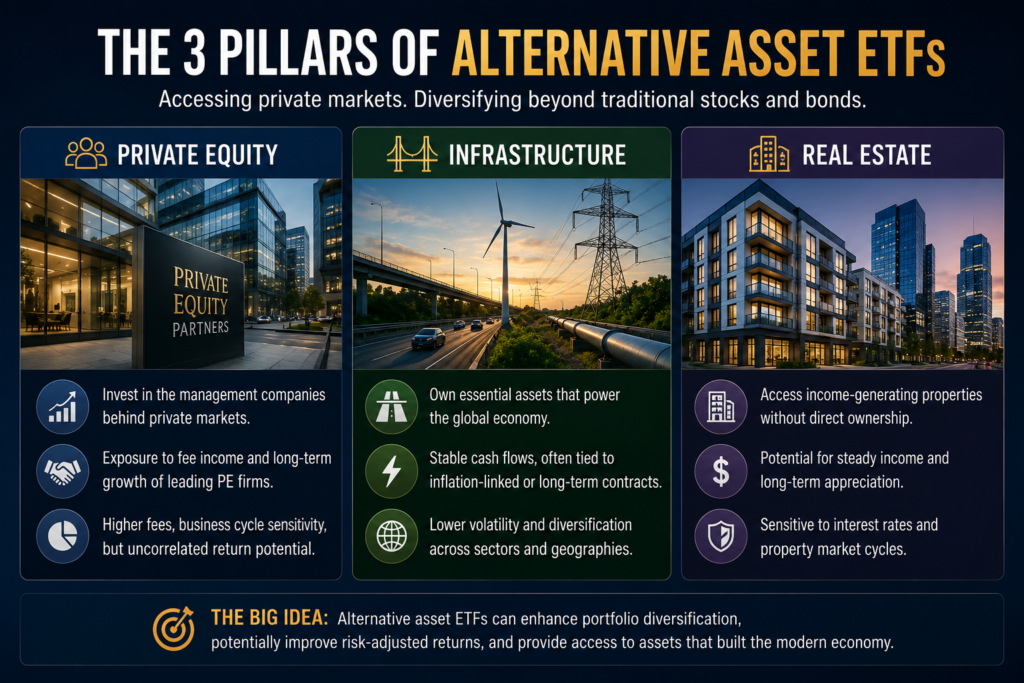
There’s an important distinction that trips up a lot of new investors here. Most «private equity ETFs» don’t hold private companies directly — they hold shares of publicly traded private equity firms, like Blackstone, KKR, Apollo, and Ares Management. You’re investing in the management companies that run private equity funds, not in the private equity funds’ underlying portfolio companies themselves.
| Fund | Fee | Focus |
|---|---|---|
| ProShares Global Listed Private Equity ETF (PEX) | 4.86% (includes underlying fund expenses) | Publicly traded PE and alternative asset managers globally |
| Invesco Global Listed Private Equity ETF (PSP) | 1.44% | Global listed private equity firms and business development companies |
These funds give you exposure to the fee income and investment gains of the private equity business model — essentially betting that firms like Blackstone will keep growing assets under management and generating performance fees — rather than direct ownership of the buyout deals themselves. That’s a meaningfully different bet than «owning private equity» in the way an institutional investor would through a direct fund commitment.
A newer category of funds, sometimes called «PE access funds» or interval funds, attempts to get closer to direct exposure by investing in a portfolio of private equity fund stakes. These typically come with higher fees, quarterly rather than daily liquidity, and minimum holding periods, and they’re structured differently from a standard ETF even when marketed alongside them. It’s worth reading the prospectus carefully to understand exactly what liquidity terms apply before treating one of these like a normal ETF you can sell at any time.
Best for: investors who understand they’re buying exposure to the private equity business model and its public proxies, not a diversified basket of actual buyout deals, and who are comfortable with the higher fees that come with either structure.
Infrastructure ETFs: Toll Roads, Utilities, and Pipelines
Infrastructure ETFs hold companies that own or operate the physical backbone of the economy — toll roads, airports, utilities, pipelines, and increasingly, data centers and cell towers. The appeal is straightforward: these assets tend to generate stable, contracted cash flows that are less sensitive to economic cycles than a typical growth stock, since demand for electricity, water, and transportation doesn’t disappear during a recession the way discretionary spending does.
Global X U.S. Infrastructure Development ETF (PAVE) focuses on companies that stand to benefit from infrastructure spending within the United States specifically, including construction, engineering, and materials companies alongside more traditional infrastructure operators.
iShares Global Infrastructure ETF (IGF) takes a broader international approach, holding utilities, toll road operators, airports, and pipeline companies across developed markets globally, which adds geographic diversification at the cost of more exposure to currency fluctuations and varying regulatory environments across countries.
Digital infrastructure — the data centers and towers powering AI and cloud computing — has become an increasingly significant slice of the infrastructure category. This overlaps somewhat with the demand story we cover in our piece on copper ETFs, since data center buildouts require enormous amounts of the same physical infrastructure and materials.
Best for: investors seeking more stable, income-oriented exposure to essential services businesses, generally with lower volatility than broad equity markets but also more sensitivity to interest rates, since infrastructure valuations are often compared to bond yields.
Real Estate ETFs Beyond the Traditional REIT
Most investors are already familiar with REIT ETFs like VNQ, which hold publicly traded real estate investment trusts. What’s newer is a wave of funds targeting more specific real estate niches tied to structural economic shifts: data center REITs, cell tower REITs, and industrial/logistics REITs tied to e-commerce warehousing demand.
Data center REITs specifically have become one of the more closely watched sub-sectors, benefiting from the same AI infrastructure buildout driving demand for copper, uranium, and natural gas. Companies like Digital Realty and Equinix, which own and operate the physical data centers that cloud and AI companies rent space in, have become significant holdings in several real estate and infrastructure-focused ETFs simultaneously — a reminder that these thematic categories increasingly overlap rather than existing in separate silos.
Practical effect for you: if you already hold a broad infrastructure ETF and a REIT-focused fund, check for overlapping holdings in data center and digital infrastructure companies before assuming you’re getting fully independent diversification from both.
The Liquidity Question Nobody Explains Clearly
This is the single most important thing to understand before buying any alternative asset ETF: not all of them offer the same liquidity as a normal stock ETF, even when they trade on an exchange.
Traditional ETFs holding publicly traded stocks (like the private equity firm shares in PSP, or the infrastructure companies in PAVE) trade and settle just like any other ETF — you can buy and sell throughout the trading day. But funds structured as «interval funds» that hold direct stakes in private funds or private real estate typically only allow shareholders to redeem a limited percentage of shares at specific intervals, often quarterly, and may impose early redemption fees if you need your money out sooner than the fund’s schedule allows.
Before buying any fund marketed with the word «alternative» or «private,» check its structure and redemption terms specifically. A fund that trades daily on an exchange and one that only allows quarterly redemptions can both be called an «alternative asset fund» in marketing material, but they behave completely differently when you actually need to access your money.
How Much Should Go Into Alternative Asset ETFs
Given the higher fees, added complexity, and in some cases reduced liquidity, alternative asset ETFs generally work best as a smaller satellite allocation rather than a portfolio core — similar to the guidance we’ve given for uranium, clean energy, and commodity-focused thematic funds. A common approach is capping combined exposure to private equity, infrastructure, and specialized real estate funds at roughly 10–15% of a portfolio, with infrastructure and REIT-based funds (which offer daily liquidity) making up the larger portion, and any interval-fund-style private equity exposure kept to a smaller slice given its liquidity constraints.
It’s also worth noting that broad market index funds already carry meaningful indirect exposure to infrastructure and real estate through utilities, telecom, and REIT sector weightings, meaning a standalone allocation should be a deliberate overweight to a theme you specifically want more exposure to, not your only source of it.
Frequently Asked Questions
Do private equity ETFs actually hold private companies? Most publicly traded private equity ETFs hold shares of publicly listed private equity management firms like Blackstone or KKR, not direct stakes in the private companies those firms invest in. A separate category of interval funds attempts to hold actual private fund stakes but comes with different liquidity terms than a standard ETF.
Are infrastructure ETFs a good inflation hedge? Many infrastructure assets have contracts with built-in inflation adjustments, such as toll roads or utilities with regulated rate increases, which has historically made the category somewhat more resilient during inflationary periods than the broader market, though this varies significantly by fund and holding.
What’s the difference between a REIT ETF and a real estate interval fund? A REIT ETF like VNQ holds publicly traded real estate companies and trades like any other stock ETF with daily liquidity. An interval fund may hold direct stakes in private real estate properties and typically only allows redemptions at specific intervals, often quarterly, with potential early redemption penalties.
Can I lose access to my money in an alternative asset ETF? If the fund is a standard ETF holding publicly traded companies, no — it trades daily like any other ETF. If it’s structured as an interval fund holding private assets, redemptions may be limited to specific windows, and you should read the prospectus to understand exactly when and how you can access your investment.
Are alternative asset ETFs worth the higher fees? That depends on whether the underlying strategy can generate returns that justify the added cost relative to a low-cost index fund. Some categories, like infrastructure and REITs, have long track records to evaluate. Newer interval-fund-style private equity access products have much shorter histories, making it harder to judge whether the fee premium is consistently justified over time.
The Bottom Line
Alternative asset ETFs have opened a door that was closed to retail investors for decades, but the ETF wrapper doesn’t change the underlying nature of the assets inside it. Private equity ETFs mostly buy you exposure to publicly traded PE firms rather than direct deal access. Infrastructure and REIT funds offer daily liquidity and exposure to essential, contract-backed cash flows. And a newer wave of interval funds gets closer to direct private market access at the cost of reduced liquidity and higher fees. Understanding which of these you’re actually holding — and reading the redemption terms before you buy — matters more in this category than in almost any other corner of the ETF market.