
Last updated: June 2026 | Reading time: 9 min
Disclaimer: This article is for informational and educational purposes only. Nothing here constitutes financial advice. Past performance is not a guarantee of future results. Always consult a licensed financial advisor before making investment decisions.
The Energy Transition Is Creating Real Investment Opportunities
The shift away from fossil fuels toward cleaner energy sources is one of the most significant economic transformations of the 21st century. Governments worldwide have committed to net-zero targets. Corporate energy procurement is shifting rapidly. And the explosive growth of AI data centers — which require enormous and continuous electricity supply — has created urgent new demand for reliable, low-carbon power that solar and wind alone cannot consistently provide.
For investors, this transition creates genuine opportunities. But clean energy investing is not a monolithic category. Solar ETFs, wind ETFs, uranium ETFs, broad clean energy ETFs, and hydrogen ETFs all behave very differently, carry different risk profiles, and have delivered wildly divergent returns over the past five years. Understanding which segment of the clean energy universe you are actually buying — and why — is essential before putting money into any of these funds.
This article covers the most relevant uranium and clean energy ETFs in 2026, explains what drives each one, and helps you decide which if any belong in your portfolio.
Why Uranium, of All Things, Is Back
For most of the 2010s, uranium was radioactive in more ways than one — a sector investors actively avoided. The 2011 Fukushima disaster triggered a wave of reactor shutdowns across Europe and Japan, uranium prices collapsed, and mining stocks in the sector spent a decade going nowhere.
Three forces reversed that, more or less at once:
- Governments changed their minds. Countries that had committed to phasing out nuclear power are now doing the opposite — France has recommitted to expanding its nuclear fleet, Japan has restarted dozens of reactors, and the UK has greenlit new builds.
- AI created a power problem only nuclear can solve at scale. Microsoft, Google, and Amazon have all signed long-term power purchase agreements directly with nuclear operators and poured capital into small modular reactor development — a level of corporate commitment uranium hasn’t seen in decades.
- A decade of underinvestment created a supply crunch. Mines simply weren’t developed during the years when uranium prices were too low to justify it. That kind of supply gap doesn’t fix itself quickly — new mines take years to bring online.
The combined effect: uranium prices have climbed well off their 2016 lows, mining stocks in the sector have outpaced most other commodity categories over the past three years, and institutional money has started treating uranium as a legitimate asset class again rather than a speculative sideshow.
The Best Uranium ETFs in 2026
Sprott Uranium Miners ETF (URNM)
The Uranium ETFs Actually Worth Knowing
Sprott Uranium Miners ETF (URNM)
Fee: 0.75% | Assets: $1.5B+ | Holdings: ~30 companies
URNM is as pure a uranium bet as you can buy in ETF form. It concentrates almost entirely in companies whose business is uranium — Cameco (the largest Western producer), Kazatomprom (the world’s biggest producer by volume), NexGen Energy, Paladin Energy, and several uranium royalty companies. Because the fund barely touches anything outside uranium, it tracks uranium spot prices and nuclear sentiment about as closely as an ETF can.
That concentration cuts both ways. URNM can swing 30–40% in a single year depending on where uranium prices and risk appetite for mining stocks go. This isn’t a fund for someone who wants steady exposure to «energy» broadly — it’s a fund for someone with a specific, high-conviction view on uranium who’s prepared to stomach real volatility to express it. The 0.75% fee is steep by ETF standards, but it reflects a simple reality: there just aren’t that many pure-play uranium companies in the world to build an index from.

For investors who want clean commodity exposure to uranium without the stock-specific risks of individual miners or mining ETFs, the Sprott Physical Uranium Trust is worth understanding. This debate between buying a wrapper versus the underlying asset is identical to the current dilemma in the digital asset space. For a detailed comparison of how this works in crypto, check out our guide on Bitcoin ETFs vs. spot crypto: which is better for retail investors?.
Global X Uranium ETF (URA)
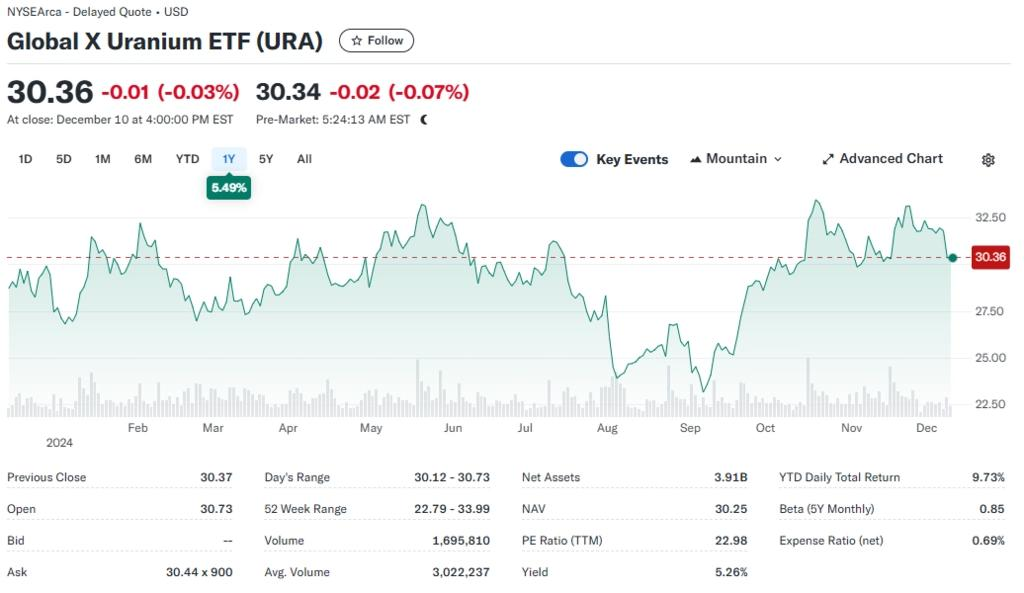
Fee: 0.69% | Assets: $3B+ | Holdings: ~45 companies
URA widens the lens slightly. Alongside uranium miners like Cameco, it holds companies across the nuclear fuel cycle — conversion, processing, and nuclear technology businesses that benefit from the broader nuclear buildout without being pure mining plays. That extra breadth makes URA a bit less reactive to day-to-day uranium spot price moves than URNM, though it still tracks the sector closely overall. It’s also the more established of the two funds, with a longer history that makes it easier to judge across multiple uranium price cycles.
Best for: investors who want uranium and nuclear exposure but prefer a bit more diversification across the value chain than a pure-miner fund offers.
Sprott Physical Uranium Trust (U.UN / SRUUF)
This one isn’t technically an ETF, but it’s impossible to talk about uranium investing without it. Instead of holding shares in mining companies, the Trust holds actual physical uranium — yellowcake, stored in licensed facilities. That means its price tracks the uranium spot price directly, without the operational risk, management-quality variance, or leverage that comes baked into mining stocks.
This is essentially the same debate crypto investors have between holding a token directly versus a wrapper built around it. We break down that exact tradeoff in our guide on Bitcoin ETFs vs. spot crypto: which is better for retail investors?
It trades as U.UN on the Toronto Stock Exchange and over-the-counter in the U.S. as SRUUF. Liquidity is thinner than the major ETFs and it’s less accessible through standard U.S. brokerages, but for investors who specifically want commodity-level exposure without stock-picking risk, it’s the cleanest option available.
The Best Broad Clean Energy ETFs in 2026
iShares Global Clean Energy ETF (ICLN)
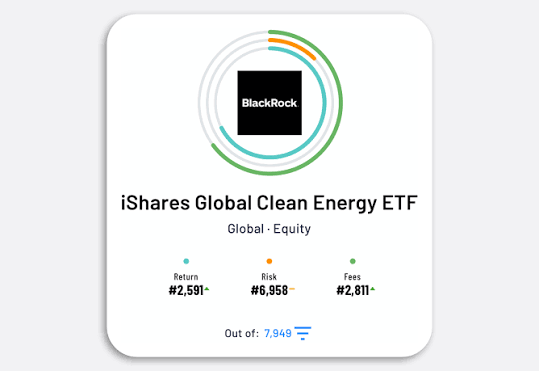
TER: 0.40% AUM: Over $3 billion Holdings: Approximately 100 global clean energy companies Focus: Solar, wind, fuel cells, and clean energy equipment globally
ICLN is the oldest and most widely recognized clean energy ETF. It holds companies involved in solar power generation and equipment, wind power, fuel cells, and clean energy utilities across the United States, Europe, and Asia. Top holdings typically include companies like Enphase Energy, First Solar, Vestas Wind Systems, and Orsted.
The fund’s history is instructive. ICLN tripled in value between 2020 and early 2021 on a wave of clean energy enthusiasm following the U.S. election and global net-zero commitments. It then fell approximately 60% from its 2021 peak through 2023 as rising interest rates crushed the valuation of capital-intensive, long-duration renewable energy projects. In 2024 and 2025 it began recovering as rates stabilized and clean energy demand accelerated.
This volatility profile is not unusual for thematic ETFs — it reflects the fact that clean energy companies are highly sensitive to interest rates (because they require large upfront capital investment financed by debt), government policy (subsidies and regulations directly affect profitability), and commodity prices (solar panel and wind turbine costs depend on raw materials). Investors considering ICLN need to understand they are taking on all of these variables simultaneously.
Best for: Investors who want broad global clean energy exposure across multiple technology types, comfortable with significant volatility and sensitivity to interest rates and policy changes.
Invesco Solar ETF (TAN)
Fee: 0.69% | Assets: $1.5B+ | Holdings: ~50 companies
TAN is the dominant pure-play solar fund, covering panel manufacturers, installers, inverter makers, and utilities with heavy solar generation. Solar has been one of the rougher rides in clean energy investing: falling panel costs — driven largely by Chinese manufacturers who now dominate global production — have been great for solar adoption but brutal for the margins of many companies TAN actually holds. Add in tariff and subsidy uncertainty, and you get a sector where the underlying trend (more solar, cheaper solar) doesn’t automatically translate into shareholder returns.
The AI-driven surge in electricity demand is a genuine tailwind here — data centers are signing long-term solar power purchase agreements at an accelerating clip, and utility-scale solar remains among the cheapest new electricity generation available. Whether that demand actually shows up in TAN’s returns depends on whether the companies in it can hold onto pricing power in a brutally competitive industry.
Best for: investors with a specific, high-conviction bullish view on solar who accept the sector’s concentration risk.

First Trust NASDAQ Clean Edge Green Energy Index Fund (QCLN)
TER: 0.58% AUM: Over $500 million Holdings: Approximately 60 U.S.-listed clean energy companies Focus: Clean energy across solar, wind, electric vehicles, and energy storage — U.S.-focused
QCLN takes a broader approach to clean energy than TAN, including not just solar and wind companies but also electric vehicle manufacturers and suppliers, battery storage companies, and smart grid technology businesses. This makes it a more diversified clean energy fund than either TAN or ICLN, with meaningful exposure to the electrification of transportation alongside renewable power generation.
The inclusion of EV-related companies — both vehicle manufacturers and battery/component suppliers — distinguishes QCLN from traditional clean energy ETFs. This adds exposure to a different part of the energy transition but also introduces different risk factors, including EV adoption rates, battery technology competition, and automotive industry dynamics.
Best for: Investors who want clean energy exposure that includes the electrification of transportation alongside renewable power, and who prefer a U.S.-focused portfolio over global clean energy exposure.
VanEck Uranium and Nuclear ETF (NLR)
TER: 0.60% AUM: Over $500 million Holdings: Approximately 25 nuclear energy companies Focus: Nuclear utilities, uranium miners, and nuclear technology companies
NLR bridges the gap between pure uranium mining ETFs and broad clean energy funds. It holds nuclear power utilities — companies that actually operate nuclear power plants and sell electricity — alongside uranium miners and nuclear technology companies. This gives it a different risk profile from URNM or URA: more stable cash flows from the utility side, with uranium price sensitivity from the mining holdings.
Nuclear utilities like Constellation Energy, Duke Energy, and their international equivalents generate relatively predictable revenue from long-term power contracts, which makes NLR less volatile than pure uranium mining ETFs while still providing meaningful exposure to the nuclear renaissance. For investors who want nuclear exposure with lower volatility than mining-focused funds, NLR offers a middle ground.
Best for: Investors who want nuclear energy exposure including the stable utility side of the industry, not just the more volatile mining and exploration companies.
The Honest Performance Picture
Before putting money into any of these, it’s worth looking at what actually happened — without the optimism that usually surrounds thematic investing.
Broad clean energy ETFs like ICLN badly lagged the S&P 500 from 2021 through 2023, even as the underlying energy-transition story stayed intact — and arguably got stronger. Rising interest rates, not a weaker thesis, did the damage. Anyone who bought ICLN at its 2021 peak is, as of 2026, still sitting below their entry price.
Uranium tells the opposite story. URNM and URA meaningfully outperformed both clean energy funds and the broader market from 2023 through 2025 as uranium prices recovered and nuclear sentiment flipped positive. But the investors who captured that move were the ones who’d already held through the brutal, decade-long drawdown from 2011 to 2020. The lesson isn’t «uranium good, solar bad» — it’s that thematic bets are extremely sensitive to when you buy, not just what you buy. Buying at peak enthusiasm, the way many people bought clean energy funds in late 2020, has historically ended badly regardless of whether the long-term thesis was right.
How Much Should Actually Go Into These Funds?
Uranium and clean energy ETFs are satellite positions, not core holdings. They express a specific, concentrated bet on one segment of the energy market rather than providing the kind of broad diversification a portfolio’s foundation needs.
A sensible rule of thumb: cap any single thematic ETF — clean energy, uranium, AI, semiconductors, whatever’s trending — at roughly 5–10% of total portfolio value. That’s enough to genuinely benefit if the thesis plays out, without wrecking the portfolio if it doesn’t. Pushing 30–40% of a portfolio into uranium or clean energy is a fundamentally different decision — one that requires real conviction and the emotional discipline to sit through multi-year drawdowns without bailing.
Worth noting: if you’re mainly interested in the energy transition as a long-term theme rather than a specific trade, you’re probably already exposed to it. A broad market fund like VOO already owns Apple, Microsoft, and dozens of other companies making enormous commitments to renewable energy and grid infrastructure. You get a diluted version of the theme without the concentration risk of a standalone thematic fund.
Bottom Line
The structural case for uranium is stronger than it’s been in fifteen years — a genuine supply deficit, reactor restarts across multiple countries, AI-driven electricity demand, and real policy reversals in favor of nuclear power in major markets. URNM and URA are the two funds best positioned to capture that story, with URNM offering more concentrated, higher-volatility exposure and URA trading a bit of that intensity for broader diversification.
Broad clean energy funds like ICLN and TAN offer a different trade: real exposure to the renewable buildout, paired with real sensitivity to interest rates, policy shifts, and brutal competition from Chinese manufacturers in solar specifically. Their history of sharp moves in both directions is not an anomaly — it’s the nature of the sector.
For most long-term investors, the right amount of exposure here is small: a 5–10% satellite allocation to whichever of these funds matches your actual conviction, sitting on top of — not instead of — a core portfolio built from broad, low-cost market ETFs.
Frequently Asked Questions
Is uranium a good investment in 2026? The structural case is genuinely stronger than it’s been in years — supply deficits, reactor restarts, and AI-driven electricity demand all support higher uranium prices over the medium term. That said, uranium is still a commodity, and commodity prices are volatile and hard to predict. Funds like URNM and URA belong as a small thematic allocation, not a core portfolio position.
Why did clean energy ETFs fall so much after 2021? Rising interest rates were the main driver. Renewable projects require large upfront capital, usually financed with debt, which makes them unusually sensitive to borrowing costs. When rates jumped in 2022, the present value of these companies’ future cash flows dropped sharply — a dynamic that hits any capital-intensive, long-duration business, not just clean energy.
What’s the difference between uranium ETFs and nuclear ETFs? Uranium ETFs like URNM and URA focus on companies that mine and process uranium — the fuel itself. Nuclear ETFs like NLR lean more toward companies that operate nuclear power plants and sell electricity. Uranium funds track the uranium spot price more closely; nuclear utility funds are more sensitive to electricity prices and regulation.
Are clean energy ETFs appropriate for a retirement portfolio? In small doses — a 5–10% satellite position — yes. As a large chunk of a retirement portfolio, the volatility is a real problem: several of these funds saw 40–60% drawdowns between 2021 and 2023, which would be devastating for someone actively drawing income. Core retirement money belongs in broad, diversified, low-cost market funds.
Which is better for clean energy exposure: ICLN, TAN, or QCLN? ICLN gives you the broadest global exposure across multiple clean energy technologies. TAN is the highest-conviction, most concentrated solar bet. QCLN adds electric vehicles and energy storage into the mix and sticks to U.S.-listed companies. The right pick depends on which part of the transition you actually believe in most, and how much concentration risk you’re willing to carry.